Why cadavers were scarce in the first place
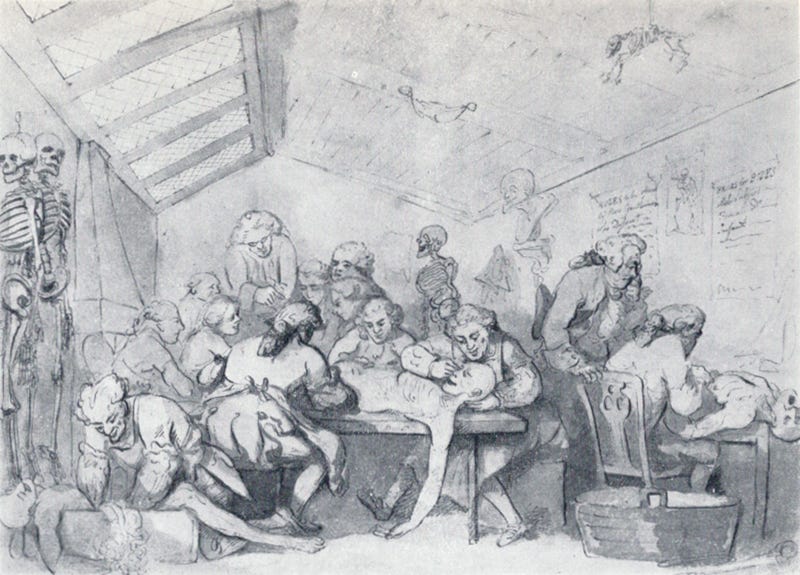
Early American medicine had a supply-chain problem. You couldn’t teach hands-on anatomy without hands (or bodies). The legal routes offered almost no cadavers. In the late 18th and early 19th centuries, the only lawful bodies available for dissection were typically those of executed criminals, and there were nowhere near enough of those going around to handle the needs of growing medical schools1,2. Administrators solved the problem with a classic American innovation pipeline: look away while students “source materials” outside of the formal market. If you’ve ever wondered when an ethics lecture gets scheduled, it’s usually a short time after the scandal breaks. Medical training ran on cadavers and the legal market could not or would not provide them, so the shadow market stepped in1,3.
How the black market worked and who paid
Resurrectionists, as the grave-robbers were then called, often students or hired specialists, worked quickly in the night to get into the fresh graves. Unequal power shaped unequal risk, with those students wanting to impress the doctors. Poor cemeteries and Black burial grounds were more exposed, having less security, being more distant from centers of power, and with fewer people City Hall felt obliged to answer to4. Petitioners in Black communities complained well before the riot, but they were largely ignored5. The practice offended religious sensibilities and common decency even then, but the incentives were simple: a dissecting class without a body is the theater without actors, absolutely pointless. And when you build a system that requires something and make it illegal to obtain, it doesn’t stop the system. Just look at what happened prohibition. In the end it just selects who gets harmed in the process2,4.
April 1788: when New York snapped
In April 1788, New Yorkers finally saw behind the curtain. Accounts differ on the exact spark, but one enduring (likely embellished or outright false) story has a medical student waving a cadaver’s arm at boys peering into a dissecting room and joking that it belonged to the mother of one of them. The boy’s father checked the grave and found it empty. Crowds gathered, stormed New York Hospital, exposed dissected remains, and dragged physicians and students into the street. Some doctors were moved into the city jail for protection; the militia was called out; shots were fired; people died. The precise toll varies by account, but this scuffle became known to New Yorkers as the Doctors’ Riot6–8.
I wish this were an urban legend neatly resolved with a civic apology and better curtains. But reputational damage to medicine lingered, and prosecutions went essentially nowhere6,7.
Not a one-off: anatomy riots as a pattern
If the 1788 riot was just a freak convergence of a bad joke and a bad day, it would make for good dinner-party trivia. It wasn’t that. Communities in other cities also rebelled as the same ingredients recurred: legal scarcity, illicit procurement, unequal targeting of graves, and a growing suspicion that medical schools would treat the poor with respect only after the poor were useful on a table2,3,9. From the standpoint of social epidemiology, you can think of it as a repeated outbreak of the same pathogen (in this case misaligned incentives) finding the same susceptible hosts.
The policy pivot: from gallows to “unclaimed”
Faced with episodic riots and chronic scandal, legislators did what legislators do: they cut a deal. States broadened lawful access by diverting “unclaimed” bodies (like those who died in prisons, almshouses, and asylums) into medical education. The policy stabilized supply and dampened the black market. It also codified a new hierarchy. If you were poor, institutionalized, or without family, your odds of becoming anatomy went up even if you never volunteered for the honor1,2. In effect, society moved from stealing from the newly buried to taking by default from the socially invisible or “undesirables”. As histories of American anatomy make clear, you can solve a practical problem without solving the underlying moral one.
What the riot was really about: trust and consent
Read contemporaneous accounts closely and the pattern is less “public hates science” and more “public hates being experimented on without its consent.” Medicine had real educational needs. The public had real claims to dignity and to the bodies of their dead. When those claims collided behind closed doors, trust was the first thing to bleed out. That is why the riot reads less like a morality tale about superstition and more like a political tale about legitimacy and the conditions under which people will let institutions touch them, literally and figuratively5,6,8.
A modern echo, quieter but familiar
Two centuries later, the procurement trouble returned in modern dress. In 2006 the FDA shut down a human tissue company amid allegations that bone and tissue had been recovered without proper consent, triggering recalls and litigation10. The New York courts wrestled with the legal fallout in Matter of Human Tissue Litigation (2012)11. Different technology, different market, same basic test: do the people whose bodies make your system run actually consent to what you’re doing?
The Edge of Epidemiology is a reader-supported publication. For more weird medical history, epidemiology, and more consider becoming a free or paid subscriber.
Citations
1. Tward AD, Patterson HA. From Grave Robbing to Gifting: Cadaver Supply in the United States. JAMA. 2002;287(9):1183-1183. doi:10.1001/jama.287.9.1183-JMS0306-6-1
2. Hulkower R. From Sacrilege to Privilege: The Tale of Body Procurement for Anatomical Dissection in the United States. Einstein J Biol Med. 2016;27(1):23. doi:10.23861/EJBM20112734
3. Lederer SE. Book Review A Traffic of Dead Bodies: Anatomy and Embodied Social Identity in Nineteenth-Century America By Michael Sappol. 430 pp., illustrated. Princeton, N.J., Princeton University Press, 2002. $35. 0-691-05925-X. N Engl J Med. 2002;347(12):952-952. doi:10.1056/NEJM200209193471223
4. Meier A. Grave Robbing, Black Cemeteries, and the American Medical School. JSTOR Daily. August 24, 2018. Accessed September 10, 2025. https://daily.jstor.org/grave-robbing-black-cemeteries-and-the-american-medical-school/
5. Costa C de, Miller F. American resurrection and the 1788 New York doctors’ riot. The Lancet. 2011;377(9762):292-293. doi:10.1016/S0140-6736(11)60083-4
6. Bell WJ. Doctors’ riot, New York, 1788. Bull N Y Acad Med. 1971;47(12):1501-1503.
7. Lovejoy B. The Gory New York City Riot that Shaped American Medicine. Smithsonian Magazine. Accessed September 10, 2025. https://www.smithsonianmag.com/history/gory-new-york-city-riot-shaped-american-medicine-180951766/
8. The Anatomy Riot of 1788. Science History Institute. Accessed September 10, 2025. https://www.sciencehistory.org/stories/magazine/the-anatomy-riot-of-1788/
9. Price D. A Brief History of American Anatomy Riots. National Museum of Civil War Medicine. February 13, 2017. Accessed September 10, 2025. https://www.civilwarmed.org/anatomy-riots/
10. Charatan F. FDA shuts down human tissue company. BMJ. 2006;332(7540):507. doi:10.1136/bmj.332.7540.507
11. Matter of Human Tissue Litig. (2012 NY Slip Op 22271). Accessed September 10, 2025. https://nycourts.gov/reporter//3dseries/2012/2012_22271.htm?utm_source=chatgpt.com