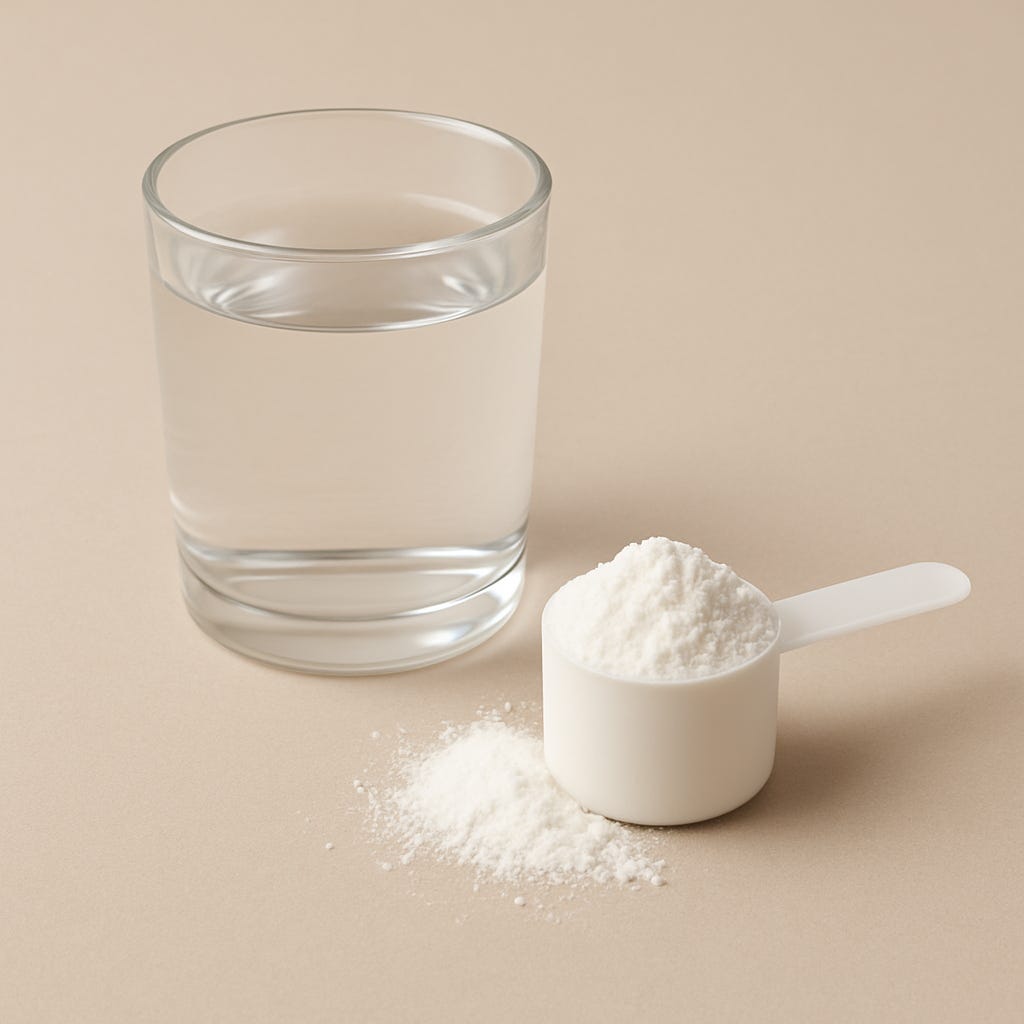
Creatine is having another moment in the news. The fitness world never really stopped talking about it, but I’m seeing more and more about it on social media and in the news. A recent Wall Street Journal article framed creatine as a trendy, potentially serious supplement for brain health, bone density, biological aging, sleep, and even mood. A few days before that I came across a twitter thread by Brady Holmer (titled Creatine Is Overrated) offering an extremely thoughtful take on the topic, arguing that creatine is safe, helpful, but wildly overhyped. That’s especially true for those promising it’ll boost IQ, fix someone’s depression, or completely fix some metabolic issue.
In all of those areas, he’s right. It’s not some miracle cure. But it’s also not just a muscle supplement. The more I dug into the literature the more I’ve come to the belief that yes, creatine is overrated, but only by the people who need it least. It’s severely underrated by those who could benefit most from supplementation.
Who do I mean by that? Vegetarians/vegans, women, older adults, those of us on the ‘Standard American Diet’, and those who eat minimal or avoid red meat altogether. In short, the creatine-poor population.
This group is rarely included in the hype train surrounding creatine. And that makes sense. When most of the people promoting it are jacked gym-bros, people tend to assume it’s for people who look like that, or want to look like that. But those people tend to have higher baseline creatine levels. The groups I mentioned tend to have lower baseline levels, and so have more to gain from supplementation.
So while the internet continues to debate whether creatine helps you get that extra rep in at the gym or do some cognitive brain game faster, I want to zoom out a bit. While I care about the average effect, I care more about who is missing out on this supplement. Who has the most room to benefit?
The Edge of Epidemiology is a reader-supported publication. To receive new posts and support my work, consider becoming a free or paid subscriber.
The Baseline Bodybuilder Problem
Let’s start with something obvious. Creatine works. It’s not snake oil. In randomized trials, creatine supplementation reliably increases muscle creatine content, enhances short-term strength output, and contributes to some modest gains in lean muscle mass (about 1-2kg), especially in older adults1,2. But these effects are modest for the people with relatively high levels already.
That’s because creatine is a saturatable compound. Most of the creatine in the body is stored in skeletal muscles, and once those stores are full, adding more doesn’t do much. You end up with diminishing returns. If you’re already eating a lot of red meat, you may be near that saturation point and further supplementation, while not risky, may be rather pointless.
Typical omnivorous humans have a muscle creatine level around 130 mmol/kg. Vegetarians average closer to 117 mmol/kg3. While that may not sound like a dramatic difference, it does show that the marginal utility of supplementation is much higher in people who start further from the saturation point. If you’re already at 95% capacity, another 5g scoop of creatine might not make much of a difference.
This helps to explain why seasoned lifters eating a pound or more of red meat per day tend to see only modest additional benefits from creatine; maybe a few more reps, a slight increase in training volume, and maybe a couple extra pounds of water-retaining lean muscle mass. Which, honestly, for a cheap supplement, that’s pretty worth it. But far from a true game-changer for the average gym goer.
So why are the people with the least to gain from creatine are at the forefront of advertising? Because they’re loud, have big followings, and are seen as high performers. But they’re not the best population to show the true potential of creatine. If anything, they’re the ceiling of what creatine can do, not the average, and certainly not the floor.
However, that may be shifting. In the last year, creatine has been increasingly marketed toward women, especially for strength, cognition, and mood regulation. And while the research in these areas is still ramping up, the early signs suggest that this is where the real story is unfolding.
Creatine for the Creatine-Poor
So who actually stands to benefit most from creatine supplementation? Definitely not the guy hitting 200 grams of protein a day and squatting three plates. It’s the people who are starting at a lower baseline creatine store. Here’s what the evidence says about some of those groups:
⚠️ Quick note before we go further:
Creatine is safe for most healthy adults, but it’s not for everyone. If you have kidney or liver disease, high blood pressure, bipolar disorder, or you’re pregnant or breastfeeding, you should avoid it or talk to your doctor before supplementing.
We’ll get into more details later, but if that’s you, skip the hype and check with your provider first.
Vegetarians and Vegans
Creatine is only found in animal products like meat, fish, and dairy. While the amino acids needed for the body to create its own creatine are found in plantI u products like legumes, some nuts and seeds, or soy protein, most vegetarians and vegans consume no dietary creatine and have significantly lower baseline muscle creatine levels3,4.
In RCTs:
- vegetarians tend to show larger increases in muscle and plasma creatine
- greater improvements in lean mass and total work output during resistance training
- larger increases in memory and reasoning performance when supplemented3–5.
If this compound was discovered today, it might be marketed as a cognitive and strength supplement for vegans, not omnivorous (or carnivorous) gym rats.
Women
Much of the literature on creatine has focused on male athletes. We’re seeing that change with an emerging, complex, and promising picture for women.
Women are a great candidate for creatine supplementation because they tend to naturally synthesize 20-30% less endogenous creatine than men on average6 with some researchers hypothesizing that this could impact more than muscle performance2. Mood, energy availability, and reproductive function are all being looked at. These are still speculative, but well worth investigating due to the wide availability, incredible safety profile, and relative low cost.
A small RCT found that creatine supplementation of 5 grams per day enhanced the effects of an SSRI in women with major depressive disorder7. Knowing whether or not this is a solid finding will require larger studies. Interestingly, side effect rates were similar between groups and no serious adverse events were reported.
We also see emerging data from NHANES and other observational datasets that suggest higher dietary creatine intake is associated with more regular menstrual cycles due to the uterine creatine metabolism fluctuating during the cycle.
Due to the fact that the creatine pools seem to be reduced during pregnancy, pregnant women may benefit from creatine supplementation6. The warning earlier is more in line with the conservative view the medical establishment has against recommending something that hasn’t been tested in a specific population. No human RCTs have been conducted, but animal studies and creatine’s “generally regarded as safe” status have researchers thinking this could be a low-cost, high upside supplement during pregnancy. Again, discuss with your doctor first.
So far, researchers haven’t proven that creatine improves mental health or hormonal regulation. This is all based on anecdotes and small studies. But if it does turn out to help, even in modest amounts, it would be one of the safest, most accessible products in the fraught world of supplements. Right now, the risk of trying it for the average person (especially at standard doses), is incredibly low.
Older Adults
As we age, we lose some of our lean muscle mass and strength. That decline can gradually lead to reduced mobility, higher risks of falls, and a loss of independence. Older adults don’t need to meet the criteria for sarcopenia to feel the impact of strength declines in their life. Going from being able to hold your first grandchild to not being able to hold the third is a harsh reality.
That’s what makes older adults one of the clearest examples of creatine’s distributional benefits. They’re not creatine-saturated on average, or working out five times a week. They also tend to have lower intakes of creatine rich foods. These all mean much more room to benefit from supplementation.
RCTs have shown that creatine in combination with resistance training has improved lean muscle mass, grip strength and lower body strength (e.g. relative bench press increase), functional performance (e.g. walking speed and chair stands), and attenuated femoral bone mineral density loss2,8. These have all been confirmed in meta-analyses2,9 and systematic reviews10.
In an older population, these gains are improvements in daily life functioning. Improving strength by a few percent at 75 years old might mean standing up without help or reducing the risk of a fall. When we factor in how safe, low-cost, and well-tolerated this supplement is, it’s hard to argue against its potential.
Honorable Mention: The Chronically Cooked
There’s a small, but growing body of research suggesting that creatine could offer some modest cognitive benefits for those under mental stress or sleep deprivation. A few RCTs have shown improvements in memory, mental fatigue, and reaction time after sleep loss (especially in those with low baseline levels)5,11,12.
That said, let’s be honest. The reason these people are having issues is probably not creatine deficiency. It’s because they haven’t gotten a good night’s sleep in weeks and are running on a combination of cold brew and cortisol. The effects of creatine are real here, but small, and won’t replace the fundamentals. If you’re part of this group, you might need a nap more than some creatine.
The Bottom Line
Creatine isn’t a miracle supplement with massive benefits. But it doesn’t need to be. It’s a supplement with plenty of upside and no established downside in terms of side effects in a healthy population. For most healthy adults, it’s a safe and affordable compound that can increase strength, support training, and maybe help with cognition or bone health.
If you’re already eating plenty of red meat, don’t expect a massive change, you’ll likely get marginal benefits at best. But for vegetarians/vegans, women, older adults, or anyone else on a low-creatine diet, the payoff will likely be higher.
So, is creatine overrated? Only if you’re already maxed out.
The Edge of Epidemiology is a reader-supported publication. To receive new posts and support my work, consider becoming a free or paid subscriber.
Citations
1. Branch JD. Effect of Creatine Supplementation on Body Composition and Performance: A Meta-analysis. Int J Sport Nutr Exerc Metab. 2003;13(2):198-226. doi:10.1123/ijsnem.13.2.198
2. Chilibeck PD, Kaviani M, Candow DG, Zello GA. Effect of creatine supplementation during resistance training on lean tissue mass and muscular strength in older adults: a meta-analysis. Open Access J Sports Med. 2017;8:213-226. doi:10.2147/OAJSM.S123529
3. Burke DG, Chilibeck PD, Parise G, Candow DG, Mahoney D, Tarnopolsky M. Effect of Creatine and Weight Training on Muscle Creatine and Performance in Vegetarians. Med Sci Sports Exerc. 2003;35(11):1946. doi:10.1249/01.MSS.0000093614.17517.79
4. Kaviani M, Shaw K, Chilibeck PD. Benefits of Creatine Supplementation for Vegetarians Compared to Omnivorous Athletes: A Systematic Review. Int J Environ Res Public Health. 2020;17(9):3041. doi:10.3390/ijerph17093041
5. Benton D, Donohoe R. The influence of creatine supplementation on the cognitive functioning of vegetarians and omnivores. Br J Nutr. 2011;105(7):1100-1105. doi:10.1017/S0007114510004733
6. Smith-Ryan AE, Cabre HE, Eckerson JM, Candow DG. Creatine Supplementation in Women’s Health: A Lifespan Perspective. Nutrients. 2021;13(3):877. doi:10.3390/nu13030877
7. Lyoo IK, Yoon S, Kim TS, et al. A Randomized, Double-Blind Placebo-Controlled Trial of Oral Creatine Monohydrate Augmentation for Enhanced Response to a Selective Serotonin Reuptake Inhibitor in Women With Major Depressive Disorder. Am J Psychiatry. 2012;169(9):937-945. doi:10.1176/appi.ajp.2012.12010009
8. Chilibeck PD, Candow DG, Landeryou T, Kaviani M, Paus-Jenssen L. Effects of Creatine and Resistance Training on Bone Health in Postmenopausal Women. Med Sci Sports Exerc. 2015;47(8):1587. doi:10.1249/MSS.0000000000000571
9. Devries MC, Phillips SM. Creatine supplementation during resistance training in older adults-a meta-analysis. Med Sci Sports Exerc. 2014;46(6):1194-1203. doi:10.1249/MSS.0000000000000220
10. Stares A, Bains M. The Additive Effects of Creatine Supplementation and Exercise Training in an Aging Population: A Systematic Review of Randomized Controlled Trials. J Geriatr Phys Ther. 2020;43(2):99. doi:10.1519/JPT.0000000000000222
11. Gordji-Nejad A, Matusch A, Kleedörfer S, et al. Single dose creatine improves cognitive performance and induces changes in cerebral high energy phosphates during sleep deprivation. Sci Rep. 2024;14(1):4937. doi:10.1038/s41598-024-54249-9
12. Avgerinos KI, Spyrou N, Bougioukas KI, Kapogiannis D. Effects of creatine supplementation on cognitive function of healthy individuals: A systematic review of randomized controlled trials. Exp Gerontol. 2018;108:166-173. doi:10.1016/j.exger.2018.04.013