Life aboard a ship before modern medicine was a hellish experience. Whether it was a pirate crew looking for a frigate flying the Union Jack to seize, plunder, and take for the crew, or that exact frigate carrying gold, weapons, and exotic fabrics, your environment was far from ideal from a health point of view. After leaving ports in the Caribbean and West Africa, the major points of disease spread and introduction, these crowded, filthy, poorly stocked environments became floating disease incubators. Of course, the burden varied by the route taken, with trips across the northern Atlantic having less of an infectious disease risk to them compared to those going through the tropics. Nevertheless, far more people were killed by the likes of scurvy, dysentery, typhus, and a litany of other infectious diseases than were ever killed in combat (a fact that would also be true in just about every war through WWI).
Scurvy
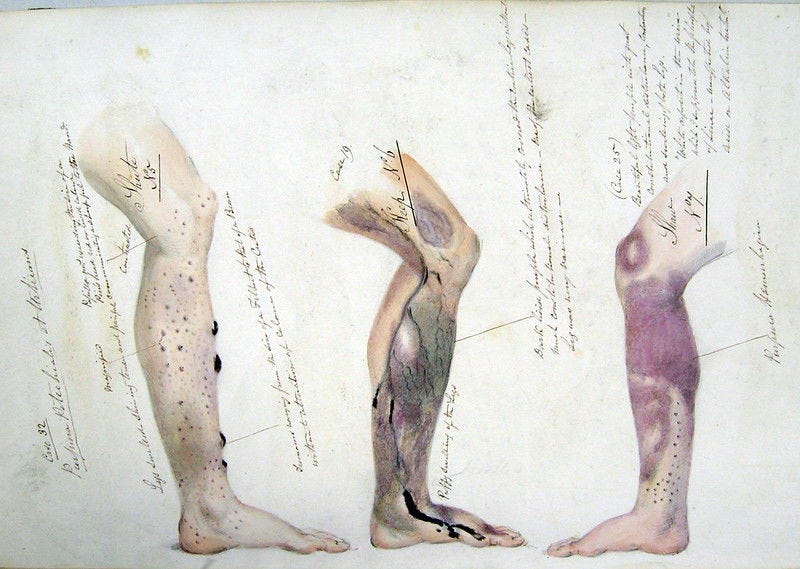
I imagine most readers will have heard the horrors of scurvy among early sailors either in school or some piece of media. A conservative estimate is that over two million died of vitamin C deficiency just between 1500 and the mid 19th century. Shipowners and governments even baked in the assumption that about 50% of their crews would die of the disease on journeys longer than six weeks. Short coastal trips or those with plenty of stopover ports with fresh produce were much less prone to scurvy. But on long voyages, relying on salted meat, caught fish, hardtack crackers, and other dried foods meant scurvy would start to set in several months into a trip, with an ashen complexion, joint pain, and a general feeling of being unwell signaling onset. That would progress to hemorrhaging, discoloration of the skin, necrosis of the gums and tooth loss, wounds not healing as they would otherwise, and finally a fatal multi-organ collapse.
There were some hints that the cause was dietary. In Jonathan Lamb’s Scurvy: The Disease of Discovery, we learn that the cures for scurvy had been lost, forgotten, or discredited before being rediscovered years later. Physicians had proposed fresh fruit and vegetables as the cause of the problem. Then in 1747, Royal Navy physician James Lind of the HMS Salisbury did a little experiment. He decided to give 12 scurvy cases the same diets of sugar sweetened gruel for breakfast, mutton broth for their midday meal, snacks like puddings, boiled biscuits with sugar, and finally for dinner, barley, raisins, rice, currants, sago, and wine, while varying a supplementary item (citrus in the form of two oranges and a lemon being one of the options, along with vinegar, salt water, cider, and a few others). He reports them as having “putrid gums, the spots and lassitude, with weakness of their knees.” The two who received citrus (for six days until they ran out of supply) fared much better than the others, with one even being ready for duty after the six-day period. His description is an incredible read, with an interesting note that he thought the cider had the second-best effect of the bunch. The effects of the discovery were far from immediate though. It took almost fifty years for at-scale efforts to be put in place but by 1804 the Royal Navy was using 230,000 liters of lemon juice per year, essentially putting an end to one of the deadliest diseases the seas have ever known.
The Fevers
The journals of ship surgeon’s show that there was some lumping of a few different fevers under the umbrella term “fever” (understandably with no germ theory) with modern interpretations giving us a better understanding of what exactly was on these ships. One type of fever was epidemic typhus, also known as Ship Fever. Transmitted through the feces of body lice, its victims suffer from high fevers, muscle pains, headaches, a dry cough, sometimes delirium, a rash starting on the torso and moving outward, and sometimes fatal encephalitis or organ failure. Our old friend James Lind also played a large part in developing hygienic and ventilation practices to reduce the risk of various fevers in the Royal Navy. His An Essay on the Most Effectual Means of Preserving the Health of Seamen in the Royal Navy is a fantastic, albeit meandering, look at many of the contributions he made to naval health practices, and is akin to a public health manual of the seas (his works seem worth going into in depth for its own piece). He even goes into ways to “recover the drowned” and prevent lightning aboard the vessels. After observing cases of ship fever in his naval career and later in hospital settings, he realized it was an infectious disease linked to the crowded, unhygienic spaces and contaminated clothing. He noticed that typhus disappeared in patients who bathed, shaved, deloused, and got clean clothes and linens, leading to recommendations that these all be compulsory on ships and in wards. Further recommendations included what amounted to fumigating the crew quarters before boarding and ensuring fresh air flow below deck to prevent stagnant air (after all, this was still an era where miasma theory dominated). Most of his recommendations regarding cleanliness also helped with typhoid fever, a disease with similar symptoms to typhus that is caused by salmonella in contaminated food and water.
By the Age of Exploration, mosquito transmitted malarial fevers (then known as intermittent fever) was endemic in West Africa and the Caribbean, lkely brought over in the form of mosquitos and their eggs from Africa in stagnant barrels of water stored in the hold of ships. In Lind’s work he recommends cinchona bark for prevention and treatment in the warmer, humid climates (funnily enough, another doctor at the time also named James Lind was working on the same thing). The Jameses had zeroed in on a source of quinine that had been used for fever since the 1630s. The bark became a part of the Royal Navy medicine chests by 1814, but by the 1820s quinine alkaloids were isolated and purified, becoming a widely accepted treatment for malarial fevers.
Those stagnant water barrels also brought along another catastrophic mosquito driven infection in yellow fever. Long journeys on slow ships through the warm, tropical waters of the Atlantic allowed ample time for breeding and egg-hatching to occur aboard the ship. Infection caused weakness, high fevers, headaches, body aches, nausea, and vomiting with more severe cases also having jaundice, bleeding, organ failure, and shock and at that point roughly 50% of patients will die within a week. Yellow jack would continue to ravage the Americas; in 1793 ships carrying refugees and mosquitos from St. Domingue after a slave uprising on the island were the likely cause of an epidemic in Philadelphia (although the swampy area was a powder keg for this kind of thing to happen) killing over five thousand people and even forced George Washington, the federal government, and about 20,000 others to flee the area.
Gastrointestinal Infections
It’s likely hard to imaging just how disgusting it was below deck on one of these ships. Contaminated food like rotting, mold covered mean and biscuits and water stored in stagnant casks contributed to the already filthy conditions. Combine that with tightly packed, poorly ventilated lower decks, along with latrine facilities made up of a wooden area with a few small holes leading down to the ocean, and you have a situation where bacteria and parasites thrive. This led to dysentery (then called “flux”) due to bacteria like Shigella, Salmonella, and E. coli or parasites. These caused abdominal pain, bloody diarrhea, and fever most commonly causing death through severe dehydration and electrolyte imbalances.
Dysentery was the most common cause of death on slave ships, due to the extremely compact and chained-up conditions they were subjected to -- with slave vessel surgeon Alexander Falconbridge having said the holds were “so covered with the blood and mucus which had proceeded from them in consequence of the flux, that it resembled a slaughter-house” -- and was a major problem on naval, merchant, and pirate vessels.
Other Crowd Diseases
Measles and smallpox were two more diseases that would benefit from the crowding aboard ships during the age of sail, but measles tended to produce more short-lived outbreaks that would often burnout before landfall; however this wasn’t always the case, as measles outbreaks in the Americas and the West Indies were common. Smallpox had a longer course of infection, presenting with fever, vomiting, ulcers of the mouth, and its heavily identifiable skin rash, blisters, scabs, and scars. It was also more infectious over longer spans of time, allowing for more persistent local spread in port towns, and would end up ravaging native populations across the Americas (a topic that deserves its own post). On ships, authorities would isolate suspected or confirmed smallpox cases, clean their clothes and bedding as best as possible, and even quarantine vessels. Measles cases would also be separated, but beyond some basic nursing like fluids and rest, there wasn’t much to try and treat the patients and there was little in place to stop the spread before the 20th century beyond promoting cleanliness.
Chronic and Trauma Related Conditions
The oral hygiene aboard ships at the time was also abysmal. Cavities, gingivitis, periodontitis, and tooth loss were just about universal in sailors after spending multiple months at sea with a diet heavy in salted meat and hardtack. That combined with the lack of produce created more acidic, damaging oral environments and would mean naval surgeons would often pull teeth (the standard treatment at the time, often done without any anesthesia). The booze rations on board, while improving morale, also caused their own problems like liver disease, impaired cognition on board, and accidents that led to injury. Accidents on the ship and naval combat caused severe cuts, broken bones, stab-wounds, and explosion-based wounds which had to be dealt with in an unsanitary operating theater using unwashed tools and with salty water making its way into bandages, clothing, and bedding leading to gangrenous wounds with necrotized soft tissue that can lead to sepsis. Being wounded on these ships was an absolute nightmare. Amputation was used as a last resort due to the high mortality it was associated with (anywhere from 10-50%). Improvements in shipboard care for wounds came in the form of tourniquets, cutting off arteries with silk, and avoiding the previously used practice of cauterizing wounds with hot tar.
The Hierarchy of Burden
Burden aboard the various types of vessels was largely linked to the systems and rules applied on those ships and to their passengers. In the Royal Navy, you had very strict provisioning with rations being determined by rank. This tended to mean the lower level employees would have poorer nutrition, plausibly leading to more severe infections in the lower levels of the crew. Officers, with their more spacious quarters and ventilation had much less disease risk, although it was far from null. As I mentioned earlier, the risk was also much less for the Naval and merchant ships taking northern routes (with merchant ships also often having better provisions). Naval ships also had dedicated Royal Naval surgeons (someone the pirates would often take captive due to their own unmet needs in the medical realm). Life aboard a pirate ship at the time was arguably better for the crew than being on a naval vessel though. Plundering ships that just left port provided them with fresh food more frequently. Combine that with a much more egalitarian ethos of profit sharing and governance and you tend to get much lower rates of abuse onboard as well.
The worst-off individuals of the time were those in the slave-holds. Mortality rates crossing the Middle Passage were up to 25% with dysentery, dehydration, smallpox, measles, scurvy, malaria, yellow fever, and malnutrition doing the bulk of the killing at sea. The holds had 5 feet of headroom, almost no lighting, and were poorly ventilated for the shackled, immobile Africans. “Guinea surgeons” were tasked with monitoring the health of the enslaved to “maximize cargo.”
Ships of the time imposed limits on disease that just weren’t there on land. You had small populations, often long voyages, constraints in resources, and route of travel were the shapers of which infections persisted and which would largely burnout by landfall. When those same diseases survived the journey and were brought into the dense, settled areas with entirely different ecological constraints, their behavior shifted, spreading with a speed and severity never seen before.
The Edge of Epidemiology is a reader-supported publication. To receive new posts and support my work, consider becoming a free or paid subscriber.