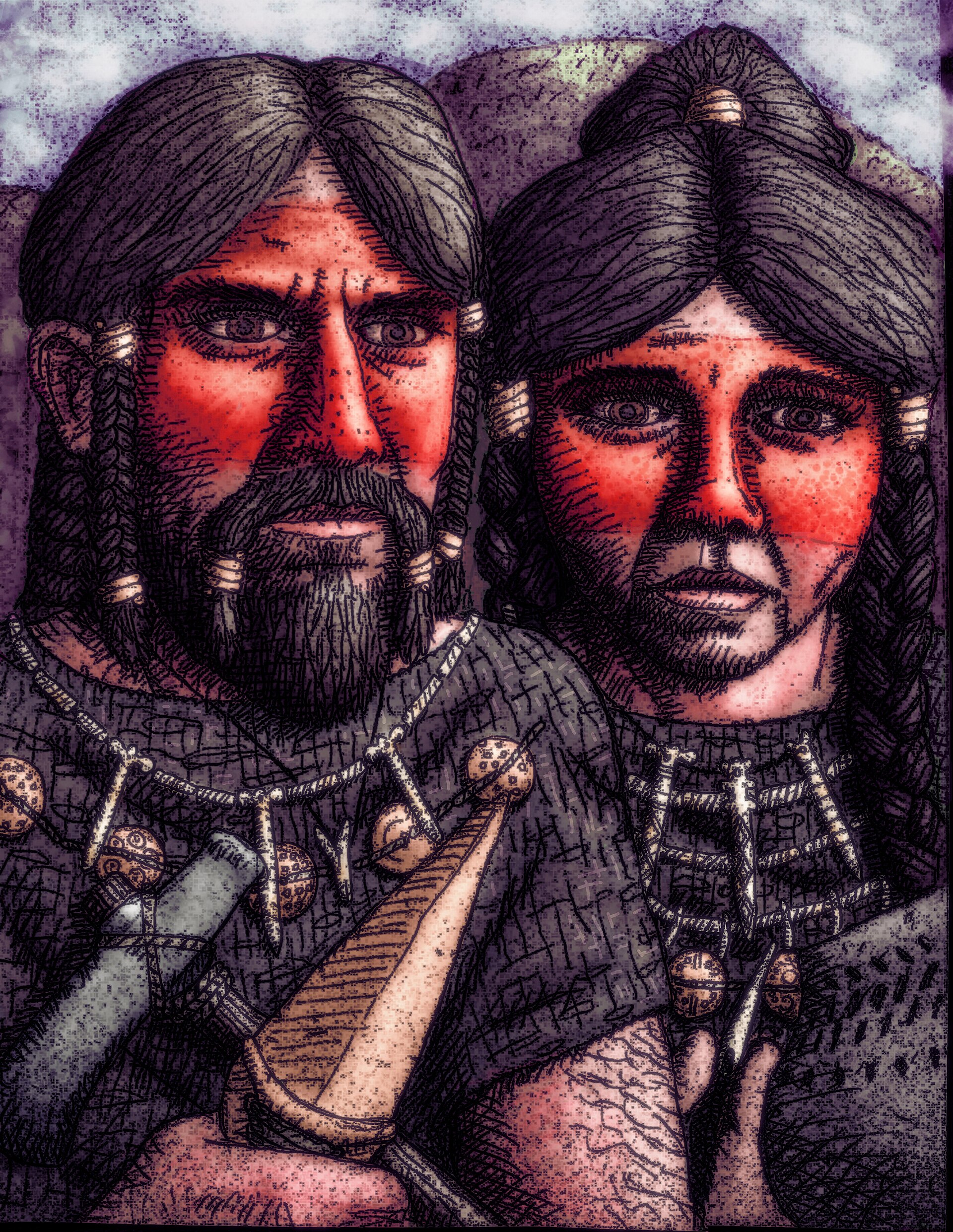
While reading the new 2026 Reich Lab paper, one question came to mind: Did the changing disease and metabolic environments drive a major share of recent human selection in West Eurasian populations? The paper is currently the biggest ancient-genomics research study on natural selection in humans ever done (though sure to be outdone relatively quickly, as is always the case in ancient DNA research). With almost 16,000 genomes , more than 10,000 of them ancient, spanning the past 18,000 years in West Eurasia and the Middle East, they used purpose-built computational models that were designed to detect consistent directional trends in the frequency of alleles in the genome. Their technique identified 479 genetic loci that showed a greater than 99% probability of genuine directional selection (either positive, driving the prevalence upward, or negative, doing the opposite and driving it downward) along with an additional 7,600 loci with better-than-chance odds of being a real signal that need further investigation.
But it’s the biological content of the signals they found that should interest any epidemiologist, especially those of us who like history. A substantial fraction of the signals are related to health, with immune function, blood types, gut health, inflammatory responses, and body composition all having changed substantially. The data seem to show that the transition from hunting and gathering to farming and on through the Bronze Age created somewhat of a biological pressure cooker, with people being selected for the ability to survive radically changing disease and nutritional environments.
This post is what the data tells me as a historical epidemiologist. Given the fact that I’m not a trained geneticist, any errors are my own and I’d love them to be pointed out by someone who knows the field or the paper very well. I’ll also be very clear when I’m moving from exactly what the evidence tells us and into some healthy speculation of my own. Reconstructing those past selective pressures is an absolutely fascinating task, but we don’t have all of the evidence needed to be exact so I’ll try to approach that with care.
Their Method and Why This Paper is Different
It helps a bit to know what prior ancient DNA selection studies were doing and why they struggled to detect the kinds of effect this new paper found. A common approach to detecting natural selection is to look for what are called “sweeps” in present-day genomes, which are essentially stretches of DNA where a variant rose so quickly that it dragged along the surrounding variants with it. This leaves a recognizable pattern that implies a reduction of genetic diversity. That method works well for very strong selection pressures that push an allele to near fixation in a population, but they missed the more subtle directional pressures that rise over millennia and never fully “sweeping”, so to speak.
Lead author Ali Akbari developed a method that sidesteps that problem by using ancient DNA as a time series. That let them ask the question “did this allele show consistent directional trends across multiple time points in the past?” They also claim to control for population structure, which can be a huge confounder in genetics work. The different ancestral groups would have mixed at different times and in different amounts which could theoretically make neutral alleles look like they were selected for because they rode into town on some expanding population. (I really hope I got all that right).
What Changed and When
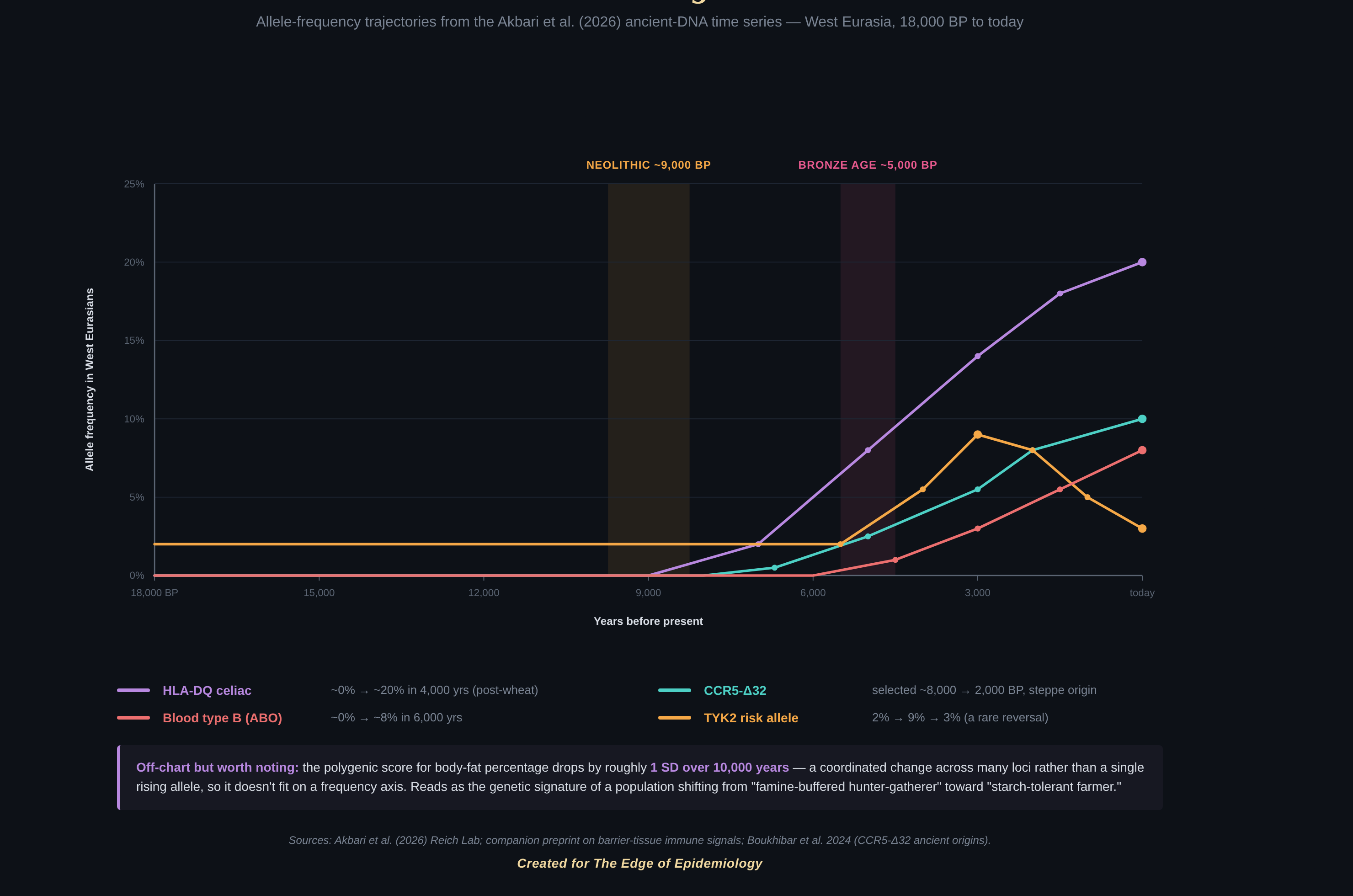
The key finding is that natural selection in the West Eurasian populations measured was accelerating over the past 18,000 years, with a clear inflection point during the Neolithic transition from mobile, small hunter-gatherer groups to being settled, grain-dependent farming communities that began to spread into Europe from the Anatolia region something like 9,000 years ago. There also seems to have been a second acceleration event during the Bronze Age about 5,000 years ago. In the Nature news post that accompanied the new paper, Reich noted that it was “an economically and culturally transformative time.” I’d add that it was also a time of drastically changing infectious disease landscape. Either way, both temporal locations of those transitions make sense as having intensified selection pressures.
The Neolithic created the first conditions for more sustained infectious disease transmission that previous small-band hunter-gatherer groups would’ve largely been avoiding through that lifestyle. That’s because being sedentary comes with waste accumulation where people lived. Grain storage would attract rodents and animal domestication brought us into sustained, intimate contact with pathogens coming from cows, camels, pigs, and birds. As population density rose, respiratory and enteric diseases start making themselves known. The evidence is in their bones; Neolithic farmers were relatively unhealthy, and likely so from a young age. They were almost four centimeters shorter than their Upper Paleolithic and Mesolithic ancestors after adjusting for a predictive polygenic height score. That tells us they likely were enduring high disease burdens combined with high levels of nutritional deficits.
The Bronze Age brought massive migrations from the Pontic-Caspian Steppe into Europe about 5,000 years ago and brought very genetically distinct populations into contact for the first time. They also brought a new pathogen pool that included an ancient strain of Yersinia pestis (plague). Long-distance trade networks intensified and settlements grew alongside the disease environment that too was growing in complexity and interconnectedness. The genomic record reflects all of that. Taken together, we have a couple of transitions that strongly suggest some of the most intense periods of human selection in Western Eurasia happened to coincide with moments of rapidly changing disease ecology.
The Signals

Blood Type B Arrives
Apparently, the allele that gives one type B blood in the ABO blood grouping system was basically absent in West Eurasia before 6,000 years ago. Since then, it has risen to a roughly 8% frequency. The different blood types carry different susceptibilities to specific pathogens with cholera, norovirus, some respiratory viruses, and others showing ABO-dependent susceptibility patterns. Mesolithic hunter-gatherers in Europe were predominantly type O, which is also likely the newest to have arisen roughly a million years ago (as we share A and B with other primates). While we don’t know what pathogen the main driver was here, the B allele apparently offered the carriers enough of a reproductive advantage in the post-Neolithic environment to become much more prevalent than it had previously been.
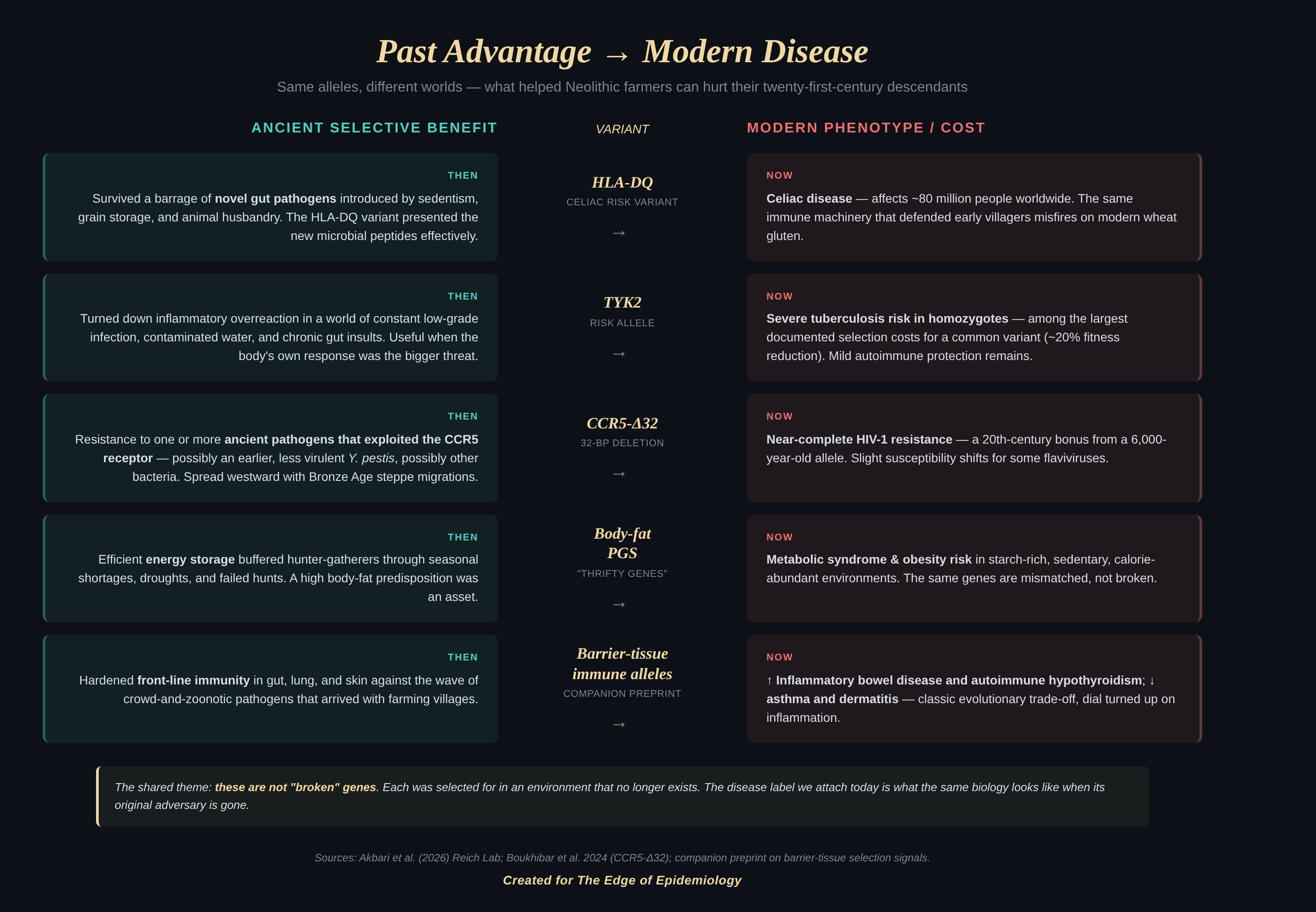
My Best Guess: Blood type B likely arose to that high of a prevalence because it conferred some sort of resistance to either an enteric or respiratory pathogen that suddenly became common once farming and animal husbandry had been adopted. The timing is consistent with when those new zoonotic exposures would’ve arisen combined with the gut infections that came with crowded settlements.
The Celiac Paradox
This one took some thinking for me, as it is a rather counterintuitive finding. The major genetic risk factor for celiac disease (a variant at HLA-DQ) went from about 0% to roughly 20% in 4,000 years during and after the spread of wheat farming across West Eurasia. Today celiac impacts somewhere around 80 million people across the globe and a common narrative is that celiac is an “evolutionary mismatch” with our ancient guts having difficulties with modern wheat, but the new data makes the story much more complicated.
My Best Guess: That’s because HLA-DQ, and other celiac risk loci, is a core immune-recognition molecule that is meant to present foreign peptides to T cells and then set up the appropriate defense response. The specific allele that today is related to celiac presumably spread because it was advantageous in a gut ecosystem full of novel bacteria, parasites, and viruses that had been introduced by grain farming and animal domestication. On that reading, celiac is a side effect of the same immune response that had helped our ancestors survive a terrible gut infection in an early Neolithic village. The HLA-DQ variant rose because of some strong selection due to gut pathogens that were new to the sedentary Neolithic communities.
TYK2 and Tuberculosis
An allele on the TYK2 gene in its homozygous form is the strongest predictor of clinically severe tuberculosis infection, so it’s interesting to know that it rose from something like 2% to 9% from 5,500 to 3,000 years ago and then fell back to about 3%. That implies shifting selection pressures with something first favoring the allele and then penalizing it later. The negative selection over the last 2,000 years was one of the largest selection effects documented in a common variant, having been associated with a fitness reduction in homozygotes by roughly 20%. It’s not hard to understand why it would have dropped off, as TB was an incredibly powerful selective force not too long ago.
The rise in the allele is the more puzzling aspect of this. The variant in question is known to have some protective effects against certain autoimmune conditions, as it seems to put a damper on the inflammatory signals in ways that reduce autoimmune pathologies. That raises the possibility that it was selected for during a period when inflammatory overreaction was more of a liability than TB was.
My Best Guess: This one is very speculative, but TYK2 can be seen as part of our immune system’s control system, something like the volume knob, as it helps to control how strongly the body responds when it senses an infection or some tissue damage. The variant appears to turn part of that response down, which could have been useful when an early farming community was hit by a new mix of gut infections, parasites, new animal microbes, contaminated water sources, and the chronic inflammation that came with that. In that type of world, some of the danger was coming from the body’s damaging reactions to such a rough disease environment in early village life.
CCR5 and Immune Pressures
The CCR5 deletion is the one you may have heard of which confers nearly complete resistance to HIV-1 infection and is unusually common in Europeans while absent nearly everywhere else. HIV having arisen during the 20th century tells us that something much much older must’ve been selecting for the CCR5-delta32 variant. The new paper identifies that allele as one of the main signals with another paper from last year giving us some more context. With over 900 ancient genomes ranging from the Mesolithic to the Viking Age, they found the oldest carriers of this mutation dating back more than 6,700 years in the Western Eurasian Steppe. It then underwent a strong positive selection between 8,000 and 2,000 years ago with most of that occurring in Easter hunter-gatherer and Caucasus hunter-gatherer groups before moving westward with the Bronze Age steppe migrations. That timeline rules out a somewhat popular idea that this allele arose during the Black Death.
My Best Guess: The most plausible candidates for selection pressure on this variant would be other pathogens that use the CCR5 receptor like various bacterial infections including Yersinia pestis in its earlier, less virulent form. This area is contested heavily though, so take my guess with caution.
Inflammation and Barrier Tissues
A companion preprint that came out the day before the new Reich paper gives us some of the mechanistic context needed to interpret the Akbari paper’s findings. They note that positively selected alleles across the genome were most commonly found in the immune cells that live in what are called barrier tissues. Those include things like the gut mucosa and the respiratory tract that are often the front lines of fighting off pathogens.
My best guess: Some of the positively selected alleles are associated with increases in the risk of intestinal inflammation and autoimmune hypothyroidism, but protective for things like asthma and dermatitis. New farming communities created an environment with contaminated food and water and new respiratory infections that could travel more easily through their crowded cities. This one is likely just evolutionary trade-offs.
Body Fat (and being cautious in science communication)
The paper notes a type of coordinated selection across multiple genetic loci that are related to the modern-day polygenic risk score for body fat percentage that decreased by about one standard deviation over 10,000 years. They note this as consistent with what is called the “Thrifty Gene Hypothesis” that claims predispositions toward energy storage that were advantageous in hunter-gatherers became deleterious in more sedentary farming communities. That interpretation makes sense but should be taken a bit cautiously, as the modern UK Biobank sample the polygenic score is created from could be different in important ways that make the interpretation more gray than black and white. A modern polygenic score for bodyfat could inadvertently also be tagging other genes related to appetite, insulin, puberty timing, energy use, inflammation, and more. So, while the signal is definitely real and genetic predisposition to store body decreased over the past 10,000 years, comparing it to a modern label needs a bit more caution than the height example we had earlier. Today many people likely have a much higher body fat than their polygenic score would predict (I say as an American living in an obesogenic environment).
My best guess: This reflects the changing energy sources after the transition to farming. Mobile hunter-gatherers likely had an advantage when able to store energy efficiently during seasonal shortages, droughts, or failed hunts but farming shifted the balance with the new diets heavy in starch, comparatively sedentary lifestyle, and infectious diseases. A decrease in propensity to store body fat makes sense in that scenario.
The limits of this paper
Like all studies, this one too has its limitations that shape just how confidently we can interpret the findings and claims. It should be made clear that the GWAS labels applied in the paper don’t always map 1:1 to their modern-day phenotypes. For specific immune-defense genes and HLA loci, we can make some good biological inferences as it’s unlikely the gene completely switched its purpose. But for polygenic behavioral traits and metabolic signals, that tends to be a weaker inference to make. Many traits failed to pass through their family-based robustness tests, although this is likely due to a lack of power for some. Interestingly enough the polygenic score for years of educational attainment is the one that did survive that was shown to increase across this timespan. The authors also note that since the method identifies when allele frequency trends were strongest, that depends on where the ancient samples are most dense in the time series. This bias doesn’t seem to explain the main results, but there’s still a bit of residual uncertainty and a lack of power regarding understanding if some traits last through their stress tests (always awaiting a bigger sample).
Farming was a massive change to what was trying to kill people. The newborn disease ecology that arose from more sedentary, crowded lifestyles with more proximity to animals, a dependency on grain, and more interconnected trade networks all intertwined to change the infectious disease landscape which in turn changed their genetics. The Bronze Age steppe migrations with the novel pathogens brought along seems to have been a second time of intensification in genomic evolution in these populations. Our ability to read the dead is getting better and better, so it’s no wonder I’m excited for the next decade of ancient genomics of both humans and the pathogens they carried, as we’ll likely get people trying to replicate this method in other populations as their sample sizes grow. That combined with new methods for recovering bacterial, viral, and parasitic DNA from burial sites will be a boon for historical epidemiologists and I’ll be patiently waiting.