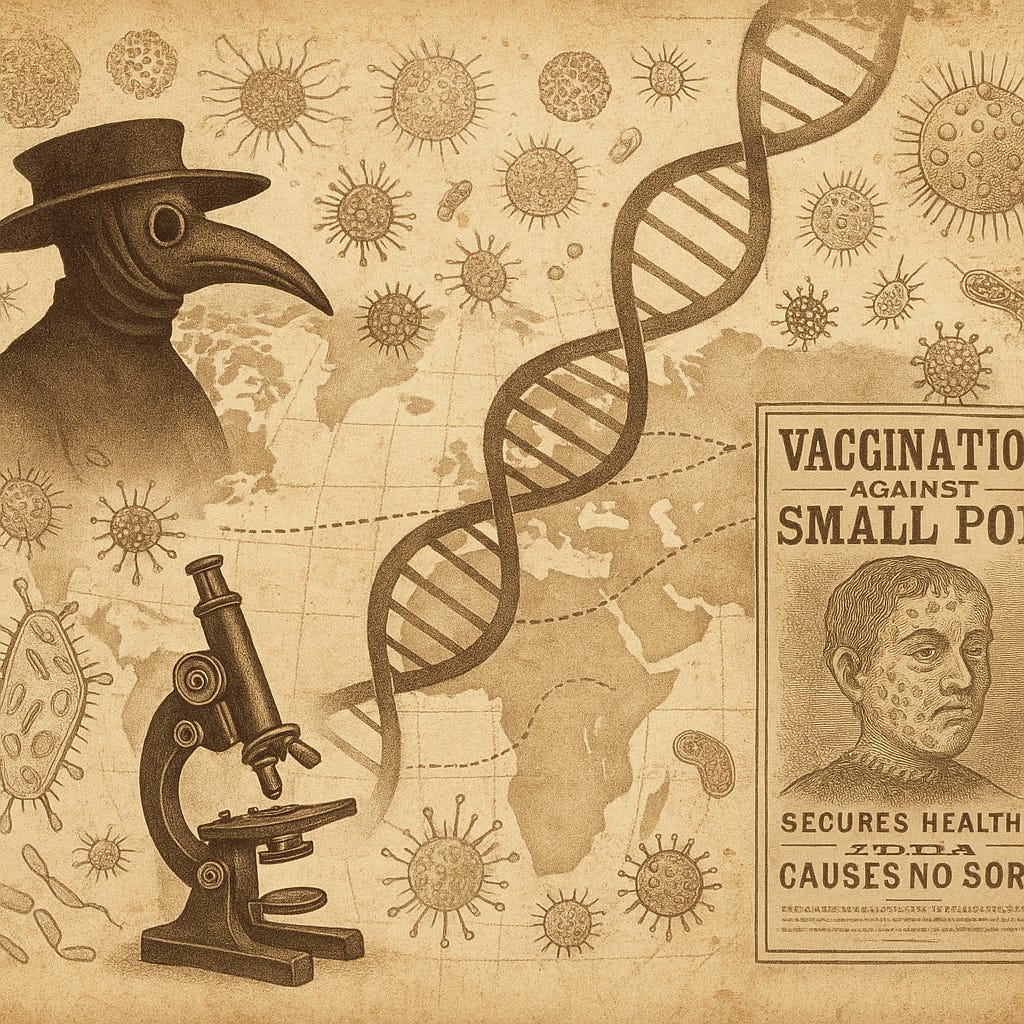
I was reorganizing parts of my bookshelf the other day when I came across my copy of Deadly Companions by Dorothy Crawford. She opens with a simple observation, that we have evolved in the company of and alongside microbes. They were here before us and will be long after us. They shaped our immune systems and hitched a ride as stowaways throughout human migrations into the unknown lands beyond. Crawford sorts our fellow travelers into distinct eras, like the ancient infections that coevolved with our ancestors (with viral DNA becoming 8% of the human genome), the animal diseases that jumped species with domestication practices, and the newcomers born of later migrations, crowding, and travel. Each one can tell us different stories of biological opportunism with microbes exploiting our success.
Crawford charted all these relationships, excellently and entertainingly I might add, in her book. But in picking it up I had a question about the total costs to human life. Which of our deadly companions were deadliest? How many people had they taken from societies throughout time? Let’s check the till.
The Edge of Epidemiology is a reader-supported publication. To receive new posts and support my work, consider becoming a free or paid subscriber.
How Epidemiological Historians Count the Uncountable
Historians of diseases usually end up with one unanswerable question: “just how many people did X disease kill?” The further back you go the more difficult this becomes to answer. The anthropological and historical voids become too vast past a certain date, with only ghosts of answers being left in places like our DNA or incredibly well-preserved bodies like Otzi. The simple fact is for most of human existence nobody has been around to count the bodies or what caused the deaths. Even today we deal with somewhat wide margins of error, and that’s with the aid of satellites, PCR tests, and bureaucrats in charge of the counts. We can’t reconstruct some Bronze Age cholera outbreak when all we’ve got is clay tablet with something like “and the god smote those along the river” tapped into it.
That’s why I’ll tell you plainly that every estimate you’ll see in this post is exactly that, an estimate. Some rough ones at that. But we can be confident in some things, like smallpox having killed more than the plague or that malaria’ death dwarf influenza deaths in the cumulative toll, but any precise number is just an educated guess at best. So, we have to hedge our bets. When we have unknown denominators in the form of the ancient populations in question, we can’t claim certainty. Even when considering a more modern figure, like smallpox’s estimated 300 million deaths in the 20th century, we’re stuck with assumptions about who was counted, who wasn’t, and how this differed across regions.
Still, a bit of rough math beats saying “I’ve got no idea.” We’ve got to try and count even when the data is messy. That fog is part of epidemiology, one that gets denser as you go further back. So even with all of the caveats, some patterns help us see through the noise. Let’s get into which microbes have been humanity’s worst enemies.
Malaria
Given where it, and we, originate, malaria likely holds the distinction of being the oldest sustained human-pathogen relationship, with evidence of the causal Plasmodium being present before homo sapiens. The interplay between host and parasite was so strong in this case that it shaped population genetics through its massive selection pressure. Multiple independent protective mutations arose due to the advantage they gave in survival and reproduction. Some of these include being heterozygous for the sickle-cell trait making infection less likely, forms of thalassemia that provide protection from severe disease, and a West/Central African variant giving resistance specifically to P. vivax.
But resistance of that form can only do so much. Not everyone living in the malarial zones hits that specific genetic lottery. That’s why it holds the distinction of likely being our deadliest historical companion. Reliable data supports anywhere from 150-300 million deaths in the 20th century alone. But like I said, the further back you go the messier the numbers get. For malaria, this issue came to a bit of a head when a Nature news brief came out in 2002 claiming malaria had killed half of people who ever lived (roughly 110-120 billion). But other researchers had other ideas, putting a more reasonable estimate around 4-5%. Either way, that’s an immense death toll that no other disease can remotely compete with.
Tuberculosis
When we talk about tb’s origins, the scientific consensus is really murky and honestly difficult to understand. Genomic clock models push the last common ancestor of human-adapted tb lineages back to ~70,000 years ago (coincident with modern human migrations out of Africa), while newer ancient-DNA studies suggest a much more recent emergence (~6,000 years) for the strains that dominate modern tb. The difference often comes down to which lineages you count and how you calibrate your molecular clock. And then there’s the Shyamalan twist with New World tb; ancient Peruvian genomes show tb variants tied to seals, not from the Eurasian lineages introduced during the Age of Exploration. So tb’s history might involve multiple spillovers as opposed to a single human-to-human lineage from the start. The takeaway: tb is ancient, but exactly how ancient, and exactly how it became our global parasite, is still an open question.
This one has a pretty severe death toll and some claim it may actually be the number one killer in human history, at least in the last 200 years. In that time it has claimed over 1 billion lives. In the pre-antibiotic era, this meant up to 25% of deaths every 5 years in Europe were due to tb. Urbanization had made tb into the “disease of cities” due to the cramped housing and poor sanitary systems in place. Even today it kills roughly 1.25 million per year and is still the number one bacterial killer. Those numbers are why some claim it is deadlier than malaria (at least for the years we can measure).
Smallpox
Possibly the next deadliest disease is also the only clear epidemiological victory in history (technically alongside rinderpest as of 2011, which I’ll get into in its own post at some point). Certified as eradicated across the globe in 1980, the smallpox virus has a more mysterious origin, with it still not being fully understood. It is thought to have arisen somewhere around 3,000 to 4,000 years ago from a spillover event with a rodent as the main suspect. The earliest evidence of it comes from Egyptian mummies found to have been infected by it. We also see some evidence in the descriptions of “pustular fever” in 1st millennium China and India. It was largely a childhood infection seen in denser urban centers. Survival meant lifelong immunity which led to generational gaps in immunity varying by region.
Any immunologically virgin soil resulted in sweeping epidemics, as seen in the Americas, Africa, and Europe’s rural hinterlands. Mortality hovered between 20-30% although 50% wasn’t unheard of in immunologically naïve populations. Its severity led to the first large-scale public health interventions in the form of variolation and later vaccination practices. Smallpox was a catastrophic import into the New World arriving with the Spanish and Portuguese in the late 15th and early 16th centuries, with mortality reaching 90% in some areas. The Aztecs and the Inca were hit particularly hard resulting in the near decimation of their empires even before any major battles with the European adversaries. As the Europeans moved around, from the north of what became Canada and the US to the southern areas of current day Argentina and Chile, smallpox razed much of the empires before any of the later dirty work by colonizing forces was even conducted.
In the 20th century alone smallpox claimed the lives of 300-500 million people, with a death toll likely topping a billion throughout history. Vaccination programs meant the last natural case occurred in Somalia in 1977. Now it only exists in two laboratories, one in the US and one in Russia. The bioweapons version of mutually assured destruction.
Smallpox’s story ends in a cold war stalemate in the form of two vials in two vaults, proof that even our victories carry a touch of dread. It’s also the perfect place to pause and talk about what’s coming here at my blog.
This post, as well as a few recent ones you may have noticed and the War Epidemiology book in progress (still working on the Black Plague chapter, but it’ll come), marks a bit of a shift for what I’ll be covering here on The Edge of Epidemiology. I’ll still be writing about science and medicine as it comes out (or when an influencer needs correcting about some supplement they’re hawking), but I plan on looking backward more often at the outbreaks, treatments, and strange detours that made the world we live in. Think of it as an epidemiologist turning amateur historian, trying to understand how we got here by following the microbes that came with us.
If you’ve been reading for a while, thank you so much for sticking around. It means more than you know! I largely write for myself but it’s great to know people get something from my writing. And if you’re new, welcome aboard. There’s plenty more to uncover in the long partnership between humans and their deadliest companions.