Why ranges change
This is essentially biology meeting infrastructure. Vectors and pathogens within them are temperature sensitive organisms. Warmer conditions accelerate mosquito biting frequency, shorten incubation periods for abroviruses and malarial parasites, and lengthen the number of weeks per year that transmission is possible. Thus the rising potential for spread1–3. But the climate-driven nudge isn’t the whole story. Range expansion and outbreak risk are multiplied (or muted) by co-drivers that include urban water storage and container habitats (stagnant water) for Aedes mosquitos, housing quality, storm water management, deer abundance, land use change, exurban sprawl for Ixodes ticks, and poverty all weaken our grasp on vector control4–9. The most defensible way to read the near future of vector expansion is that climate sets the stage while human environments decide the size and location of the problem. European indicators and modeling agree on where this is going. We’ll see earlier seasonal onset and expanding suitability for spread in many regions2,10.
Aedes mosquitoes: hosts of dengue, chikungunya, and Zika
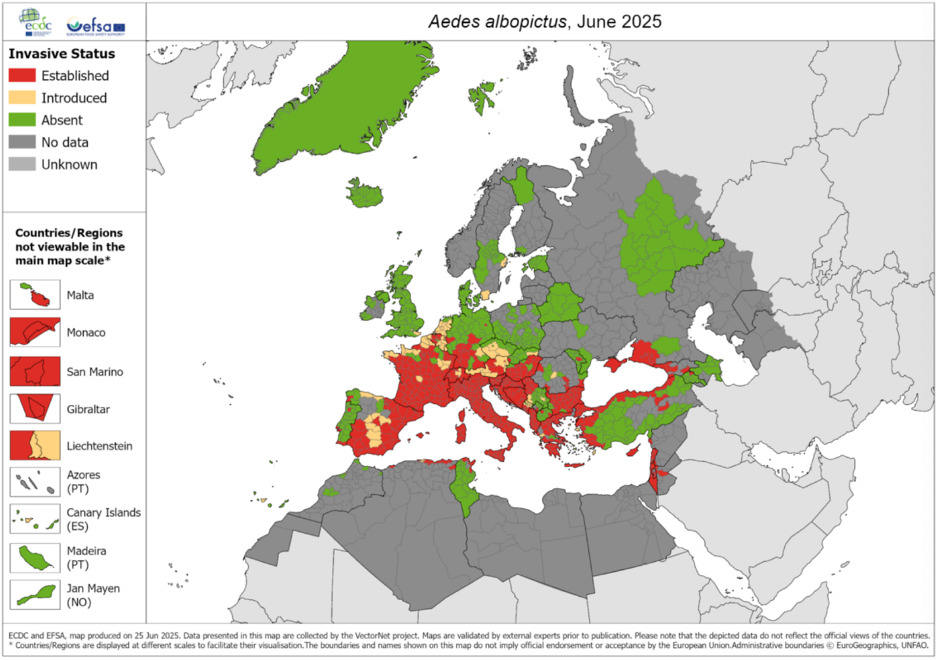
Continental surveillance continues to show a northward and upslope establishment of Aedes albopictus in Europe, with the latest distribution map confirming a presence across much of the southern EU/EEA (map above)11, with new establishments in places like Cyprus and Slovakia since 2024. In the US, the CDC’s potential range-graphic still places most of Aedes risk across the Gulf and Southeastern states, as well as into the Mid-Atlantic and West (although the maps – below- themselves haven’t been updated since 2017. The recent dengue outbreaks suggest we need new ones)12,13.
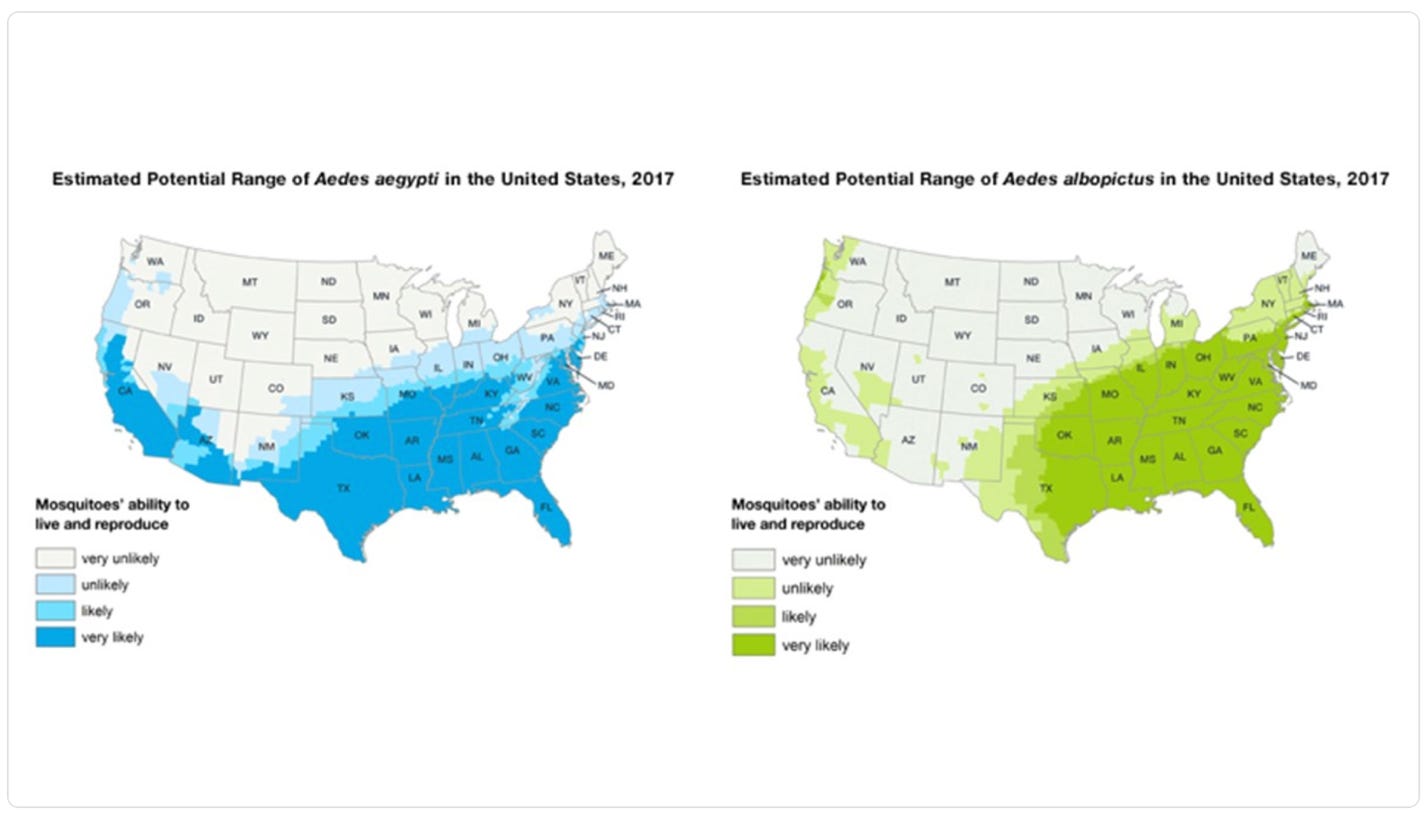
Why this is happening
Temperature and season length shift the traits that govern transmission like biting rates, survival of the vector, and parasitic incubation periods (as I mentioned earlier). The county I live in runs a vector control program with educational content around getting rid of environmental factors like stagnant water to prevent mosquitoes from using it as a breeding ground. More practical actions will be found throughout the post.
Culex Mosquitoes and West Nile virus
West Nile is still the most dominant mosquito-borne threat for the temperate areas of North America and for parts of Europe. Seasonal risk is tied to similar variables in warmer months and poor urban water infrastructure management. The indications are that Europe is showing increasing climatic compatibility for multiple vector-borne infections, including West Nile2,3.
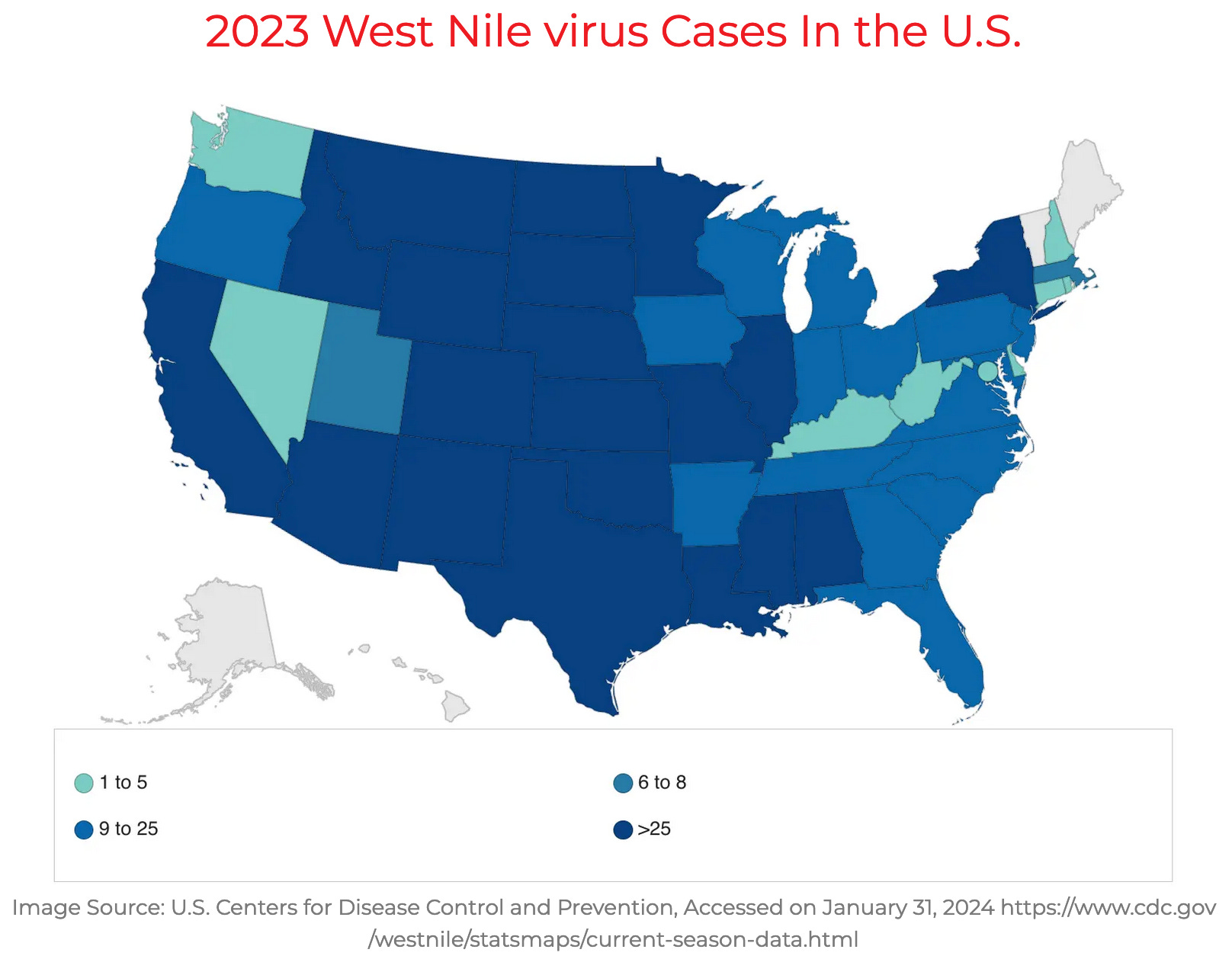
The why is largely the same (and will continue to be, so forgive the repetition). Warmer summers and nights lengthen the amplification window in bird-mosquito cycles and shoot vector numbers upward. Poor storm-water drainage design, stagnant water in containers in yards, and neighborhood maintenance patterns are the main determinants in where human cases cluster 4,14.
The Edge of Epidemiology is a reader-supported publication. To receive new posts and support my work, consider becoming a free or paid subscriber.
Practical Advice for Mosquito Management
Do an audit of your yard to reduce mosquito density and breeding grounds. Clear your gutters, dump any standing water, keep fountains running. Ensure the screens on your windows are intact.
Ticks on the March
Blacklegged or deer ticks (Ixodes scapularis) have been and continue to establish themselves in more US counties, with CDC surveillance documenting the spread across the Northeast and Upper Midwest (map below)15. These are a vector for multiple diseases including Lyme, babesiosis, anaplasmosis, and more. They’re projected suitable range now goes deep into Texas, Kansas, Nebraska, and the Dakotas. Something to note here is that “established” is defined as six or more blacklegged ticks having been collected within a year. Not being collected somewhere (yet) shouldn’t be taken as a sign that it’s free of these ticks.
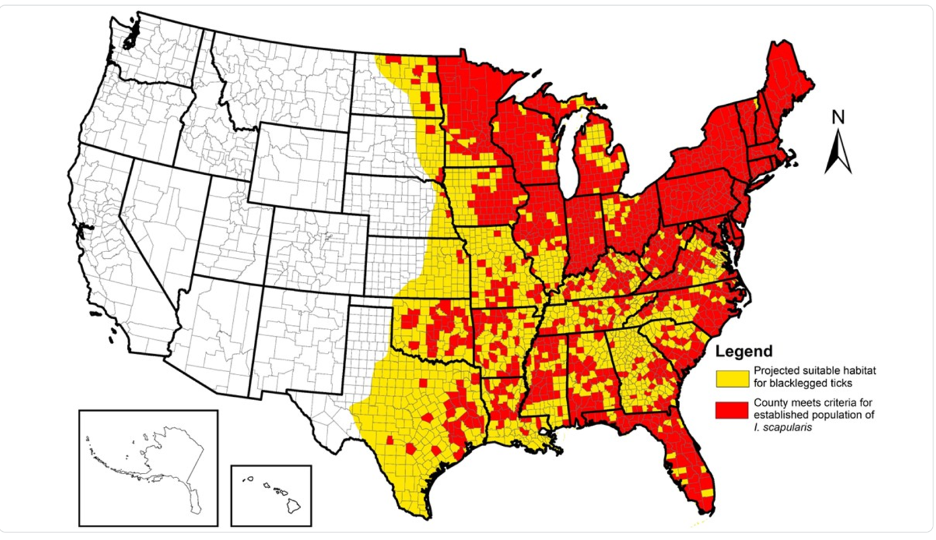
The mechanistic and field evidence is showing a role for milder winters and longer warm seasons in enabling this further establishment of their range, along with important contributions from deer abundance, reforestation of ex-farmland, and exurban sprawl all playing their part5. Amblyomma americanum (the lone star tick) are another species expanding their range, this time toward the Northeast, bringing with them a risk of alpha-gal syndrome and concerns of rickettsial disease6.
Practical Advice for Tick Management
Permethrin-treated clothing (long pants preferably) along with EPA-listed repellents should be the go-to protection for ticks. Check for ticks after any exposure to the brush and be sure to check your pets as well.
Sandflies and leishmaniasis
Back over to Europe, indicators are pointing to increasing suitability for the sandfly species Lutzomyia longipalpis, the vector for Leishmania infantum transmission (the cause of infantile visceral leishmaniasis), with modeling work highlighting a northerly and increasing in altitude range expansion in the coming decades2,16. The map below16 shows just how much the range has shifted in the 2011-2020 period (dark pink) compared to where it was suitable in the early 2000s (lightest pink, in Turkey for those struggling to find it like I was).
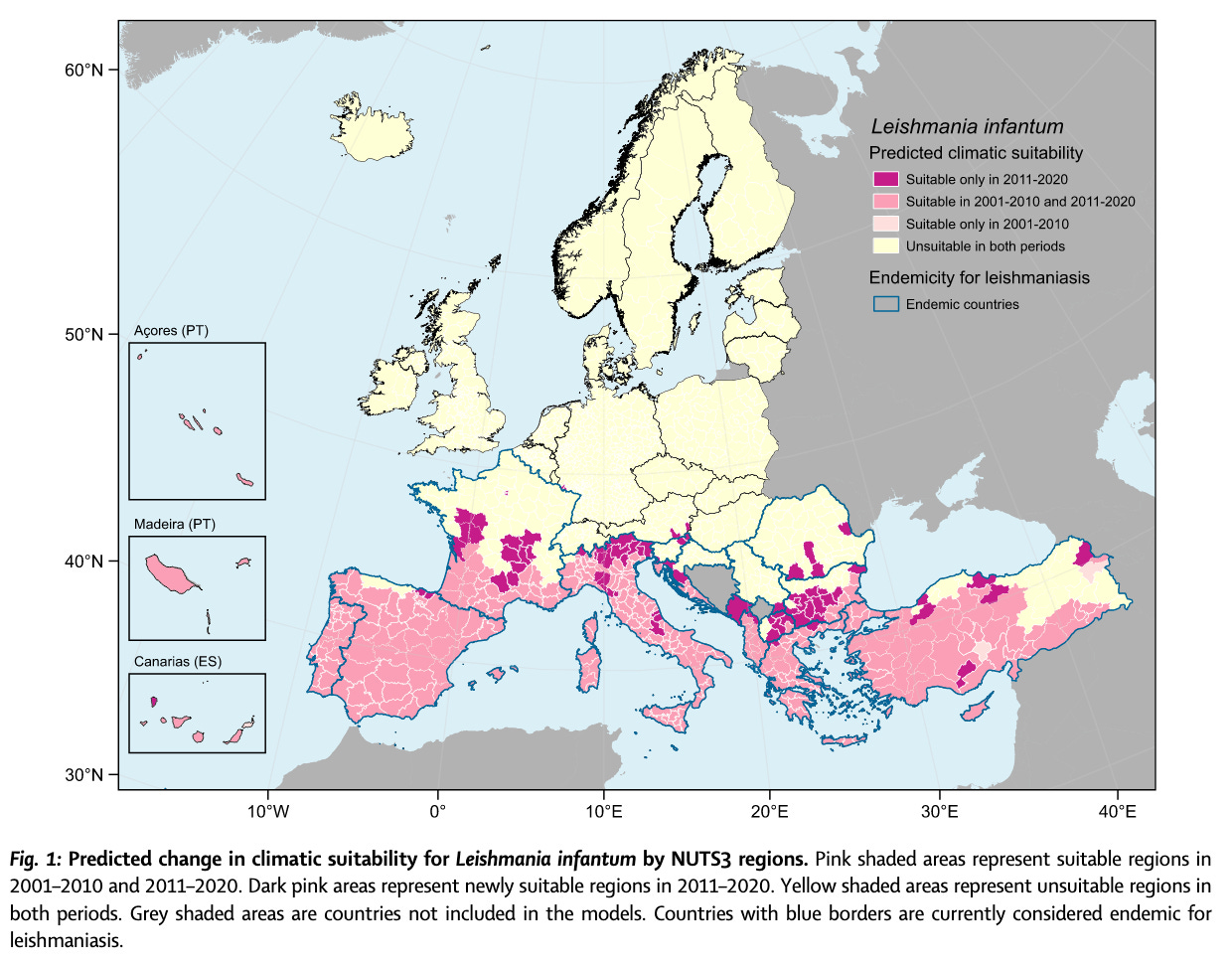
The reason for the spread is the same as for the mosquitoes and ticks, so I won’t bore you with them yet again. But dogs are again part of the picture here, as they’re a natural reservoir for L. infantum.
Practical Advice for Avoiding Sandflies
For dog owners and immunosuppressed individuals living in, or traveling to, southern Europe and the adjacent regions (North Africa, the Middle East) you should reduce dusk/dawn exposure as much as possible and use screens on windows. Health systems should plan for earlier seasonal case detection in warmer years and strengthen entomologic surveillance in predicted hotspots 16,17.
Urban Malaria
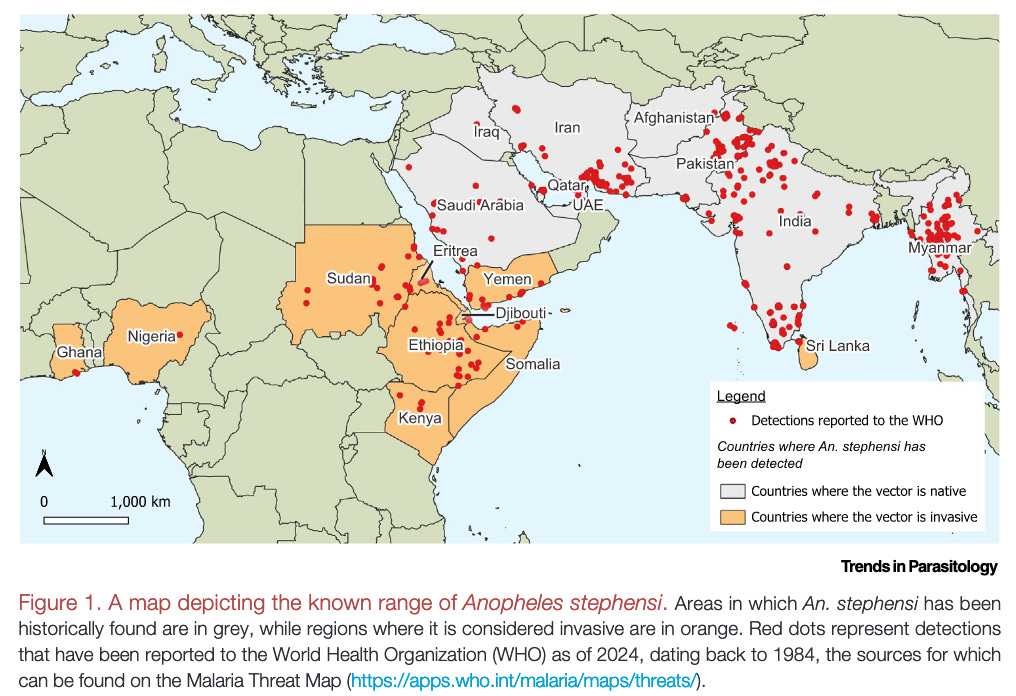
Anopheles stephensi, a container-breeding and city friendly malarial vector, has established itself across parts of the Horn of Africa, raising the probability of seeing urban malaria transmission where it was previously assumed to be mostly rural18,19. History (and modern analyses) shows that human habitats aligning with vector preferences leads to massive, rapid range shifts20. As you can see in the map below, the entirety of the Horn has invasive malarial mosquitoes, as well as the west coast countries of Nigeria and Ghana18.
The same familiar causes
Again, warmer conditions tweak survival, biting, and parasitic development times, boosting the potential for transmission. Then urban water storage and container habitats do the heavy lifting in the places cases actually show up. Yet again, climate primes and cities decide.
A quick word on climate attribution
The weight of the recent evidence shows that climatic suitability is increasing for multiple vector-borne diseases, with earlier seasonal onsets and expanding ranges (though these are highly variable by pathogen and place). Mechanistic work shows why modest warming can have outsized effects by changing trait rates within workable temperature windows1. But that kind of attribution shouldn’t be mistaken for some kind of destiny. The main co-drivers, in the form of urban containers and poor storm water management, deer management and land use patterns, poverty and weak vector control capacity, all determine where this suitability will likely convert into actual human burden. If you’re tired of hearing about the same culprits, good. That’s where the levers for change exist.
The Edge of Epidemiology is a reader-supported publication. To receive new posts and support my work, consider becoming a free or paid subscriber.
Citations
1. Shapiro LLM, Whitehead SA, Thomas MB. Quantifying the effects of temperature on mosquito and parasite traits that determine the transmission potential of human malaria. Schneider D, ed. PLOS Biol. 2017;15(10):e2003489. doi:10.1371/journal.pbio.2003489
2. Daalen KR van, Tonne C, Semenza JC, et al. The 2024 Europe report of the Lancet Countdown on health and climate change: unprecedented warming demands unprecedented action. Lancet Public Health. 2024;9(7):e495-e522. doi:10.1016/S2468-2667(24)00055-0
3. Parums DV. Editorial: Climate Change and the Spread of Vector-Borne Diseases, Including Dengue, Malaria, Lyme Disease, and West Nile Virus Infection. Med Sci Monit Int Med J Exp Clin Res. 2024;29:e943546-1-e943546-3. doi:10.12659/MSM.943546
4. Health (ASH) AS for. Vector & Pathogen Ecology. August 2, 2024. Accessed May 28, 2025. https://www.hhs.gov/climate-change-health-equity-environmental-justice/climate-change-health-equity/climate-health-outlook/vector-pathogen-ecology/index.html
5. Eisen RJ, Eisen L. Evaluation of the association between climate warming and the spread and proliferation of Ixodes scapularis in northern states in the Eastern United States. Ticks Tick-Borne Dis. 2024;15(1):102286. doi:10.1016/j.ttbdis.2023.102286
6. Molaei G, Little EAH, Williams SC, Stafford KC. Bracing for the Worst — Range Expansion of the Lone Star Tick in the Northeastern United States. N Engl J Med. 2019;381(23):2189-2192. doi:10.1056/NEJMp1911661
7. Hotez PJ. Neglected Infections of Poverty in the United States of America. PLoS Negl Trop Dis. 2008;2(6):e256. doi:10.1371/journal.pntd.0000256
8. Hotez PJ. Globalists versus nationalists: Bridging the divide through blue marble health. PLoS Negl Trop Dis. 2019;13(7):e0007156. doi:10.1371/journal.pntd.0007156
9. Blum AJ, Hotez PJ. Global “worming”: Climate change and its projected general impact on human helminth infections. PLoS Negl Trop Dis. 2018;12(7):e0006370. doi:10.1371/journal.pntd.0006370
10. The 2024 report of the Lancet Countdown on health and climate change: facing record-breaking threats from delayed action - The Lancet. Accessed August 17, 2025. https://www.thelancet.com/journals/lancet/article/PIIS0140-6736(24)01822-1/fulltext?utm_source=chatgpt.com
11. Aedes albopictus - current known distribution: June 2025. July 1, 2025. Accessed August 17, 2025. https://www.ecdc.europa.eu/en/publications-data/aedes-albopictus-current-known-distribution-june-2025
12. CDC. Current Dengue Outbreak. Dengue. July 29, 2025. Accessed August 17, 2025. https://www.cdc.gov/dengue/outbreaks/2024/index.html
13. CDC. Potential Range of Aedes Mosquitoes. Mosquitoes. July 1, 2024. Accessed August 17, 2025. https://www.cdc.gov/mosquitoes/php/toolkit/potential-range-of-aedes.html
14. Verhulst M. 2023 Mosquito-Borne Disease Year In Review. Vector Disease Control International. February 19, 2024. Accessed May 28, 2025. https://www.vdci.net/vdci-capabilities-brochure/
15. CDC. Blacklegged Tick Surveillance. Ticks. July 7, 2025. Accessed August 17, 2025. https://www.cdc.gov/ticks/data-research/facts-stats/blacklegged-tick-surveillance.html
16. Carvalho BM, Maia C, Courtenay O, et al. A climatic suitability indicator to support Leishmania infantum surveillance in Europe: a modelling study. Lancet Reg Health - Eur. 2024;43:100971. doi:10.1016/j.lanepe.2024.100971
17. González C, Calderón JM, López AM, et al. Species-specific variation in predicted distribution and habitat suitability of phlebotomine sand flies in Italy under different climate change scenarios. Sci Rep. 2025;15(1):13297. doi:10.1038/s41598-025-96296-w
18. Taylor R, Messenger LA, Abeku TA, Clarke SE, Yadav RS, Lines J. Invasive Anopheles stephensi in Africa: insights from Asia. Trends Parasitol. 2024;40(8):731-743. doi:10.1016/j.pt.2024.06.008
19. Abebe W, Sisay A, Mihret Y, et al. Prevalence of Anopheles stephensi in Horn of Africa: a systematic review and meta-analysis. BMC Infect Dis. 2025;25(1):614. doi:10.1186/s12879-025-11022-1
20. Rapid range shifts in African Anopheles mosquitoes over the last century. doi:10.1098/rsbl.2022.0365