Happy holidays! Today we take a look at some of the less festive gifts our ancestors left us: the oldest sexually transmitted infections humanity still carries.
Most of the talk around ancient diseases tends to be linked to diseases of civilization that arose from domestication of animals, farming, crowding, and poor sanitation practices. That focus makes sense. For most of human history they were some of the primary causes of death. But a small number of pathogens and parasites have much deeper histories, going back to our non-human ancestors. Today we’ll be looking at a few of these diseases that have accompanied humanity since it emerged. Interestingly enough, these all fall (somewhat awkwardly) under the modern “sexually transmitted infection” label.
The Herpes Viruses
Modern humans are unique in that they’re the only known primate species to play host to two distinct herpes simplex virus lineages. Humanity deals with HSV-1 and HSV-2, which respectively affect the oral cavity and genitalia. An astonishingly high two-thirds of the population is infected with at least one of these at a time. The two viruses have vastly different histories with regard to how humanity ended up with them though.
HSV-1
HSV-1 is primarily spread through oral contact. The common infection causing cold sores shows a deep co-evolution with our hominid ancestors. So much so that the ancestral branching point is thought to be the herpes virus that currently infects chimpanzees. We know this because genetic comparison studies indicate that HSV-1 (or its evolutionary predecessor) was infecting ancestral hominins/apes even before the human-chimpanzee split happened. This is thought to have happened about 6-7 million years ago, making it incredibly likely that early Homo populations were carrying an HSV-1 like virus as a legacy of their primate ancestors. The virus has been with our species since it left Africa, and there’s little reason to think any groups were spared.
However, it is possible that the different groups (eg. Homo erectus, the Neanderthals, the Denisovans) ended up with their own lineages. This could have been passed back and forth in prehistory via interbreeding, however this would have been a transfer of an already somewhat familiar virus (to the immune system), likely causing less trouble for the population than a totally novel introduction. Today’s most common variant only became dominant in the last few thousand years, with recent ancient DNA studies finding a date of about 5000 years ago during Bronze Age expansions.
HSV-2
The strain of herpes affecting the genital region is also closely related to the chimpanzee herpes virus. However, this time it wasn’t something we carried with us from the human-chimp split. Instead, HSV-2 was acquired much later by ancient humans, with the divergence from the chimpanzee virus happening somewhere around one and a half million years ago, well before modern Homo sapiens evolved.
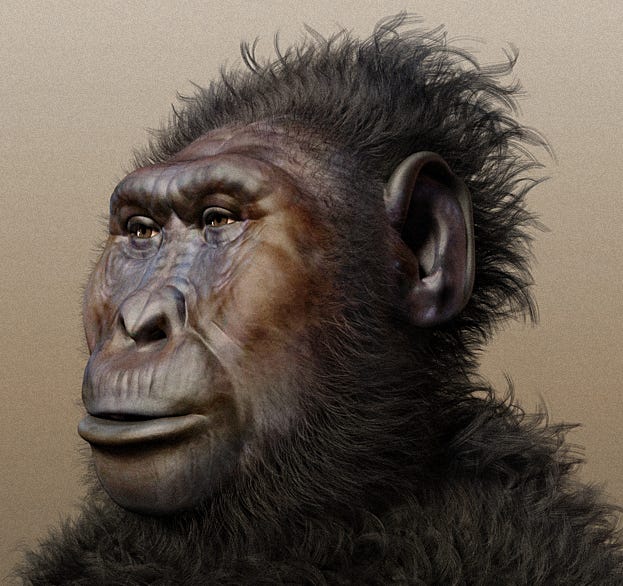
In this case, researchers propose that there must have been an intermediate “bridge” host in our hominin family tree that facilitated the jump from chimps into our ancient African ancestors. The proposed bridge host in this case, Paranthropus boisei, was an archaic bipedal hominin from East Africa around 2.5-1.2 million years ago. According to models taking into account fossil, climatic, and viral genetic data, they were in the right place at the right time to contract HSV-2 from an ancestral chimpanzee population, then spread it to the Homo lineage. The cross-species transmission event is thought to have happened when P. boisei’s habitats overlapped with both chimpanzee and H. erectus ranges. Erectus and boisei likely coexisted around the African lakes and rivers, creating opportunities for contact. A timing that aligns well with the estimated divergence of HSV-2 from the other herpes viruses and strongly suggests that Neanderthals, Denisovans, and modern humans would later inherit HSV-2 as part of our pathogen repertoire.
The initial infection likely occurred via P. boisei scavenging or butchering an HSV-infected chimpanzee carcass. Any open wound would have provided opportunity for the virus to enter the new host. The same process is one possible mechanism for HSV-2 entering the erectus lineage as well, with another possibility being inter-species sexual contact. Nevertheless, once it had entered the Homo family tree, it established lifelong infections, allowing persistence even in the low-density populations of the time.
Human Papillomavirus 16
HPV16, a high-risk variant linked to cervical, anal, throat, penile, and other cancers, often doesn’t show itself symptomatically, though when it does, its usually in the form of warts, unexplained bleeding, or throat pain. Its variant lineages are A, B, C, and D, with genetic analyses indicating a split between the A vs. B/C/D variants happening roughly 500,000 years ago. That timing roughly coincides with the proposed split between modern Homo sapiens and archaic humans like Neanderthals and Denisovans. The data is suggestive of both ancient co-divergence, as well as more recent host-switching. It’s likely that some HPV16 lineages co-evolved on their own in different hominin groups. Lineage B/C/D likely arose in African H. sapiens groups while lineage A is thought to have evolved in Neanderthal or Denisovan populations. This is backed up by evidence that HPV16A (and its subtypes) are predominant in non-African groups and are rare in sub-Saharan Africans, strongly suggesting that lineage A wasn’t in the early H. sapiens who stayed in Africa.
The proposed explanation is that modern humans acquired the HPV16A lineage through sexual contact with our Neanderthal or Denisovan cousins somewhere in Eurasia. After anatomically modern humans left Africa and started interbreeding with archaic populations, the (then) archaic HPV16A strain jumped into the modern human population. It’s implied this happened multiple times, as different A sublineages are found in different European and Asian populations. HPV16’s success in modern humans could have been boosted by the naïve immune systems of the new hosts. We even see evidence that certain immune gene variants present in Eurasians (some inherited from Neanderthals) increase the susceptibility to HPV-related cancers, suggesting we picked up both the virus, and genetic traits impacting our immune response to it.
Pubic Lice
The pubic louse that infects humans (Pthirus pubis) is a close cousin of gorilla lice (P. gorilla). Genetic evidence suggests these two last shared a common ancestor somewhere around 3.5 million years ago, long after the human-gorilla lineage split around 7-8 million years ago. This means co-evolution can’t explain its presence in human populations and is heavily indicative of a host switch somewhere around 3 million years ago. We got “crabs” from gorillas.
But it wasn’t “us” who were the first ones to be infected. It’s thought that an early hominin (like Australopithecus, but really any existing at the time would do) was a bridge species for this infection. Essentially, one of our tree-dwelling or ground-foraging ancestors acquired gorilla lice and then passed them on to its descendants; an easy task when most of the body was covered in coarse fur. Since direct contact is pretty much needed for lice transfer (as they don’t really jump or survive off-host for long), the proposed scenarios include hominins sleeping in gorilla nests or dens and picking up the lice from bedding, or predator-prey interactions, where hominins scavenged or hunted gorillas with lice crawling onto the humans during the butchering. Today, P. pubis mainly infests the coarser hairs of the groin and armpit, suggesting once our hominin ancestors had lost most of their body hair, the lice were confined to the remaining patches.
What struck me most in my reading for this piece is that a parasite being picky about its host or a pathogen mutating slowly can turn a genome into a kind of historical document. The pubic lice record tells us of contact between an ancient hominin and gorillas millions of years ago. HSV-2 preserves the likely encounter between ancestral humans and other apes by way of another hominin group that died out over a million years ago. HPV16 is another indicator of contact between modern humans and Neanderthals. These were simple accidents of ecology, down to shared landscapes, hunting grounds, and brief moments of contact, which documented details about humanity’s journey through time. Occasionally, our best ideas of human history don’t come from bones or tools, but from pathogens whose genes never forgot where they came from.