“Started out soon this morning, passed several graves, we hear that it is sickly on the route…” noted Lodisa Frizzell in May of 1852 in her journal documenting her family’s journey from Illinois to Wyoming. Her family appear to have been some of the luckier ones, with only one family member being noted as ill 73 days in (although we only have about half of the journey documented). More than 300,000 similar people chose to make the more than 2100-mile journey from the Missouri River delta to the Pacific Northwest, California, and Utah from 1840 to 1869. As many as 1 in 10 would die en route, the vast majority attributable to infectious disease as opposed to the heavily mythologized threat of hostile encounters with the Natives. The Oregon/California/Mormon Pioneer Trail corridor is known as “the nation’s longest graveyard” for good reason; there were anywhere between 10 and 15 deaths per mile of the trail, with the death rate of emigrants having been double that of Civil War soldiers and quadruple that of the civilian mortality rate at the time.
What was killing them? Of the 9 out of 10 deaths from disease, cholera, dysentery, typhoid, and measles were the major killers, cholera being worst of all.
The Edge of Epidemiology is a reader-supported publication. To receive new posts and support my work, consider becoming a free or paid subscriber.
Cholera and Dysentery on the Trail
Cholera, caused by Vibrio cholerae is a bacterium that colonizes the small intestine. There it produces a potent toxin that results in the gut being flooded with a combination of chloride and water, heavily dehydrating the sufferer, who can lose anywhere from 10-20 liters of fluid in just hours. You end up with its signature “rice-water stool” (a nearly odorless, thin and watery stool) which results in heavy electrolyte losses. In the 19th century when there was no understanding of the need to replace electrolytes, you ended up with a case fatality rate in the untreated of up to 60%. It resulted in quick, yet grotesque deaths. Since it wasn’t isolated until 1883, the emigrants on the Oregon Trail had no idea what it was, where it came from, or how it was transmitted from person-to-person (it’s the fecal-oral route). They simply called it “cramps” or “blue death”, the latter of which is a reference to the skin discoloration that can come with severe dehydration in dying patients.
Cholera had been brought to North America in 1832 via Canada. The 1849 wave rode west on the coattails of those heading west on the trail, many chasing gold in California. The discovery of gold at Sutter’s Fort ended up bringing tens of thousands of emigrants across the plains, a mass migration event that would result in the cholera epidemic. A heavy increase in population density is the type of environment cholera thrives in. Public health and medical historian Brian Lee Altonen’s master’s thesis is an incredibly detailed spatia-epidemiological analysis of disease transmission on the trail. He notes that there were two major, distinct disease regions on the Trail.
The first was cholera, and it was typically confined to the Platte River flood plain from 1849 to 1852 and was heavily driven by population dynamics, regional climate, and, importantly, the alkaline-saline chemistry of the Platte River itself, which helped cholera to survive. Emigrants were using the river as a toilet and rinsing feces-tainted rags in streams. Once in the river the bacteria could hang around for long periods before it ended up being drunk by some thirsty traveler. Fort Kearny was the first major military outpost on the trail, nearly 200 miles from Missouri. The unlucky post had an aqueduct connecting them to the Platte River, resulting in the highest disease density for cholera at the time. Cholera became more rare the further you got into the trail. Population density was dropping, temperatures fell, and water sources became more favorable.
The fact that 19th century emigrants and physicians used the word “cholera” so generically meant Mr. Altonen had quite the job cut out for him in figuring out what had killed who (thus the 300-page document his thesis became). In the end, he noted that the second major disease region on the trail was largely made up of dysentery cases, the first hotspots of which formed in eastern and central Nebraska where large numbers of buffalo had been slaughtered and left to rot. As they decayed, they became breeding grounds for opportunistic bacteria like Salmonella and Campylobacter. Those then contaminated the nearby water sources that would cause prolonged cases of bloody diarrhea (still called “cholera” by travelers, though clearly different from Asiatic cholera as described earlier). As traffic increased and livestock herds pushed their way west, a much larger region of dysentery contamination developed further on the trail. Dead oxen, mules, and cattle that had collapsed from exhaustion of disease became new bacterial reservoirs. Dysentery became especially common in places with stagnant water, polluted streams, or recently dead animal remains.
Diaries as Epidemiological Documents
The private diaries kept by the overland emigrants are, in hindsight, accidental epidemiological field reports. Written without any medical training, they nonetheless contain raw data of disease surveillance, complete with precise symptom descriptions, incubation periods from first onset of malaise to death or recovery, observations of who did die and who did recover, and the improvised behaviors families came to adopt in order to protect themselves as fear of disease rippled through the train of wagons. With no understanding of germ theory, they were left to their senses: how things looked, smelled, and sounded. They described the bad tasting water, foul odors from the carcasses, the crowded campgrounds, and the sudden deaths, all capturing the environmental and behavioral conditions that shaped the disease ecology of the Trail. Read today, the journals resemble the notebooks of field investigators who didn’t quite know what they were investigating. Now modern historians and epidemiologists can reconstruct both where the diseases moved to and from, as well as how emigrants perceived and navigated the invisible hazards around them.
Mrs. Lodisa Frizzell’s 1852 journal was written from her cabin in the Sierra Nevada mountains. Her daily entries catalogued what us modern epidemiologists would call “syndromic surveillance.” In plain language, she notes symptom clusters – “it is sickly on the route”, disease rumors of cholera, smallpox, and measles, gives estimates of deaths “we have not passed less than 100 fresh graves”, and environmental risk waters like foul water and decaying animals. Her language, a matter‑of‑fact, often weary, and occasionally frightened, captures the subjective experience of moving through a landscape transformed by disease.
The Measles Catastrophe and the Whitman Massacre
While “cholera” in the broad term was killing off the European emigrants, the measles they brought with them was the epidemic that would end up defining the collision between those on the Trail and the Native American people’s they would come across in its western portion. The influential anthropologist and ecologist Robert Boyd’s article on the measles epidemic of 1847-48, based on fort records, missionary journals, baptismal registries, and emigrant diaries became the definitive reconstruction of the consequential event. His central finding was that the measles epidemic was not introduced by the overland migrants specifically. He argues it arrived earlier, having been brought by a party of Walla Walla and Cayuse returning from California where measles had been epidemic around Sutter’s Fort. The first recorded case on the Columbia Plateau was at Fort Nez Percés in July of 1847, which was a full two weeks before the 1847 migrants arrived.
The epidemic also was what triggered the Whitman Massacre. The Cayuse had been watching their children die at The Whitman Mission at Waiilatpu as most white patients recovered. They reasoned that Marcus Whitman, a physician-missionary, and his wife Narcissa, had actually poisoned the nearly 200 who died. They tested that hypothesis by sending three people, two sick and one not, to Whitman’s mission. All three ended up dead. On November 29th, 1847 the Cayuse killed the Whitmans and twelve others.
By early December of 1847, a Cayuse messenger had arrived at the Lapwai Mission reporting that 197 Cayuse had died in the previous few months (out of a total population likely < 500), a number consistent with a classic virgin-soil epidemic in a population without prior immunity. That biological vulnerability became coupled with what ended up being a lethal therapeutic practice: a transition from sweat bath to cold-water plunge. This dramatically worsened outcomes in febrile patients with Boyd documenting the sudden deaths across multiple groups including the Clackamas, Cowlitz, and Kalapuya. The Spokane on the other hand, under the guidance of Elkanah Walker who taught the sick to “keep dry and warm” and gave them cayenne pepper tea, had much lower mortality than the other surrounding groups.
While functioning as a migration route, the Trail was also an epidemiological delivery mechanism for the pathogen-rich settlements of the eastern United States to connect with immunologically naïve groups out West. In 1849 a cholera swept through multiple groups. The Pawnee lost around 1,100 people and the Cheyenne lost about half of their tribe that summer. Robert Boyd’s The Coming of the Spirit of Pestilence documents the full trajectory of infectious disease in the Pacific Northwest, conservatively estimating a population of over 180,000 in the late 1700s had dropped to 35,000 a century later. The demographic collapse had been driven largely by smallpox, malaria, measles, and influenza introduced through the fur trade, missionary contact, and overland emigration.
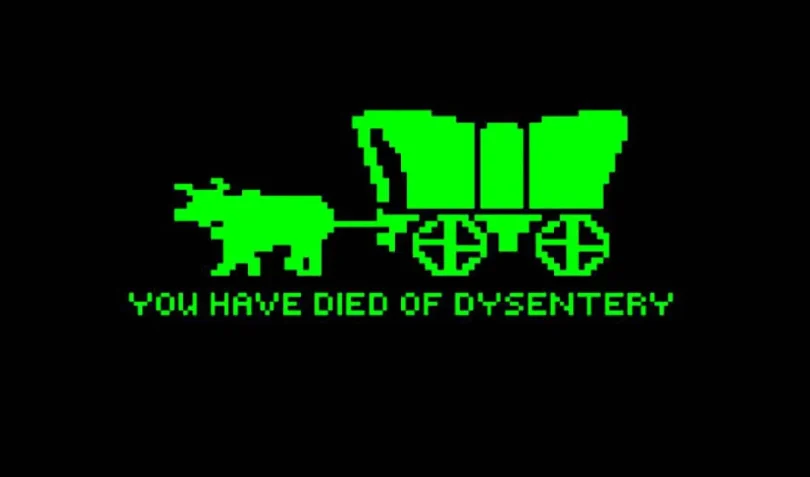
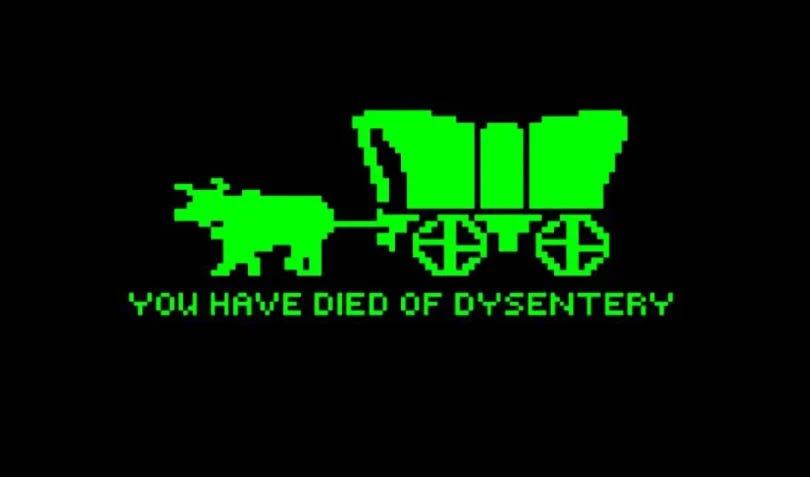
Since I first played The Oregon Trail game as a kid, I’ve known disease was the real killer of the Overland Road. But now I’m an epidemiologist and I see exactly how the Trail functioned as a massive epidemiological corridor stretching across the continent. The thousands of shallow graves littered from Missouri to the West Coast are the archeological record of an invisible war fought in wagons and camps. When Lodisa Frizzell noted she had passed “several graves” and heard it was “sickly on the route”, she was unknowingly describing one of the largest disease corridors in North American history.
The Edge of Epidemiology is a reader-supported publication. To receive new posts and support my work, consider becoming a free or paid subscriber.