Leprosy is much older than any empire. Fragments of its causal bacteria, Mycobacterium leprae, genomes have been recovered from medieval skeletons in England as well as from burials along the Silk Road. Using estimates from genomic clocks, it’s thought to have diverged tens of thousands of years ago, likely sometime after humans started clustering in settlements large enough for chronic infections to matter. Especially a slow, nerve-eating bacterium that has been bound to human migration patterns for millennia.
The Edge of Epidemiology is a reader-supported publication. To receive new posts and support my work, consider becoming a free or paid subscriber.
As 19th century medicine started to name and classify diseases, leprosy was just a bit too ancient and socially charge to fit neatly into that new clinical lexicon being developed. It somehow lingered in the space between sin and modernizing science, with treatment often conducted by missionaries and the disease itself feared by governments and societies. That type of ambiguity made it the perfect candidate for overreaction from bureaucrats. Colonial states were confident that cleanliness and order could be exported with their trade-goods, leading to islands of isolation. These islands became laboratories for the management of contagions.
The first and most famous was Molokai in the Hawaiian Islands. In 1865 the Kingdom of Hawaii was under pressure from missionaries and merchants, leading to the passage of the Act to Prevent the Spread of Leprosy1. Anyone diagnosed was shipped off to the Kalaupapa area, a rocky lava shelf cut off from the rest of the island by sheer cliffs. More than 8,000 people would eventually die there. To visiting officials, it looked like a decisive action while those sent there were experiencing a social death at the hands of medicine. The settlement’s rows of tiny cottages and chapels were soon looked to as the model for future quarantine efforts throughout the Pacific2,3. Missionaries celebrated Molokai as a triumph of their Christian compassion, embodied by the martyr Father Damien, a Belgian Catholic priest who ministered to the Molokai colony for 16 years, catching leprosy and passing away in 1889. But to the colonial administrators it was nothing but a template of how efficient segregation and self-sufficiency (patients doing things like cultivating their own food) could work in quarantine circumstances. The formula spread across the Pacific in the early 20th century as leprosy rates soared in tropical territories.
By 1900, the island of Beqa had been established as a leprosy station for British Fiji, on which a handful of patients were living in huts built from scavenged wood and guarded more by social stigma than by soldiers. Fear traveled fast in these days with officials worrying that “the native race” would disappear if the disease wasn’t contained. This led to the administration moving their operations to a larger, more permanent outpost on the island of Makogai in 1911, passing the Leprosy Ordinance in the same year to justify indefinite confinement4.
Magokai
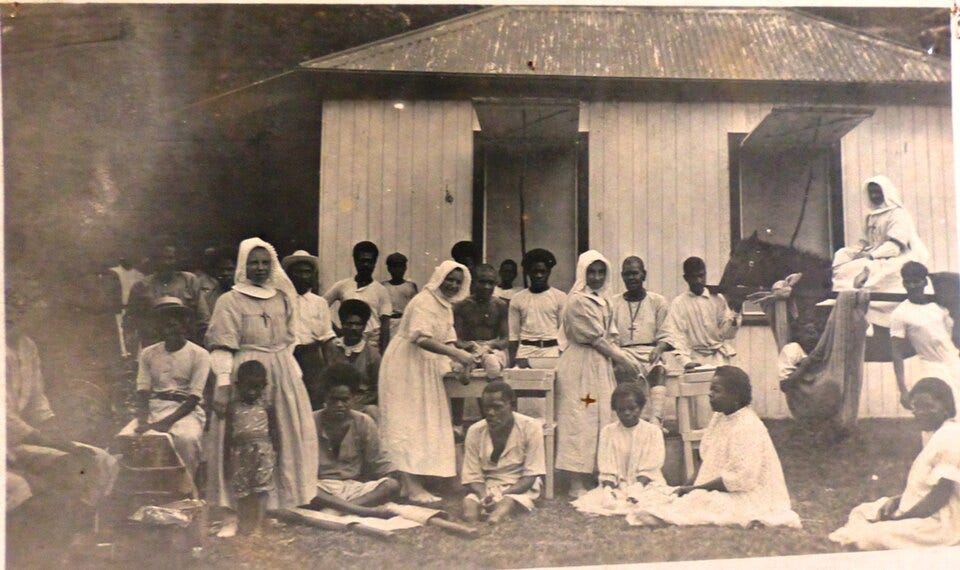
While Magokai was meant to be humane, the officials would also have probably really preferred it to stay an unseen entity. Run in tandem by the colonial government and the Missionary Sisters of the Society of Mary, the island was soon holding patients from all across the South Pacific, with representatives from Fiji, Tonga, Samoa, the Gilbert and Ellice Islands, and more. They’d created a microcosm of illness by building their own wards and gardens, attending mass under the watch of the nuns, and learned to live within the boundaries drawn by those in power. By 1933 the 40 patient census had grown to 427 on the island with roughly half already having died5. But those who survived and were interviewed decades later remembered Magokai as more village than prison, calling it “a world of our own.”
The measure of success to Makogai’s colonial government was the numbers. The issue with relying on simple numbers of cases and deaths is it tells you nothing about the transmission. When you’ve got an invisible denominator in the form of the general population you don’t have much. That said, the Austin report from 1936 reported 1,365 total cases having been treated since the founding, with three quarters being men and mortality hovering around 50%6. The survivors did so even through a rhythm of labor that was blurring the lines between care and coercion. Patients build their own homes, maintained the gardens, fished, cooked, and even made bricks for the new wards being built. Each nationality was assigned a village and leading headman, creating a bit of a miniature caricature of the empire itself 5. European patients lived separately with their cottages being spaced further apart on the hillside. Fijians and Samoans tended to be grouped together below with the other groups (Tongans, Gilbertese) filling in the gaps.
To the missionary Sisters this was an opportunity for moral and religious rehabilitation. They taught literacy classes, ran the medicine dispensary, and enforced things like silence during prayer. “Every patient must have occupation so that the devil may find no idle hands” wrote one Sister3. Their language of discipline and servitude to their God fit nearly into one of colonial medicine’s metaphors, disease as disorder and labor as the cure. One medication used was the Ayurvedic Chaulmoogra oil, applied to the skin and even injected into swollen limbs. But the oil itself burned and left abscesses that would sometimes heal faster than the leprosy lesions themselves6.
But even inside of the hierarchies people worked to build something as close to a thriving community as possible. A fantastic (and long) Master’s thesis from Dorothy McMenamin (Univ. of Canterbury, 2009) in the form of an oral history report records everything from evenings filled with music and storytelling to the sharing of gardens between wards and marriages sanctioned by the Sisters5. Patients described a serene sound to the island, only scarred by the ringing bell that marked curfew. Other than that it was the surf, the wildlife, and the occasional burst of laughter cutting into the routine. Some even claimed to prefer life on Makogai to the villages that had rejected them.
An archipelago of containment
Looking back with 20/20 vision, Makogai was a much better example of what leprosy colonies could be. Compare that to the likes of later colonies on New Caledonia, where they were situated within former prison sites and had much stricter isolation enforcement. Or Tonga, where biblical references claimed leprosy was a curse and the sufferers biblically unclean.
Makogai’s visibility due to the plethora of visitors coming from the empire made it an experiment worth repeating. By the 1920’s the colonial governments across the South Pacific had fine-tuned the isolation structure into policy. The idea spread like wildfire. Samoa was sending patients over to Makogai by steam ship until they were able to establish some of their own smaller wards, of course run on the same Christian systems, but with a bit less fire and brimstone than the Tongan’s seem to have gotten with the “uncleanliness” quotes. The Gilbert and Ellice Islands did their best to adopt the Makogai model as well, with smaller wooden huts being spaced out in carefully designed rows, food gardens being tended by the patients, and warders enforcing heavier rules for hygiene based on their British manuals.
The epidemiology was still incredibly thin though. Few records were made to distinguish between a patient with active lesions and those who were just suspected of contact with a patient. Surveillance was conducted, but more with simple inspection tours by a colonial doctor as opposed to anything looking like modern infection prevention practices us epidemiologists or medical practitioners learn about. But the people running the colony didn’t care that much about precision. Or maybe they just didn’t know to yet? It’s hard to tell. But we do know that containment mattered to these administrators in the most literal sense possible. In plenty of places they were just putting bodies on an island to be counted, then forgotten about.
The French colonies of New Caledonia and Tahiti were some of the worst examples of what these leprosaria could look like, making them extensions of previous penal sites that were definitely only designed with containment in mind. Treatment was an afterthought. Where the Sisters at Makogai kept patients working in the gardens, the overseers in New Caledonia were kept behind walls built by prisoners 1. One thing stayed the same across all of the colonies though, that being a sense of order in the tropics being maintained through faith, fear, and a simple ledger.
Ending the era of leprosy colonies in the Pacific
By the middle of the century, the world was beginning to outgrow these island colonies. Antibiotics had completely rewritten the rules of contagion with international health agencies starting to treat disease as something to be treated and managed within societies as opposed to removing the diseased individuals. The logic of isolation, which at a time looked like the prudent thing to do, began to look expensive and a bit cruel.
Sulfone therapy started to arrive to Makogai in the late 1940s. Within a few years the patients who responded were walking out of the wards and onto the docks, awaiting the boats that would take them back to their home islands, escorted by public health officers who were more interested in rehabilitation than any sense of Christian purity 5. As a result, colony populations fell from the hundreds to a few dozen. Records from the Fijian medical department show the first formal outpatient programs appearing in the 1950s, a quiet acknowledgement that segregation had lost its medical justification4. These changes swept through the pacific. Tonga and Samoa had new hospital wings to replace the isolation huts. French territories emptied the prisons-turned-colonies and began using clinics. Finally, the World health Organization came up with their Leprosy Control Program and launched it in 1953, declaring that all patients should have access to treatment without confinement3.
Makogai closed in 1969, the chapel and wards being left to the tropical vines and plants. The government repealed the Leprosy Ordinance and the remaining patients were brought back to the main island, some having been isolated for more than 70 years. The sea between islands was no longer an impassable medical border.
The Edge of Epidemiology is a reader-supported publication. To receive new posts and support my work, consider becoming a free or paid subscriber.
References (Zotero was being annoying with what these look like so I had to do a mix of hyperlinks in text and citations, sorry bout that)
1. Santacroce L, Del Prete R, Charitos IA, Bottalico L. Mycobacterium leprae: A historical study on the origins of leprosy and its social stigma. Infez Med. 2021;29(4):623-632. doi:10.53854/liim-2904-18
2. Jane Buckingham. The Inclusivity of Exclusion: Isolation and Community Among Leprosy-Affected People in the South Pacific. Health Hist. 2011;13(2):65. doi:10.5401/healthhist.13.2.0065
3. Luker V, Buckingham J. Histories of Leprosy: Subjectivities, Community and Pacific Worlds. J Pac Hist. 2017;52(3):265-286. doi:10.1080/00223344.2017.1379124
4. Fiji | Country | Geographical Region | International Leprosy Association - History of Leprosy. Accessed October 21, 2025. https://leprosyhistory.org/geographical_region/country/fiji
5. LEPROSY AND STIGMA IN THE SOUTH PACIFIC: CAMARADERIE IN ISOLATION. Accessed October 21, 2025. https://ir.canterbury.ac.nz/server/api/core/bitstreams/07fd68f2-2c06-4d9c-bd97-64b5ed634c3b/content
6. A Study of Leprosy in Fiji. Accessed October 21, 2025. http://ila.ilsl.br/pdfs/v4n1a07.pdf