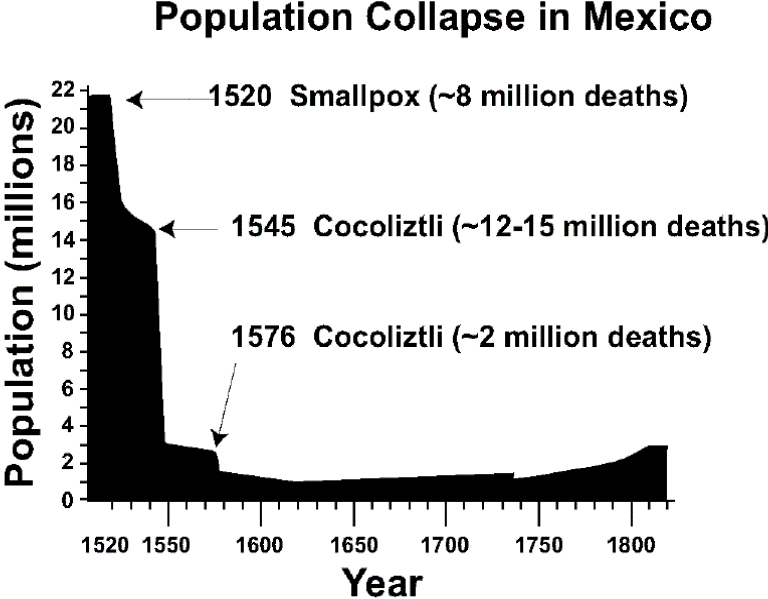
In 16th century Mexico (New Spain at the time), two extremely high mortality epidemics swept through Mesoamerica, decimating the population. The largest of the 12 cocoliztli epidemics (Nahuatl for “pestilence”) ran from 1545-1548 and 1576-1580 and killed anywhere from 5-15 million (or 80% of the population) and 2-2.5 million (45% of the population at the time) indigenous people. After nearly five centuries of research into these epidemics, there is still no singular explanation that fully accounts for the vast range of symptoms and environmental clues that were left behind. We’ll get into some of the more recent ancient DNA evidence for what has been found a bit later, as well as what current research methods and simple biophysics mean for what other explanations we could feasibly find. But first, we should try to understand this epidemic from first-hand accounts of the physicians trying to deal with it at the time.
A First-hand Account
The most detailed description we have from a clinician’s point of view comes from Dr. Francisco Hernandez, former physician to the king, and a witness to the 1576 epidemic. In 1571 he set sail on what is widely called the first scientific expedition to the region where he collected and tested the medicinal properties of plants in the area. Working in a hospital in the afflicted region at the time, he documented the symptoms and performed autopsies of patients. His account mentions an extensive list of symptoms: severe fever and dehydration, jaundice (suggesting liver involvement), dark or black tongue, black or green urine, weak pulse, severe headache and vertigo sometimes leading to seizure (suggesting possible viral encephalitis), nodules behind the ears and on the neck, profuse bleeding from facial orifices, vaginal bleeding, bloody diarrhea, abdominal pain, and death most commonly occurring within 2-7 days. Hernandez noted that the disease had a greater effect on those living in the highlands than those of the lowlands and a seasonality with both epidemics first showing up in the warmer summer months. It was also reported that Spaniards seemed more resistant to the disease, what could be taken as a sign of prior immunity, however it’s’ important to note the social positions were vastly different between the indigenous populations and the Spanish, with differences in labor, exposure, nutrition, and access to care. Another thing that is less indicative of prior immunity for Spaniards alone was the differential in age patterns. Older individuals tended to be spared compared to the younger. This differs from known viral hemorrhagic fevers (one of the possible explanations we’ll get to) which tend to more heavily affect the elderly.
Molecular Evidence and Other Hypotheses
In 2018 researcher published a study in Nature Ecology & Evolution using ancient DNA from skeletal remains from a cemetery in Oaxaca dated to the first epidemic. They extracted DNA from the dental pulp of 29 people buried at the site. Comparing the findings against a database in the National Center for Biotechnology Information of all complete bacterial genomes, they received a match for Salmonella enterica Paratyphi C bacteria in 10 of the 29 victims. This finding, while groundbreaking, led to more questions than answers. Today, untreated infection and enteric fever from that species have a fatality rate of about 10-15%, with bleeding happening in 10%, and upper gastrointestinal hemorrhage being rare. It also has a course of infection of about 2-3 weeks, not the mere days of cocoliztli. Severe malnutrition may have raised the fatality rate quite a bit, but could it have really led to 60-80% mortality rates? We haven’t seen that in any Salmonella outbreak, even in untreated and malnourished populations.
Other researchers, like Rodolfo Acuna-Soto, propose an indigenous viral hemorrhagic fever as the major agent of infection, possibly an arenavirus or similar virus. These have been documented in Mexican rodents and are a fit for many of the symptoms including fever, headache, diarrhea, colored urine, tremors, and necrosis. At the time, the epidemics seemed to have sprung out of nowhere at the time, but using tree-ring chronologies for north-central Mexico from the time of the epidemic, researchers suggested a megadrought from 1540-1580 worse than that of the 1930s Dust Bowl era. Just as importantly, the two epidemics happened during, or just after intense periods of rainfall. Using both climatological and rodent ecology studies, they proposed a mechanism of ecological cascade that led to the event. The prolonged drought led to reduced ranges for rodent populations, with them gathering around the remaining water and food sources. This would lead to increased territoriality over food and denser living spaces leading to viral transmission within those rodent groups. Then, the brief periods of heavy rain restores the plants and widens the availability of water, leading to population explosions for the rodents (with historical comparisons to a severe El Nino event from 1992-1993 that led to a 20x increase in southwestern deer mouse populations and a corresponding hantavirus outbreak in 1993). This would have led to a spillover event somewhere in the agricultural fields or settlements of the area and the devastating outbreaks. The drought also would have vastly reduced the food producing capacity of the region, leading to malnutrition in the area. Severely malnourished people have a 2-5x increase in fatality rates for respiratory and enteric infections. This feasibly could explain some of the difference in mortality between the indigenous and Spanish populations, with forced labor and a maize monoculture leading to nutritional issues. None of this to say a Salmonella outbreak wasn’t vastly making things worse through concurrent infections.
Their hypothesis fits some of the key ecological and epidemiological constraints the causal agent(s) has to match up with. The highland concentration corresponds to denser agricultural populations and settlements that would be in contact with rodent populations. The seasonal timing a rainfall-related rodent booms and harvest seasons also would have led to more opportunities for a spillover event. The faster progression of the disease also lines up more with one of these than just a Salmonella outbreak. The hypothesis also comes with its own limitations. Most crucially, the fact that arenaviruses and other RNA viruses degrade incredibly quickly and would not have survived to today. This means identifying a specific viral agent is basically impossible.
A Model of Compromise
The most probable explanation is a convoluted, multi-causal model taking all of what we’ve discussed into account. This model has been called a “syndemic,” essentially what occurs when two or more epidemics or disease clusters are happening in one group that greatly exacerbates the disease burden compared to only one epidemic at a time. In the case of cocoliztli, we’ve likely got multiple pathogens tearing through the population, one definitely being Salmonella, and the other likely being some kind of viral hemorrhagic fever already native to the area or brought over from Africa via the slave trade. Nutritional stress led to immunocompromised individuals and the megadrought worsened those nutritional and hydration matters even worse, leading to one of the deadliest epidemics in history and a near complete civilizational collapse.
Across history, the deadliest epidemics have tended to occur when a novel pathogen collides with some other type of societal breakdown, be it nutritional stress, environmental disaster, or population displacement. Famine-associated typhus in 19th century Europe, the black plague during periods of late medieval climatic change, influenza during World War I, and Ebola during the collapses of various West African countries all show versions of that same pattern. The baseline mortality of an infectious agent is shifted upward by these types of stressors. Cocoliztli fits neatly within that class of events, and a monocausal explanation was never likely. Retrospective diagnosis in a case like this might be impossible, but defining the ecological and biological constraints any pathogen would have had to operate under still leads us out of the dark with at least a partial explanation.
The Edge of Epidemiology is a reader-supported publication. To receive new posts and support my work, consider becoming a free or paid subscriber.