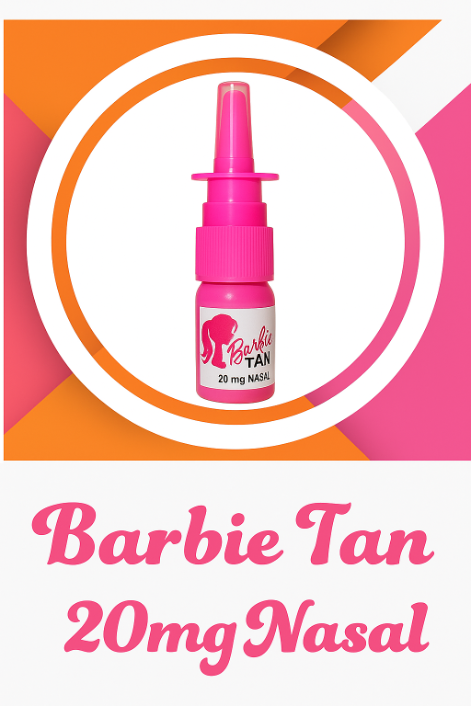
There’s a black-market peptide that’ll give you a tan, a hard-on, and possibly cancer; and it’s going up people’s noses in Barbie-core packaging. It’s called Melanotan II, a synthetic analog of α – MSH (a peptide hormone involved in pigmentation, appetite regulation, and sexual activity) that was originally intended for subcutaneous injection. It’s recently been rebranded as a nasal spray in hot pink packaging reminiscent of Barbie. Thankfully this doesn’t seem like something that is going viral in terms of sales. From what I can tell, it’s a niche, black-market, hard to find compound. But it’s weird, and I like weird.
The effects of the Barbie drug vary. In men, there’s facial flushing, abdominal pain, and sometimes priapism (the medical term for erections that last for hours). In women, users report rapid nausea, allergic reactions, and breathing difficulty that has caused hospitalization on more than one occasion. For both sexes, we see darkening of moles, new mole formation, and a likely increased risk in melanoma risk.
What we’re seeing in the Barbie drug trend is a deregulated pharmacological clown show propped up by influencers exploiting body dysmorphia and aesthetics maxxing.
How Melanotan II Works (and How it Went Off the Rails)
What’s now colloquially called the ‘Barbie Drug’ was never meant to be a supplement peddled in the TikTok store. It was synthesized in the 90s as a research compound to stimulate melanin production through the activation of melanocortin receptors. The goal was for it to bind specifically to MCIR, the receptor that controls skin pigmentation. But the drug wasn’t that specific. It also binds to MC3R, MC4R, and MC5R, receptors playing a part in sexual function, appetite, pain, and inflammation. That is how we end up with a rogue’s gallery of side effects like nausea, spontaneous erections, darkened moles, and more1,2.
Formal pharmaceutical developers abandoned the compound due to safety concerns and not getting any regulatory traction with the FDA. After that, it migrated into underground use. A company called Melanocorp, run by Edward Manookian, began selling it online as a tanning injection. The FDA sent warning letters in 2007 but the company kept selling it in the US and abroad. Manookian later plead guilty to two felony charges of conspiracy for violating federal drug laws, leading to him being banned from working in the industry3.
The compound also gained popularity on bodybuilding and enhancement forums, where users would combine it with anabolic steroids, tanning bed use, and fat-loss supplements to speed up the aesthetic changes4. Eventually it crossed over to a wider online market as a quick fix for looking hotter with minimal effort.
Why This Still Matters
I’m not talking about the next Ozempic here. Melanotan II probably isn’t going to be come some popular over the counter supplement at GNC (but the guy there might know a guy who knows a guy). It’s not FDA-approved, it’s hard to find, and it seems to be lurking mostly in the darker corners of biohacker circles and TikTok’s algorithmic jungle (although they seemed to have banned various hashtags related to the #tanningnasalspray). But those are things that make it worth watching to me. The supplement industry is an unregulated wasteland of good, bad, and delusional, but understanding which supplements have their place is harder than it should be.
We live in a world where regulatory ambiguity is a feature, not a bug. A compound abandoned by pharma due to safety risks ends up finding new life in influencers, wrapped in a Barbie-pink wrapper, and sold at high costs in the name of self-improvement.
So while the Barbie Drug will probably never hit the mainstream, it’s a great little case study in how deregulated supplements and viral trends can converge into untested and unhinged insanity. You’re not going to fix that body dysmorphia with a tan.
The Edge of Epidemiology is a reader-supported publication. To receive new posts and support my work, consider becoming a free or paid subscriber.
Citations
1. Nelson ME, Bryant SM, Aks SE. Melanotan II injection resulting in systemic toxicity and rhabdomyolysis. Clin Toxicol. 2012;50(10):1169-1173. doi:10.3109/15563650.2012.740637
2. Hjuler KF, Lorentzen HF. Melanoma Associated with the Use of Melanotan-II. Dermatology. 2014;228(1):34-36. doi:10.1159/000356389
3. https://www.fda.gov/media/100529/download?utm_source=chatgpt.com. Accessed May 28, 2025. https://www.fda.gov/media/100529/download?utm_source=chatgpt.com
4. Gilhooley E, Daly S, McKenna D. Melanotan II User Experience: A Qualitative Study of Online Discussion Forums. Dermatology. 2021;237(6):995-999. doi:10.1159/000514492