Disease as History’s Invisible Army
In the Winter of 1776, the American Revolution faced a threat different from the redcoats they were getting used to. This threat came with pustules. In between the musket fire and the roaring of cannon fire, smallpox had made its way through the ranks. The American Revolution, in hindsight, looks much more like a microbial war than one that would be defined by musket fire. Historians estimate that somewhere around 8,000 soldiers died in action from 1775 to 1783. Disease, on the other hand, took 17,000 lives at the very least with some estimates suggesting over 60,000 had passed of disease when counting prisoners of war and those who died after returning home. The deaths of about 11,500 Americans on British prison ships in New York Harbor of disease and starvation alone exceeds the total of American deaths in battle. John Adams, writing to his wife Abigail in 1777, noted that “for every soldier killed in battle, disease killed ten,” which, is not far off from the later analyses suggesting somewhere around a 9:1 ratio. All causes taken together, anywhere from 25,000 to 70,000 American Patriots died during active military service.
The major infectious diseases wreaking havoc were smallpox (Variola major), dysentery, typhus, typhoid fever, malaria, and influenza. The conditions soldiers lived in on these 18th-century military encampments were ideal transmission environments where men from geographically dispersed communities, many rural and with different exposure histories, ended up packed into poorly ventilated areas that had primitive latrines for toilets (often inadvertently dug upstream of someone’s water source), and a never-ending shortage of clean clothes. This was far from unique though, as deaths in pre-modern warfare were more often due to infectious disease than direct combat losses (although festering, infected wounds took their fair share of soldiers through time). Due to medical advancements the 9:1 ratio declined over time to about 2:1 by the American Civil War, but it wasn’t until World War II that disease deaths in most armies finally had dropped to about 10% of battle deaths.
The Edge of Epidemiology is a reader-supported publication. To receive new posts and support my work, consider becoming a free or paid subscriber.
Smallpox and the Quebec Campaign
September of 1775 marked the beginning of the Congressional Congress authorized two-pronged invasion of the Quebec region. By late August, General Richard Montgomery had left Fort Ticonderoga with somewhere around 1200 men. After laying siege to and capturing Fort St. Johns by early November, he took Montreal with little to no resistance on November 13th. At the same time, Colonel Benedict Arnold was leading a force of around 1100 men from Cambridge, Mass. on an extraordinarily laborious march through the wilderness of Maine. By the time they’d reached Quebec City in November they had been ravaged by starvation, desertion, and exhaustion leaving the forces substantially reduced.
By the time the two forced made it to Quebec City in December, their combined strength had dropped to somewhere around 1000-1200 total (an attrition rate of about 50%). Crucially this was less than the British garrison had under Governor General Guy Carleton. Since military service would be over at the start of the new year for many of his troops, Montgomery felt it was crucial to attack before losing even more of his forces. So in the middle of a snowstorm on December 30th and New Year’s Eve the Americans launched their two-pronged assault. Montgomery ended up killed almost immediately while Arnold was shot in the leg and over 400 Americans ended up captured. The Brits lost only 5 soldiers with another 14 wounded.
Smallpox had been reported among the troops by December of 1775. By mid-March of the following year, Benedict Arnold was left with 617 rank and file men with another 400 in the hospital, largely due to smallpox. He had tried maintaining the siege in the Spring, but the smallpox had spread too far. He wrote to Washington in May noting “ Our army consists of a few more than 2,000 effective men and 1,200 sick and unfit for duty, chiefly with the smallpox, which is universal in the country.” Later Major General John Thomas took the command, but he had an even further reduced force. There were less than a thousand men fit for duty noting “the rest were invalids, chiefly with the smallpox.” The Americans were forced to retreat by British reinforcements led by General Burgoyne; hundreds of the sick were left behind. Thomas himself ended up contracting smallpox and passing away that summer on June 2nd.
The differential rates of immunity were the critical asymmetry that allowed the catastrophe to be so one sided. Smallpox was endemic in 18th-century Britain with virtually every adult having been exposed in childhood or via inoculation campaigns. The Brits and German Hessians were arriving in the colonies already immune. Contrast that with the upbringing of the American colonists, especially those from rural and southern areas, who only dealt with smallpox in sporadic waves or had never encountered it at all. Less than a quarter of the Continental Army had previously contracted the disease when George Washington put in the inoculation order in February of 1777. By mid-July of 1775, of the Northern Army forces consolidated at Ticonderoga, some 3,000 were sick, mostly with smallpox.
Just How Deadly was Smallpox Then?
The case fatality rate of smallpox is actually the subject of a long-going epidemiological debate. Consensus places the overall CFR at somewhere around 20-30% in unvaccinated populations, but that masks the substantial variation that’s possible depending on age pyramids, nutrition, and whether smallpox is endemic of epidemic to the area. A 2026 study helps us get a better idea of what this CFR could be depending on the scenario. It could range as low as 8% in endemic areas where it is primarily a childhood disease (such as Sweden) and up to 55% in areas where it hits susceptible adults and children (Iceland for example). The authors argue that social disruption arising from household caregiving lapsing when adults and children both fell ill were dramatically elevating the mortality rates. For colonial North America, we end up with estimates of roughly 10% among infected colonists, but this was dramatically higher in the filthy, malnourished conditions seen in military camps.
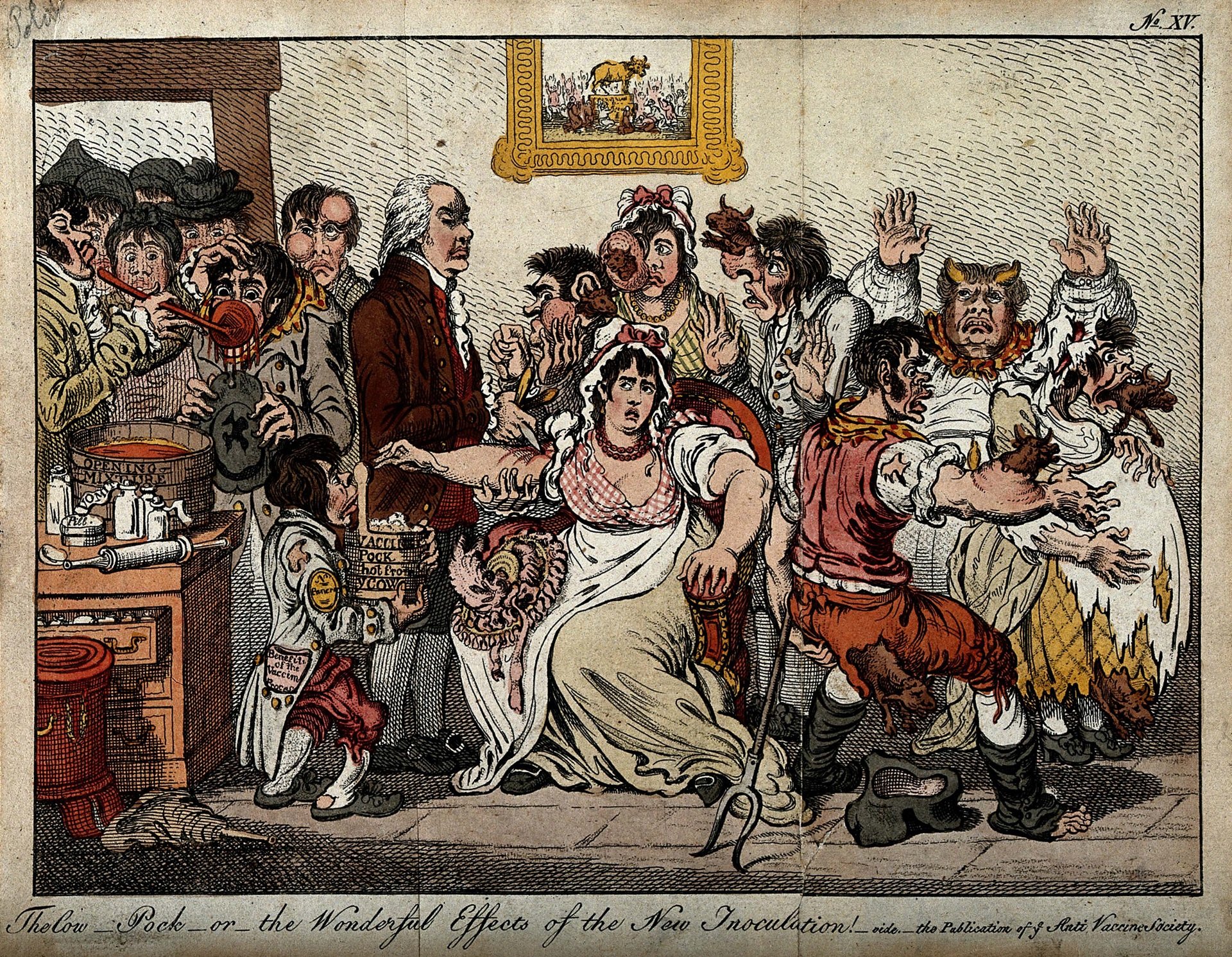
While 18th century physicians didn’t have germ theory to guide them, largely thinking in terms of miasma (dirty air, damp weather, dirty environment), smallpox was slightly different, being recognized as being spread through contact, person-to-person. The high death rates seen led to the practice of variolation, whereby patients would be deliberately exposed to smallpox (usually via a scab or pus from an active case) through a small incision. The goal was to give them a milder, more localized infection to give them lifelong immunity. Estimates of CFR for variolation compared to natural infection due to small pox were about 2% for variolation and 14% for infection using data from the 1721 Boston epidemic. By the 1764 epidemic the gap had widened further to 1% and 18%.
Washington’s Variolation Dilemma
George Washington apparently had his own encounter with smallpox that had major impacts on the army and nation he would end up leading. In the fall of 1751, when he was nineteen years old, he traveled to Barbados with his half-brother Lawrence who was hoping to find some relief from tuberculosis by escaping to the topics. That November Washington was at the home of Major Gedney Clarke, even noting he was reluctant as “the smallpox was in his family.” Twelve days later, matching the classical incubation period of smallpox almost perfectly, he recorded that he “was strongly attacked with the smallpox” and ended up confined for nearly a month. Left with pockmark scarring on his nose and a lifelong immunity, he understood the disease as well as any non-physician at the time.
So when Washington arrived at Cambridge in July of 1775 to take charge of the Continental Army, smallpox was already in Boston doing damage. He immediately implemented quarantine measures with daily inspections for symptoms, a dedicated hospital for smallpox, putting immune troops on the front lines, and controlling access to the quarantine zone. He was initially against inoculation, issuing a harshly worded general order where he declared “Any Officer in the Continental Army, who shall suffer himself to be inoculated, will be cashiered and turned out of the army, and have his name published in the Newspapers throughout the Continent, as an Enemy and Traitor to his country.” The Continental Congress soon followed with their own proclamation that prohibited inoculation in the army.
There were a few reasons for the ban on inoculation, namely the epidemic risk that came with inoculated soldiers who were contagious during the recovery period. Rigorous quarantine would be difficult in a mobile army, so inoculation could have inadvertently triggered an epidemic it was designed to prevent. That also would mean temporary military weakness due to the 2-5 weeks of recovery needed. A disaster in Quebec would validate these fears. Soldiers had been secretly inoculating themselves which had the effect of intensifying the epidemic. More evidence would strengthen Washington’s position as smallpox continued to make its way through the army at New York and New Jersey. Returning soldiers were spreading the infections into their hometowns. In January of 1777 he would write to his younger brother John Augustine noting that he wanted to “move for a law to compel the Masters of Families to inoculate every Child born within a certain limited time…”
Mass Inoculations of 1777
In February of 1777 Washington wrote to John Hancock who was serving as President of the Second Continental Congress at the time. He noted how far and wide smallpox had spread in his army and called for inoculation: “The small pox has made such Head in every Quarter that I find it impossible to keep it from spreading thro’ the whole Army in the natural way. I have therefore determined, not only to inoculate all the Troops now here, that have not had it, but shall order Doc(to)r Shippen to inoculate the Recruits as fast as they come in to Philadelphia.” Another letter was sent to Dr. William Shippen Jr. who served as Director of the Medical Department. The letter, preserved at the National Archives’ Founders Online section contains the famous quote “Finding the Small pox to be spreading much and fearing that no precaution can prevent it from running through the whole of our Army, I have determined that the troops shall be inoculated. This Expedient may be attended with some inconveniences and some disadvantages, but yet I trust in its consequences will have the most happy effects. Necessity not only authorizes but seems to require the measure, for should the disorder infect the Army in the natural way and rage with its usual virulence we should have more to dread from it than from the Sword of the Enemy.”
The campaign ran primarily from February to May of 1777, in line with the winter drop in fighting which would allow as much recovery as possible before the major spring campaigns would begin. The main inoculations occurred at the army’s winter camp in Morristown, New Jersey and facilities in Philadelphia, while private homes and churches were used as isolation and treatment centers. To minimize the impact on the military’s readiness, physicians staggered the inoculations at 5-6 day intervals. Washington also started a protocol whereby new recruits would be inoculated immediately when they enlisted even before joining the main army. It had to be done in secrecy as well, as Washington noted that the British would happily take advantage had they learned quite a large portion of the Continental Army was gathering in a temporarily weakened state.
It’s estimated that the inoculations had a 2% mortality rate at most, with the Army Heritage Center noting it could have been less than 1% (compared to 16% with natural infections on average). Within a couple of years smallpox was no longer an operational concern for American forces. In the end, the immunity of the British army began to wane as they required more American-born soldiers who lacked the immunity of European troops. Historians regard the order of February 1777 as massively impactful, with some noting the Patriots may not have won the Revolutionary War at all without it.
The survival of the Continental Army ended up hinging on a calculated gamble. Independence itself ended up depending on immunity just as much as on solid weaponry, commanders, and tactics. The Revolution was won on the battlefield but secured in the quarantine houses and churches where the soldiers were inoculated.
The Edge of Epidemiology is a reader-supported publication. To receive new posts and support my work, consider becoming a free or paid subscriber.