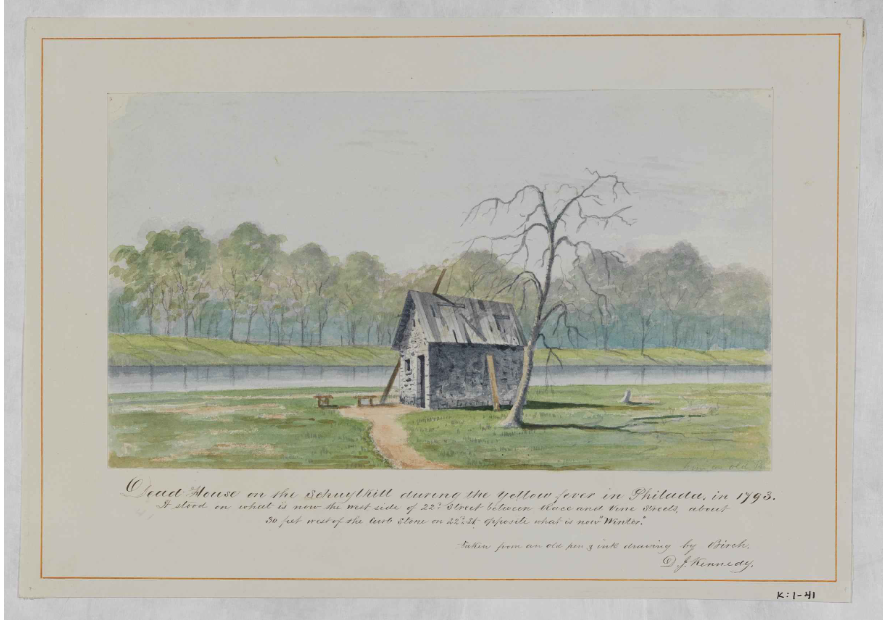
In late summer of 1793, approaching a full decade of independence, Philadelphia was the most populous city in the United States and was the temporary seat of the federal government. With about 50,000 residents (~ 94% White and ~ 6% Black), it was serving as the interim national capital under the Residence Act of 1790, which designated Philadelphia as the seat of government until the turn of the century when the new capital on the Potomac would be ready. President George Washington, Secretary of State Thomas Jefferson, Secretary of the Treasury Alexander Hamilton, and all of Congress operated from the streets of Philly.
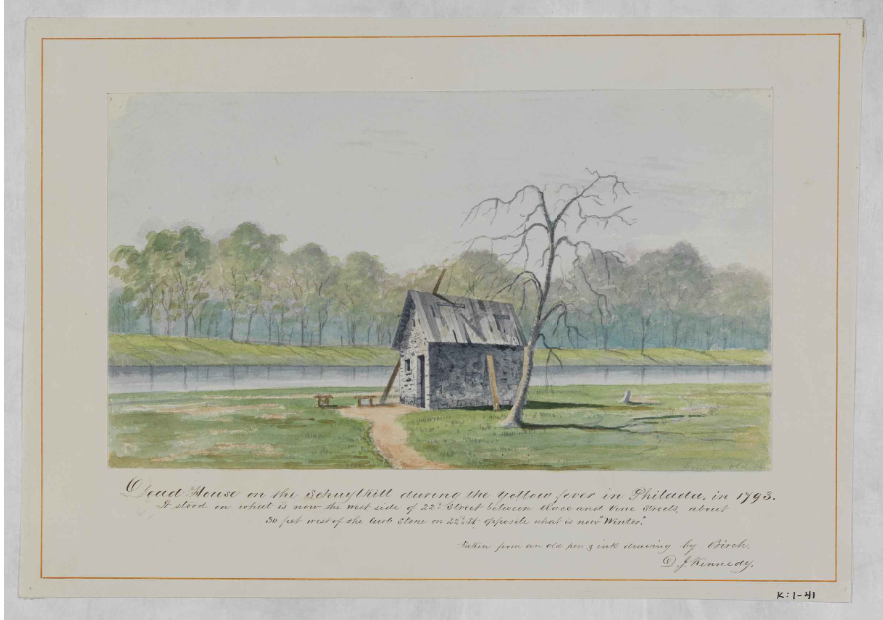
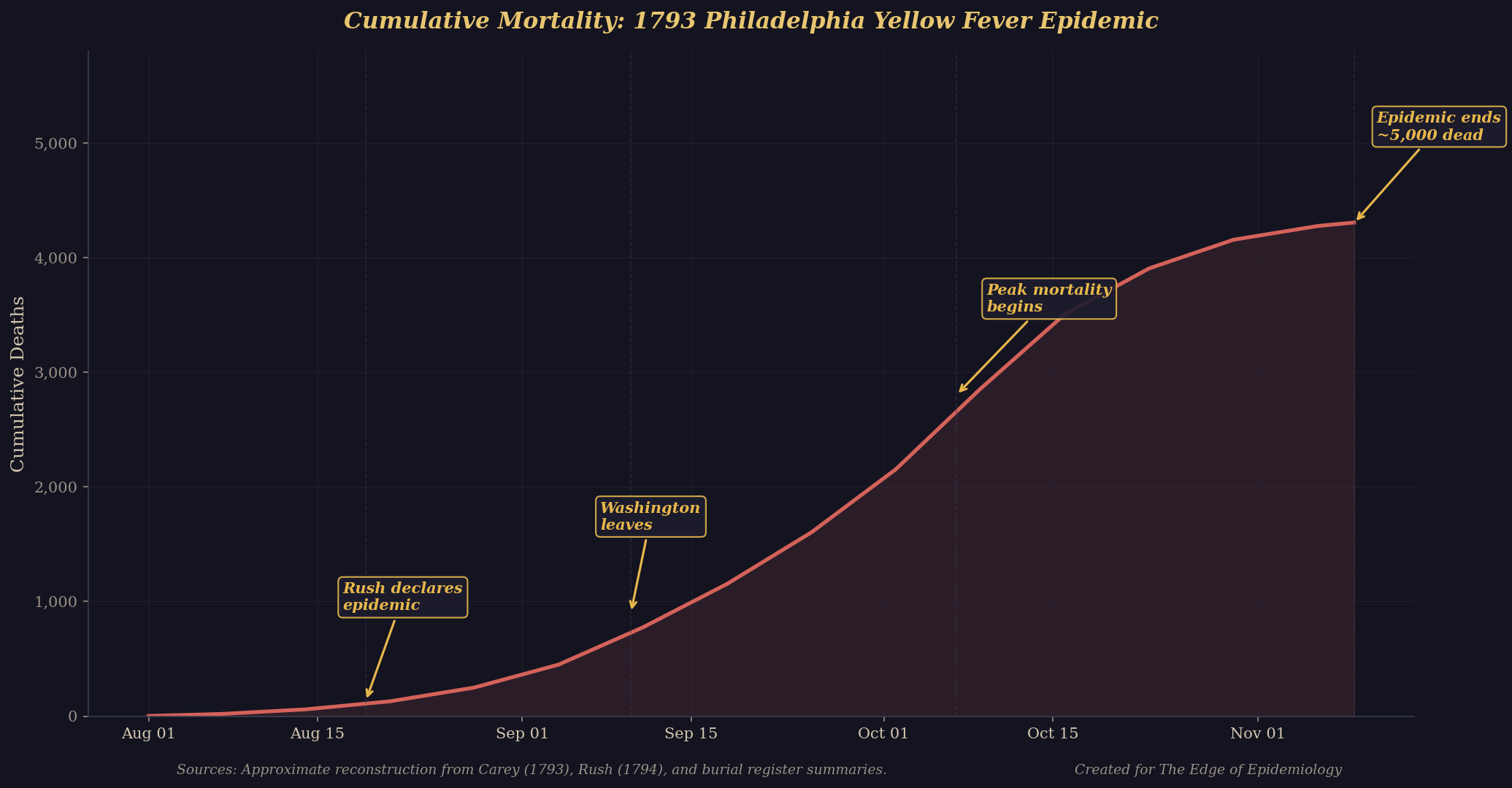
Between August 1 and November 9, 1793, a devastating yellow fever epidemic killed more than 5,000 Philadelphia residents with an estimated 20,000 fleeing the city by the end of September, including just about every member of the federal government. Irish-born publisher Mathew Carey was one of the few to remain in the city and document the catastrophe in real time, counting over four thousand deaths from burial registers while cautioning that these are likely incomplete (the official register had more than five thousand). The town was uniquely vulnerable to an epidemic, being home to the nation’s busiest port with docking facilities all along the Delaware River. It’s thought that stagnant water accumulated in Dock Creek (a Delaware River tributary that had been converted to an open sewer that ran through the city center) along with in the countless barrels, cisterns, and puddles that could develop on the outskirts of the low-lying coastal town. This, combined with an exceptionally hot and humid summer, made for ideal breeding habitat for the Aedes aegypti mosquito, the vector for yellow fever.
Beyond the mortality event it caused, the epidemic paralyzed the young government of a republic just four years old under the new Constitution. Within a month of the fever showing up in the area, the city, state, and federal governments basically stopped functioning. It forced the first true test of presidential power during a public health crisis and exposed the deep fractures already existing in the young nation, be they political, racial, or medical. Historian Martin Pernick argues the epidemic revealed a medical community that was “split along partisan political lines” with each faction having their own theory of contagion that tracked with their political alliances.
The Edge of Epidemiology is a reader-supported publication. To receive new posts and support my work, consider becoming a free or paid subscriber.
Arrival of the Epidemic
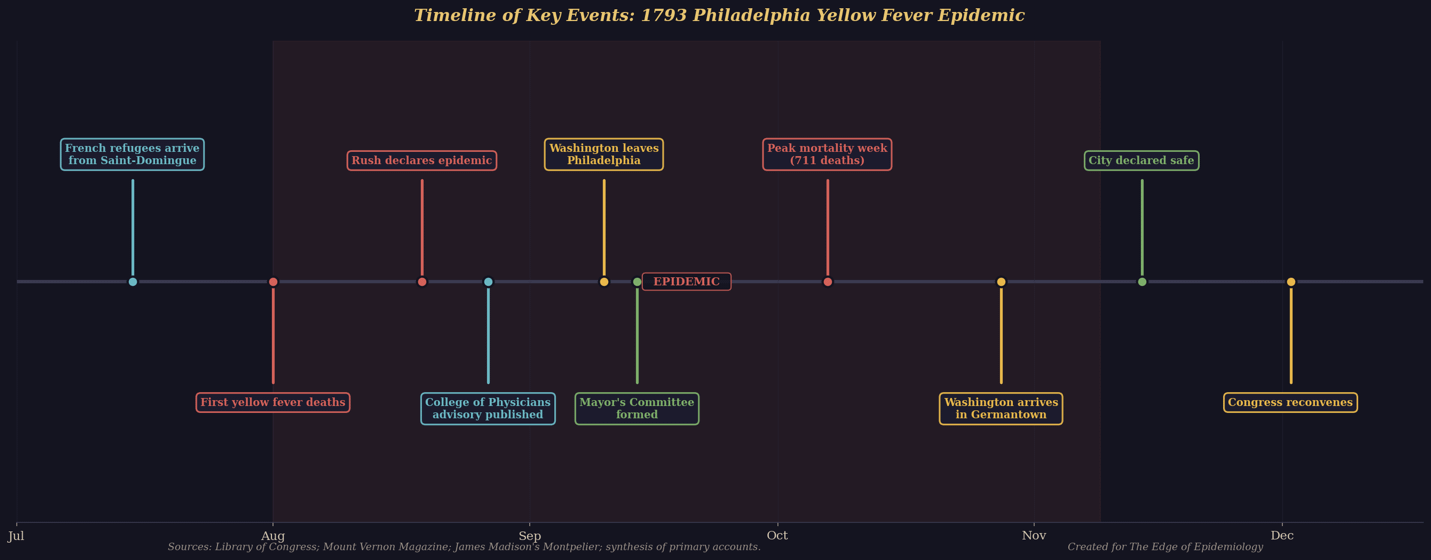
The epidemic is thought to trace back to spring of 1793, when about 2,000 French colonial refugees arrived in Philly from Saint-Domingue (modern-day Haiti), having fled the slave revolution that engulfed the north of the island. They arrived aboard ships long suspected of helping introduce both yellow fever and the mosquitoes that transmitted it. However, this may not have been the only introduction of yellow fever to the city. In his book Ship of Death, historian Billy Smith argues that a British merchant vessel called the Hankey had departed the West African island colony of Bolama that previous November and had been an additional starting point for the epidemic. The ship had tracked yellow fever to every port it came to in the Caribbean and up the eastern seaboard before finally reaching Philadelphia.
Whatever the route of introduction, the first recognized deaths from yellow fever in the city occurred in late July or early August 1793. The two initial fatalities were recent immigrants, one from Ireland and the other from Saint-Domingue, who died in their temporary lodgings near the port. The disease initially struck transients, immigrants, and the poor living along the waterfront, thus not immediately attracting the attention of the broader medical establishment. The clustering of early cases around Richard Denny’s lodging house on North Water Street and near the wharf at Arch Street pointed to the waterfront origin, although the mechanism of mosquito-based transmission was completely unknown to physicians at the time.
Among those drawn into the unfolding crisis was Dr. Benjamin Rush, the most prominent physician in Philadelphia at the time, signer of the Declaration of Independence, and a former apprentice during the previous yellow fever outbreak in 1762 while still under British rule. On August 5th he was called to the home of Dr. Hugh Hodge on Water Street where Hodge’s young daughter was jaundiced, running a fever, and vomiting blood, later dying that same day. He was also called to the home of one Mrs. Peter LeMaigre on the same street near Ball’s Wharf on the river. By August 19th he was convinced the city faced an epidemic of what he called “bilious remitting yellow fever”. He publicly warned that it was “highly contagious, as well as mortal”, but was immediately ridiculed as an alarmist. Despite the ridicule, he persisted, alerting the Mayor Matthew Clarkson and Governor Thomas Mifflin.
Governor Mifflin responded by directing port physician Dr. James Hutchinson to assess the conditions near the Arch Street wharf. He found that 67 of the roughly 400 residents in the area were sick, with only 12 having “malignant fevers.” The numbers would get much worse before they got better. On August 25th, Rush and his colleagues published an advisory in the city papers via the College of Physicians of Philadelphia where they outlined 11 measures to prevent the “progress” of the fever. It warned citizens to avoid contact with the sick, fatigue, and the hot sun, as well as suggesting the use of “vinegar and camphor in infected rooms.” City officials were urged to stop tolling the church bells for the dead, to make burials private, and to clean the streets. Some tried stopping the epidemic by lighting bonfires and firing their guns into the air, both of which ended up being forbidden by the mayor.
The Fever Spreads
The epidemic proceeded to follow a brutal trajectory, as between August 1st and September 7th, a total 456 people died in the city. 42 alone died on September 8th, signaling an acceleration in the spread. Dr. Hutchinson himself died of yellow fever on the 7th. Thomas Jefferson, who remained in the city longer than most other officials, tracked the escalation with a morbid curiosity and precision, writing to James Madison in early September, noting “The week before last about 3 a day died. This last week about 11 a day have died; consequently from known data about 33 a day are taken, and there are about 330 patients under it.” The daily death toll stayed above 30 through October 26th with the deadliest week being October 7th to 13th, when 711 deaths would be recorded. This was a sharply escalating urban mortality event that would peak before a winter frost would interrupt transmission. By the second week of September Rush had estimated “not less than 6,000 persons” were simultaneously sick with fever.
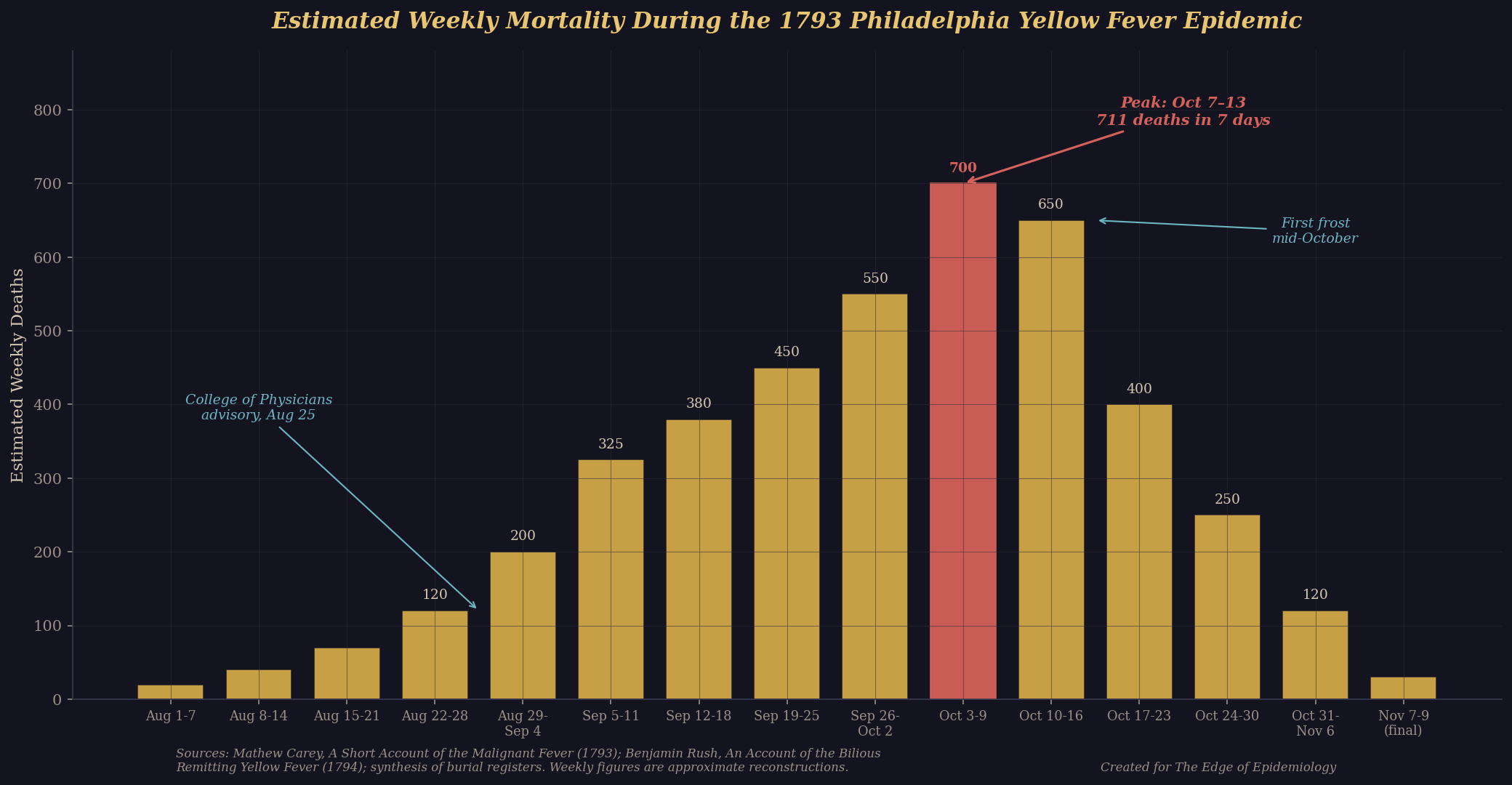
The case fatality rate of the epidemic was devastating. Bush Hill, the emergency fever hospital established outside the city, had something like half of their patients die. The disease’s clinical course was described by physicians at the time, with Rush documenting initial symptoms of headache, fever, nausea, and chills, often accompanied by “redness or faint yellowness in the eyes” and “dull or shooting pains about the region of the liver.” The telltale sign of a terminal case was black vomit, coming from digested blood from a gastrointestinal hemorrhage. Carey recorded that most died between the 5th and 8th day after symptom onset. The hardest hit were the poor who couldn’t afford to flee the city. A census conducted by the Mayor’s Committee found that the majority of victims were poor people dying in homes in alleys.
Flight from the Capital
The mass exodus of citizens from Philadelphia was one of the defining features of the first American epidemic. By the end of September some twenty-thousand people, roughly 40% of the town’s population, had fled. Those numbers included just about everyone in the federal and state government as well. George and Martha Washington had departed on September 10th for their home at Mount Vernon. He wrote his secretary Tobias Lear on the 25th, noting he wished to stay longer but Martha refused to risk staying in an infected city,; “I could not think of hazarding her and the Children any longer by my continuance in the City and arrived at [Mount Vernon] the 14th”. Before departing, they offered Samuel Powel, speaker of the Pennsylvania State Senate, and his wife to accompany them to Mount Vernon. Powel decided against that, eventually contracting yellow fever and dying September 29th.
Thomas Jefferson, as noted earlier, had stayed longer than most, leaving Philadelphia for Monticello sometime in mid-September. Writing to Thomas Mann Randolph explaining the possibility of famine combined with epidemic, he noted that “everybody who can is flying from the city, and the country people, being afraid to come to the market, there is fear of a want of supplies.” Treasury Secretary Alexander Hamilton and his wife Elizabeth would not escape the city in time, catching yellow fever early in September. They would be treated by Dr. Edward Stevens, Hamilton’s brother via adoption, who prescribed a regimen of cold baths, rest, and Peruvian bark (a source of quinine). This was a much gentler approach to treatment than Rush’s “heroic medicine” methods that entailed extreme bloodletting.
Congress had been in recess since August and was scheduled to reconvene in the fall, but the epidemic made a return to Philadelphia unimaginable. This triggered a constitutional debate, as in mid-October Washington wrote to Jefferson and Madison asking if he had the authority to convene Congress elsewhere. They concluded the President did not have that authority, with Jefferson taking an incredibly literal view that Congress had to meet in Philadelphia be it “in the open fields.” In the end the situation would resolve itself, as a November cold front would kill off the mosquitos causing the epidemic to subside. Congress then reconvened in Congress Hall on December 2nd.
Political Parties and Pestilence
The epidemic of 1793 ended up being the battleground for one of the most consequential medical debates to be had in the early republic, with the controversy being inextricable from the political divisions that were already fracturing the young nation. Martin Pernick and others like Simon Finger argue the epidemic landed in Philadelphia at the exact moment that America’s first party system was coming together, and ended up accelerating and deepening those divisions. Yellow fever had made it so theories of disease became proxies for arguments about commerce, immigration, urban life, and the future directions the republic would go in. By summer of 1793 the partisan conflict was already simmering, with Hamilton and Jefferson being locked in a public war of words through the newspapers, foreign affairs being inflamed by the French Revolution, and Philadelphia had become a symbolic battleground over what kind of nation the United States ought to become. Bring a highly deadly disease of unknown origin with disputed cures into that kind of situation (especially without adequate medical science) and you get political ideology rushing in to fill the vacuum.
The heart of the debate came down to a question of origin. Contagion theorists argued yellow fever was brought to the city by infected people and goods arriving from the Caribbean. That fit neatly within Federalist priorities, of protecting commercial reputation, justifying quarantine, further regulation of the ports, and possibly most importantly, casting suspicion on the French refugees who arrived with the epidemic. To the Federalists, an imported disease would better protect Philadelphia’s honor and reinforce it as a safe town, with danger only arising from the outside. Their opponents were the miasma theorists, who advocated a local origin whereby the disease came from stagnant docks and decaying organic waste. Dr. Rush would be the most ardent supporter of this position. As a Jeffersonian and Republican, the localist argument aligned better with the broader critique of centralized commercial power and moral decay in the city. Disease was generated by human neglect, environmental mismanagement, and civic failure on a broad level.
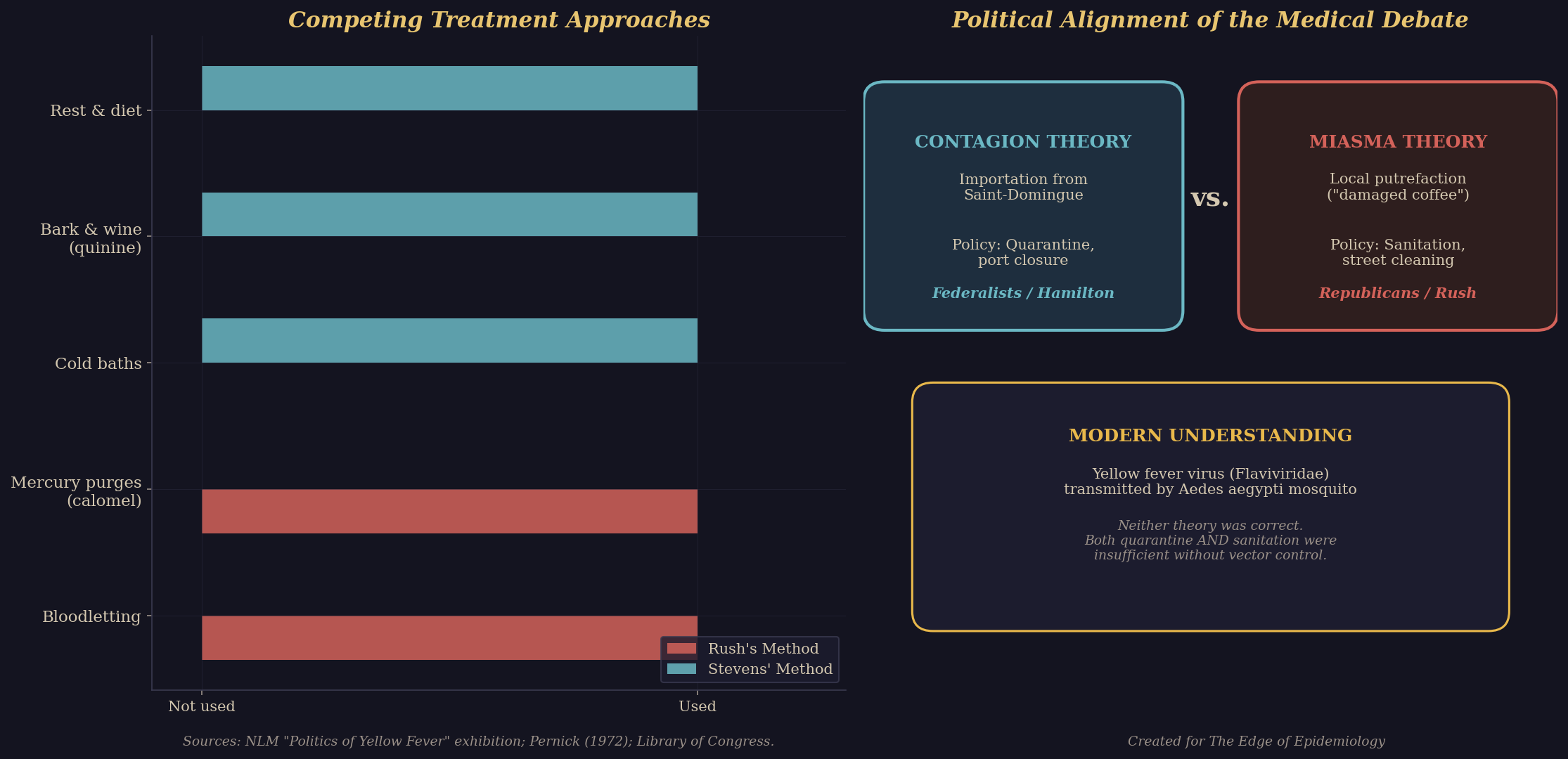
This medical split often tracked closely along party lines, with Republican physicians overwhelmingly supporting the domestic origins and the Federalists and less politically committed doctors leaning toward an imported epidemic. Each explanation carried political implications, with imported disease resulting in quarantine, trade restrictions, and immigration control and local disease ending up causing more sanitation and infrastructure reform, along with trying to understand what else would need to change in urban life. These rival explanations for the start of the epidemic forced Philadelphia’s residents to ask a somewhat difficult question, that being “what kind of place is Philadelphia?” Was it a healthy republican city that was just temporarily impacted by a foreign contaminant or was it a morally and physically corrupted metropolis with rapid growth coming with hidden costs? Federalists would wince at the thought of the latter being true, while Republicans (as more skeptical of larger cities and the concentration of power they came with) were more likely to entertain that thought.
The disagreements would spill over rapidly from the medical pamphlets into newspapers, sermons, and political correspondences. Editors began framing medical claims as political acts or positions. Treatment regimens would compound the divide, with Rush’s aggressive regimen of bloodletting and purging becoming associated with Republicanism. He framed his method as more accessible, democratic, and hostile to the medical elitism he saw around him, even training free Black assistants and publishing some simplified instructions in newspapers. The more moderate treatments mentioned earlier from the likes of Dr. Stevens and Dr. Devèze would be deemed the Federalist cure, especially after Alexander Hamilton credited the methods with saving his own life.
Just as divisive was the question of flight vs duty, as tens of thousands fled the town, including most of the federal officials. This reinforced the sense that the government had wavered in the face of pestilence. Those who stayed tended to be physicians, civic volunteers, and members of relief committees. They would later be celebrated, criticized, or politicized depending on one’s party affiliation. Republicans dominated the Committee of Public Safety that basically ran the city during the worst points of the epidemic, and they were eager to translate that moral authority into political capital. In return, the Federalists would accuse them of profiteering, authoritarian overreach, and grandstanding. But any heroism of the time was not rewarded. Pernick notes that gratitude is a fragile foundation to build a political party on, with many who returned to the city wishing to forget the whole ordeal as opposed to reliving it through political activism and recrimination.
Social Impact and Institutional Legacy
The 1793 epidemic forced the early American republic to confront the meaning of responsibility, citizenship, and state power under the conditions of mass death. More than 5,000 residents of the capital, roughly one in ten, died in just over three months. However, contemporary observers like Mathew Carey and Benjamin Rush relied on incomplete burial registers, struggling to quantify the devastation they were living through. Modern historical reconstructions confirm their instincts though, with mortality having been incredibly high, unevenly distributed, and imperfectly recorded. The poor died in disproportionate numbers, having been unable to flee to the countryside. Physicians suffered incredible losses, with very few escaping the illness and many dying. Every day customs of trust and familiarity collapsed, with handshakes vanishing, churches closing, or people avoiding each other on the streets becoming increasingly common.
None were more grievously affected and maligned by this breakdown in society than the Black Philadelphians. Long subject to discrimination, they were recruited into the epidemic response by the likes of Dr. Rush under the dangerously false belief that they were immune to yellow fever. They ended up nursing the sick, burying the dead, and performing medical services that had been abandoned by many of the fleeing whites, only to later be accused of profiteering and other crimes. Carey’s widely read pamphlet amplified those charges for years. Absalom Jones and Richard Allen answered with A Narrative of the Proceedings of the Black People a direct rebuttal to Carey’s charges. Published in the wake of the epidemic, it rebutted his allegations, documented the labor performed, money lost, lives risked and lost, and did so under a federal copyright in a nation that denied them citizenship. Carey would publish his fourth edition nine days after A Narrative was published, weakly walking back his accusations against the Black population who stayed and helped, noting “The extortion here mentioned, was very far from being confined to the negroes: many of the white nurses behaved with equal rapacity.”
Out of 1793’s chaos came some good changes for public health. The Philadelphia Board of Health arose a year later, created in response to the failures of the year prior. Following three successive outbreaks before the turn of the century, they built Lazaretto quarantine station downstream. From 1801-1895 every ship entering the port in the warm months was required to stop there and drop off sick passengers or crew. It’s now the oldest standing quarantine-related structure in the United States.
But the epidemic also resulted in some of the first fractures along partisan lines in health and medicine, and those divisions proved more enduring than the fever itself. In 1793, Americans learned that while disease could paralyze a city and scatter a government, those facts would be interpreted, argued over, and weaponized through competing political worldviews. Federalists and Republicans drew opposing lessons from the same catastrophe, turning uncertainty into ideology and medical disagreement into political identity. That habit of encountering collective danger not as a shared problem to be solved, but as a contest over blame, authority, and meaning would recur throughout American history. Yellow fever was the first epidemic that taught Americans how to live in a crisis without consensus, a lesson whose repercussions would long outlast Philadelphia’s sickly summer.
The Edge of Epidemiology is a reader-supported publication. To receive new posts and support my work, consider becoming a free or paid subscriber.