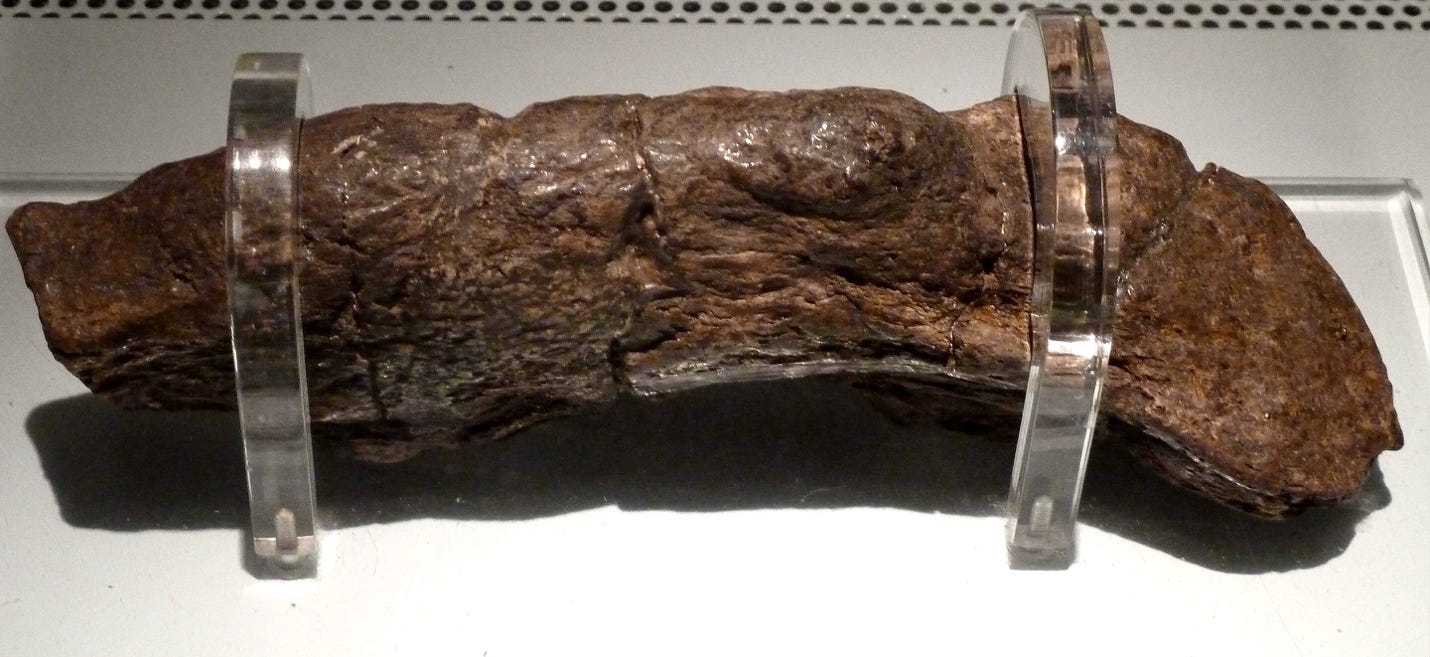
When construction first broke ground for the Lloyds Bank building in York in 1972, within a moist layer of peat was something each of the crew would have seen countless times before, although never one like this. What they found, intact and completely unmistakable, was a single, perfectly preserved human stool roughly the size of an iPhone (although slightly longer and less wide, at 20x5 cm; pictured above). That’s when the archeologists were called in to examine the finding. To their surprise, and likely their amusement, the lump of 9th century waste would become one of the crown jewels in Viking archeology, giving us a gut-level record of diet, disease, and daily life. Some 1200 years ago a Viking squatted down and left us, from what I can tell, what is still the largest known human coprolite. Now it’s on display at the Jorvik Viking Center, in what is likely one of the least glamorous museum spotlights imaginable.
Fossilized feces like this are known as coprolites and they form when organic matter is quickly buried in oxygen-poor areas resulting in a gradual replacement by minerals, just like the peat layer the Lloyds Bank sample was found in. Scientists looked under the microscope and found hundreds of whipworm and roundworm eggs as well as plant remains (mostly cereals) and fatty meat fibers. This suggested a diet heavy in grains (likely porridge or some equivalent) and animal proteins. It also shouts “malnutrition” and “poor sanitation” in today’s terms, as the parasites likely thrived in latrines that drained into the same soil used for growing food. The fantastic condition of the turd owes itself to the peat layer it was stuck in. Bones tell us who people were. The tools they made tell us a bit about daily life. Coprolites, especially more recently made ones, can tell us exactly what passed through these individuals (although resolution decreases time goes backwards).
Preservation of coprolites is not uncommon, so they appear across the fossil record, from Neanderthal caves to the floodplains stalked by dinosaurs. Each one becomes a timestamp in the history of digestion and nutrition on earth. But not all coprolites are equal or as talkative as the Viking one from York. As I mentioned, as we get into older coprolites, we get less from them, but not nothing. Here’s a quick tour of what we can learn from the turds of the past.
The Edge of Epidemiology is a reader-supported publication. To receive new posts and support my work, consider becoming a free or paid subscriber.
The Timeline of Decay
The more we rewind through the millennia and eras of the Earth, the more layers of information get peeled away from these fossils. If we could reverse time, we’d watch them lose their smell, color, chemistry, and DNA until all that remains is mineralized turd.
The youngest samples are filled with biochemical information in the form of DNA, lipids, sterols, and even some microbial fragments when they end up in anaerobic environments. We get confirmation of human or specific animal identifies via biomarkers like coprostanol and host DNA. We see examples from Neolithic settlements in Britain from about 4500 years ago, very close to Stonehenge. More than a quarter of these contained helminth parasite eggs, 1 had fish tapeworm, and four had nematodes. Eggs like these can be seen even in dinosaur coprolites, as I mentioned in my previous post The Oldest Diseases We Know. At this age we get incredible detail about individual level diet, health, and even some bits of the ancient microbiomes of these people.
But the further back we go the more things get messy. DNA begins to fragment, fats oxidize, proteins unravel, and what we’re left with are microscopic structures at best. These end up being things like pollen traces, bone shards, and hair. Before there was a litany of evidence against the Clovis First hypothesis of the peopling of the Americas in the form of artifacts or the White Sands footprints (found in 2009), coprolites were discovered in the Paisley Caves complex that dated to 14,400 years ago. But these early claims set off one of archaeology’s more intense scatological debates. The first DNA-based identifications turned out to be a mess of canid contamination and leaching. More recent sterol and bile acid tests confirmed that at least three coprolites were genuinely human and date to around 13,200–13,500 years ago, possibly just before Clovis, but not by much.
As we rewind further, even those microscopic traces start to go away. DNA is long gone and the lipids fade away. What we’re left with are the indigestible fragments that resisted both digestion and time. These can be bone fragments, plant fibers, and bits of a shell from a mollusk which stay locked in their mineral cast, reaching their final stage of preservation. It’s from these stony residues that paleontologists can still reconstruct the feeding behavior of creatures that vanished tens of millions of years ago. Late Cretaceous coprolites from India contain the silica bodies of ancient grasses, proving that grasslands were already spreading while dinosaurs still reigned. Another from Saskatchewan, nearly the length of a forearm, carries splintered bone throughout its matrix, evidence that Tyrannosaurus rex not only hunted but crunched through carcasses wholesale.
If the Viking coprolite from York tells us about a single day in one person’s life, these ancient ones tell us about the state of entire ecosystems. Coprolites chart one of the most universal acts in biology, eating and excreting, across the full history of life, a record written not in ink or bone but in the ghosts of meals.
What We’ve Learned from Ancient Poop
Once scientists stopped laughing long enough to look through a microscope, coprolites turned out to be a cheat sheet for evolution. They’ve confirmed who ate whom, who carried which parasites, and how ecosystems stitched themselves together long before written history. What was once thrown away has become a better historian than most bones. And from these fossils, researchers have reconstructed vanished food webs with near-criminal precision. The droppings of New Zealand’s moa revealed forests that no longer exist, packed with pollen and seeds from plants that depended on the birds to reproduce. In one stroke, their extinction explained a cascade of botanical disappearances that no amount of carbon dating could have traced. Coprolites did what tree rings and teeth could not: they caught ecosystems in the act of falling apart.
Human history also runs through this digestive record. Ancient feces from caves in Spain showed Neanderthals were omnivores, not the steak-addled caricatures of old textbooks or your local carnivore-diet bro. Even the earliest farmers left their mark, filled with intestinal hitchhikers that mapped the dawn of agriculture and sanitation’s long losing streak. Coprolites quietly recorded the moment humans stopped wandering and started fouling their own water supply. Ecology gained a way to measure ancient biodiversity, archaeology got new tools to track migration and diet, and parasitology found out just how far back the field’s expertise applies. The coprolite has become a kind of Rosetta Stone for the living world, translating the language of decay into data.
For all their comic reputation, these fossils have revealed a continuous chain from Cretaceous floodplains to Viking latrines. Every layer of earth that holds one is proof that digestion, not intellect, is what truly connects us across time. The world has been eating, excreting, and recording itself for half a billion years. We’re just the first species to notice.
The Edge of Epidemiology is a reader-supported publication. To receive new posts and support my work, consider becoming a free or paid subscriber.