Staten Island, September 1858.
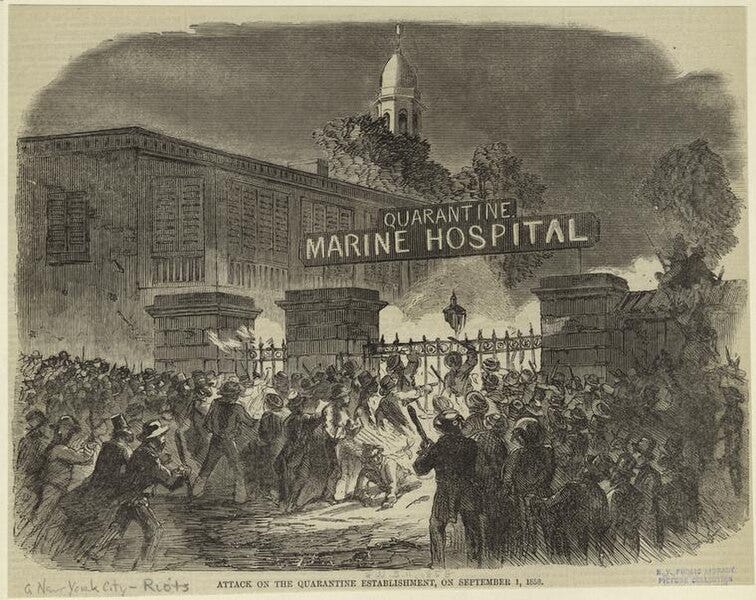
The air on the island was heavy from the salty breeze, usual for Staten Island in the late summer with the harbor rot and swampy air. Just after dusk, men with torches crept toward the walls of the New York Marine Hospital, a sprawling brick compound referred to by locals as the Quarantine. Behind those walls lay a few dozen patients recovering (or not) from yellow fever and cholera. To the crowd gathering outside these patients were threats, incubators who might contaminate the entire island.
By midnight, the mob had decided to solve the problem with fire. “The hospitals, barns, doctors’ residences, outhouses, and kitchens were burned; even the carriage house, coalhouse, and dissecting room were destroyed,” historian Kathryn Stephenson later wrote in her reconstruction of the event. Witnesses claimed men doused straw in camphene (a flammable industrial solvent) and dragged flaming bundles of hay from building to building. Flames reflected off the calm harbor as the smoke rose over New York Bay like a bad omen. By morning, most of the complex had been reduced to rubble. But “most” wouldn’t be enough for the mob. The next evening, the mob returned to “raze the remainder.” They had finished what they started, and the Quarantine was nothing but ashes.
At the time, the New York Times called the destruction “the most diabolical and savage procedure that has ever been perpetrated in any community professing to be governed by Christian influences”. But the locals felt different. They called it self-defense. For decades they’d been pleading with state officials to move the hospital farther from their homes. The facility treated sailors and immigrants infected on incoming ships. Every yellow-fever season there seemed to be new cases popping up around the grounds, and to Staten Islanders, that correlation was enough to claim causation. And that causation was a terrifying prospect.
Over the years that fear had been hardened into certainty. Stephenson notes “the primary complaint of Staten Island residents was that the Quarantine imported diseases into their communities, particularly yellow fever, which inspired intense fear”. Nearby property owners called it a “pest and nuisance.”
By sheer luck, nobody died in the blaze, although a few hospital workers were shot at and a dock-worker wounded. A community so frightened of disease had just destroyed one of the only defenses it had via civic immolation.
Now, its worth pointing out that yellow fever (AKA yellow jack) is transmitted via mosquitos. This wasn’t known until the early 1900s and in 1858 miasma theory still dominated. Bad air from decaying matter caused illness to these folks. Staten Island’s marshy shores and standing water were perfect for these vectors to breed. That’s to say, the Staten Islanders were mistaken in an understandable way. Disease probably did spread near the Quarantine, but not because of it.
The Edge of Epidemiology is a reader-supported publication. To receive new posts and support my work, consider becoming a free or paid subscriber.
The Hospital that would Burn
To understand why Staten Islanders brought torches to a hospital, we need to rewind (or maybe recent public health events give you a decent idea why this happened). For nearly sixty years the New York Marine Hospital sat on Staten Island’s north shore where it treated sick sailors and newly arriving immigrants before allowing them into the city. It was founded in 1799, when people still believed disease came from filth, not vectors, and that the solution was to wall off the sick from the healthy and hope for the best.
The logic was very simple. Every ship arriving from the tropics was treated like a floating time bomb. One case of yellow fever on board could lead to half a year in quarantine for everyone aboard. To the healthy passengers and the merchants paying for their goods to rot in the bay, that was bad news. To the people living near the Quarantine, it was worse. They could see infected patients carried ashore, bleeding from the nose, jaundiced, and vomiting black bile, the classic “vomito negro” of yellow jack. The New York Times later described it as “a sight which the stoutest heart could not contemplate without a shudder”.
By the 1850s, Staten Island had changed from a remote buffer zone for contagious seamen to an area filling with homes, farms and hotels ready to cater to well-off New Yorkers looking for a bit of fresh air. The Quarantine was suddenly prime waterfront real estate. As a local historian described it “the well-prepared arsonists were led by men of property who wanted to remove an obstacle to development and investment”. Public health was in the way of some real estate magnates making a buck. Residents petitioned for years for the state to move the hospital. Albany agreed in principle but couldn’t decide on where to put it. One proposal, to be located in Sandy Hook, New Jersey, died a red-taped, bureaucratic death. The next site at Seguine’s Point on the southern tip of the island seemed perfect until the new buildings there mysteriously burned down as well in May of 1857. Someone clearly wanted Quarantine to be gone for good and not just relocated.
The Powder Keg
All patience had evaporated by late 1858. The Castleton Board of Health passed a resolution declaring the Marine Hospital “a pest and nuisance” pledging to “protect themselves by abating it.” They took the law into their own hands. In retrospect, the state had created the perfect feedback loop of panic. It had placed an isolation hospital within sight of middle-class homes, then refused to move it, then ignored petitions from people who genuinely feared for their lives. The epidemiology was wrong, but the sociology was inevitable: once a community loses trust in its health authorities, it starts inventing its own public-health policy. Staten Island’s was to burn the problem down.
The plan wasn’t exactly a secret. In the days before the blaze, Staten Island’s Board of Health had already met to debate “the abatement of the nuisance.” Arson was on the agenda. A crowd of several hundred gathered near the grounds on the night before, armed with a rabid sense of civic duty.
The superintendent of the Quarantine, Dr. Richard Thompson, sense what was coming. He sent word to city officials in Manhattan begging for police or militia support. None arrived. New York City had long wanted the hospital gone itself and the fury of the Staten Islanders served as a convenient accelerant. When the fires began, Thompson ordered the patients carried to the beach and away from the flames. One witness later recalled them lying on stretchers by the waterline, “shaking with fever and fright as the buildings burned behind them.”
By morning, the brick walls stood blackened and hollow. Inside, surgical instruments had warped from the heat and records were turned to ash. A handful of volunteers tried to salvage medical supplies, but most were stolen by the same crowd that set the blaze. The next night’s return was almost celebratory. Drums and church bells sounded. Residents came to “see the work completed,” as the New York Times put it. Every remaining structure, including the physician’s quarters and the dissecting room, was methodically torched.
Afterward, local leaders insisted that no crime had been committed. The state’s attorney general, stunned, filed charges against several men, but Judge Metcalf of Richmond County dismissed them. In his written opinion, he called the act “a measure of self-preservation” and declared that “no offence against the law has been made out.” The mob had, in effect, been legalized retroactively. Public health, already on fire, was now on trial. It lost.
The Times fumed that it was “mob law triumphant,” while the Herald and Tribune were more ambivalent. Editorials praised the courage of “our Staten Island citizens” for “removing a menace to their homes.” The same newspapers that had once decried yellow fever panic now printed its apology. As Stephenson dryly observed, “The people who burned the Quarantine saw themselves not as rioters but as reformers.”
What remained of the Marine Hospital was a smoldering lot fenced with charred timbers. Patients were relocated to temporary tents on Swinburne and Hoffman Islands, two artificial quarantine stations later built offshore to keep contagion, and public anger, at a safer distance. The state had learned its lesson: if you want to isolate disease, isolate it somewhere the neighbors can’t see.
Aftermath and Reflection
For a few years, the ruins of the Marine Hospital sat untouched, a black scar on the harbor. The state moved on, building its new isolation stations on artificial islands where no one could torch them again. Out of sight, out of mind, out of fire.
The Staten Island Quarantine War slipped into local legend, half cautionary tale, half civic origin story. Some called it proof of the island’s independence; others called it proof that panic is contagious. The truth, as usual, sits somewhere between pathology and politics. The residents who burned their hospital didn’t see themselves as villains. They saw themselves as homeowners defending their families from invisible death, having felt abandoned by officials who spoke the language of science but not of fear. That gap, the space between expertise and empathy, is where most epidemics metastasize. In 1858, that gap went up in flames. If you squint hard enough at any public health crisis since, you can still see the lingering smoke.
The Edge of Epidemiology is a reader-supported publication. To receive new posts and support my work, consider becoming a free or paid subscriber.