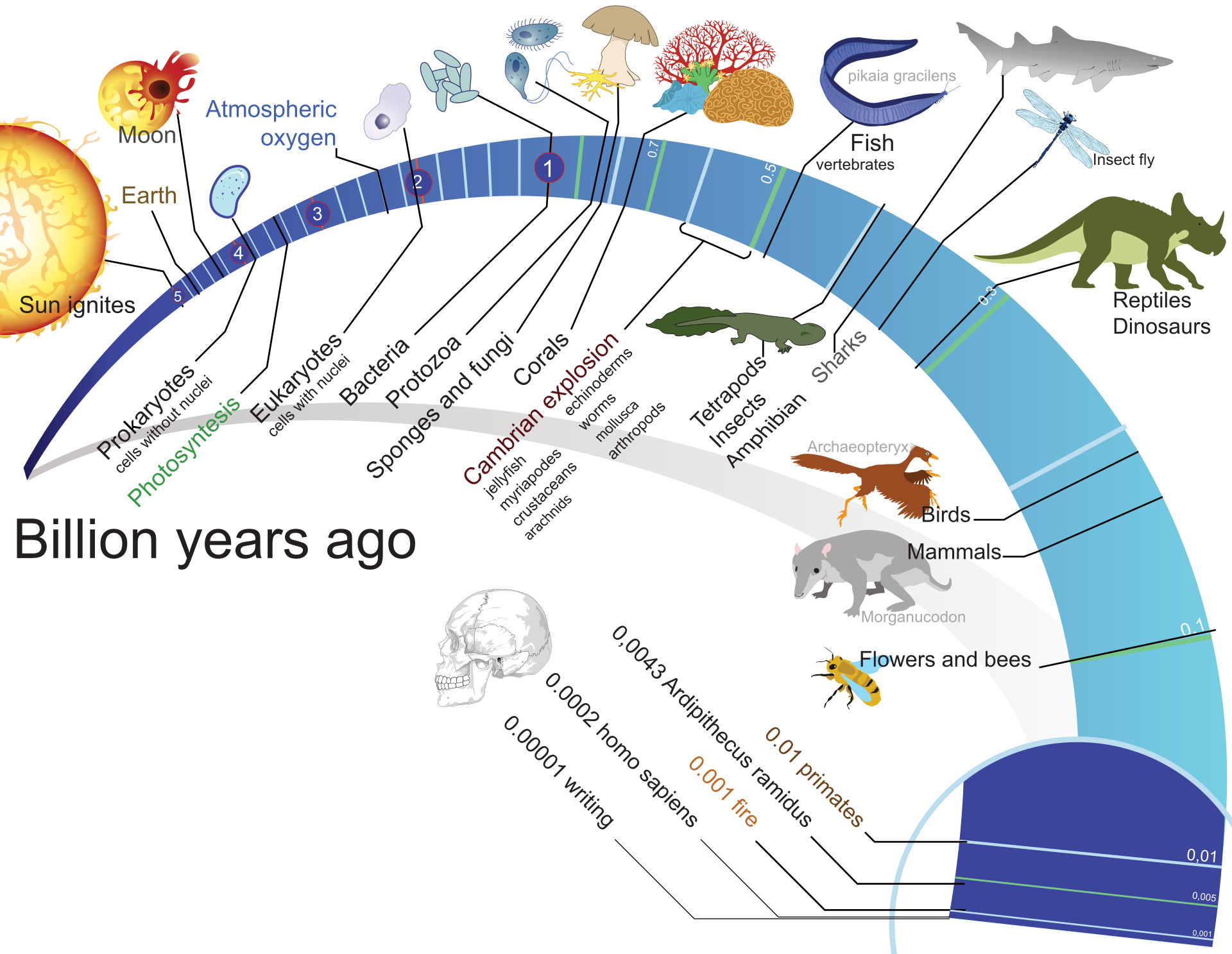
Recently I covered what are likely the most deadly diseases in all of human history. But that post got me thinking about another superlative. What are the oldest diseases we have evidence for? And what exactly is that evidence? Before the earth was covered in predators and prey with diseases that we’d recognize as such, before the dinosaurs or flowers of the land or shells of the sea, there was a primordial arms race between microbes. All we had was microbial warfare for 80% of life’s history on earth, because that’s all there was, microbes. For reference, life has been around for about 3.5 billion years with complex organisms only arising about 600-800 million years ago.
The Non-physical Stuff
We can’t carbon-date the first viruses precisely (as they don’t fossilize) but the fingerprints of this arms race are still visible. They come in the form of anti-viral systems evolved among bacterial species. The CRISPR-Cas system was an extremely early evolutionary pivot that implies some serious viral infection pressure was around well before Kingdom Animalia existed. The oldest viral “fossils” we’re able to see come in the form of endogenous viral elements in vertebrate genomes. These are confidently dated to be at least 400 million years old but some strong inferences of older viral origins push them back to likely older than 1 billion years based on how conserved some antiviral machinery is across bacterial species.
But once evolution introduced multicellularity, they faced a new threat in the form of cells that don’t cooperate with their brethren. This meant there was a new need for cell-cycle control to mitigate any types of cellular over-proliferation. Once organisms had evolved these multicellular structures the possibility of cancer logically existed. Sadly, we don’t have any fossilized tumors from these early multicellular beings, but given that tumor suppressor genes (like those in the p53 family) are also incredibly conserved across lineages, it’s likely multicellular organisms have been dealing with cancer or cancer-like growths for as long as they have existed. But like I said, these didn’t fossilize. Instead, the first cancers we can touch in the fossil record came much later. So we’ll start where the fossil record is the clearest, with the first cancers preserved in the fossil record.
The Edge of Epidemiology is a reader-supported publication. To receive new posts and support my work, consider becoming a free or paid subscriber.
Ancient Cancers
Once evolution had started building bodies out of multiple cells it had also created the possibility of some individual cells abandoning the overall body plan. That misbehavior came in the form of a refusal to stop dividing when everyone else does. We see hints of its evolutionary age in the previously mentioned genes that were tasked to keep that cellular ambition in check. Tumor-suppressor families like the p53 family are conserved across animals and even some much simpler organisms, implying that life has been battling these cellular rebels long before vertebrates had stepped foot on land. Thankfully the fossil record gives us something more concrete than molecular breadcrumb trails to follow. There, we get bones that still bear the mark of internal warfare.
The fossil record offered up an amphibian-like creature from about 245 million years ago that shows bone lesions consistent with malignant cancers. It shows irregular bone destruction, no sign of trauma, and a growth pattern that matches the same modern pathology seen in malignant bone cancers today. Paleo-oncologists diagnose these using the same radiology and histology techniques as are used in hospitals today, making this a much less speculative look than we have for any of the first cancers in multicellular life. We’ve also got evidence of a Cretaceous period dinosaur with osteosarcoma, confirmed through CT imagine and a cross-section analysis performed by paleontologists and orthopedic oncologists.
We don’t have the soft-tissue cancers things like ancient jellyfish or early worms may have had. Those definitely didn’t fossilize well enough. But by the time vertebrates were experimenting with limbs and lungs, cancer was already part of Earth’s biological landscape. Nothing about malignant cells is uniquely human (most people who’ve had an old dog or cat with a lump already know that), modern, or industrial in nature. Cancer is a byproduct of growth, repair, and increases in longevity. This is the toll we pay for being on a road paved by cells who continually take orders from one another. That’s why some scientists, like Athena Aktipis of The Cheating Cell (a fantastic book on cancer. Highly recommended along with The Emperor of All Maladies by Siddhartha Mukherjee), frame cancer as a breakdown in cooperation akin to a rebel forces within the multicellular collective.
Ancient Parasites
Parasitic organisms have probably existed for as long as life has had anything worth stealing. Broadly, a parasite can be seen as any organism that survives through the exploitation of another living being, often by living off of its nutrients, stealing its resources, or by hijacking the hosts cellular machinery. These don’t tend to fossilize well, as they’re soft-bodied freeloaders who rarely leave anything for us to study. So the record for these starts off pretty late compared to viruses or cancers. But where they do show up, they appear rather vividly in coprolites (fossilized poop), bones, and ancient arthropods.
The earliest clear evidence of a parasitic fossil comes from the Paleozoic era. Shark coprolites from 270 million years ago show evidence of tapeworm eggs, with one even possibly showing a developing larvae inside. More early evidence from roughly 230 million years ago can be seen in parasitic worm eggs that were found in vertebrate coprolites in Thailand. These were tiny, ovoid eggs with the classic look of helminth species. This bit of paleo-parasitology forced a strange visual into my head. Millions of years ago you could likely see distended bellies of young dinosaurs in the same way we do today in kids or puppies with high parasitic loads. Ancient life was just as burdened as life today in some ways.
We also see evidence of fungal parasitism documented in arthropods trapped in early Cretaceous era amber showing the complex host-parasite symbiotic relationships hundreds of millions of years ago. Parasites were likely much simpler organisms long before that, but these are the earliest confirmed evidence of “something was living inside of something else and was not paying rent.” So if cancer was rebellion from within, parasitic infection is occupation from without.
Ancient Bacterial Infections
Parasitism almost certainly predates animals, as microbes have been hijacking and exploiting each other long before anything had bones or flesh. But the fossilization process doesn’t give a damn what came first. It only preserves what can be fossilized. Parasite eggs show up later in the record because soft bodies and intestines vanish. Thankfully some bones do show the impacts of infection.
The oldest confirmed bacterial infection in a terrestrial vertebrate comes in the form of the jawbone of the reptilian Labidosaurus hamatus that’s roughly 275 million years old. The beast had cracked a tooth to the point of the pulp chamber opening which allowed a bacterial invasion. This resulted in the jaw developing chronic osteomyelitis, a bone-eating infection. CT scans show abscess cavities, bone erosion, and trapped tooth fragments completely entombed in inflamed bone. More of the same disease was found in the Upper Cretaceous site in Brazil called the Ibira locality in six sauropod specimens. In this case with evidence the infections had not healed fully, with the dinosaurs dying either from or with the infection.
Most Paleozoic era pathology is still invisible to us. Soft tissue rots too well, microbes don’t fossilize well enough, but bone survives. Thankfully, sometimes those bones give us some hints as to what might’ve happened before that. It’s there that we also find the first evidence of a probable respiratory disease entering the fossil record. A Triassic marine reptile was found to have tuberculosis-like bone lesions, in the form of patterns of granuloma-like damage in its ribs and vertebrae, which resembles a chronic bacterial infection.
In closing
If there’s a running theme in all this ancient suffering, it’s that disease is in no way an anomaly of modern life. Life has been negotiating with disease since the first cells figured out how to divide. It’s much older than bones, blood, or any creature we’d recognize. Viral sabotage is much older than any animal species. Cancer likely has existed in some form or another since multicellularity arose. Parasites were exploiting flesh long before mammals had gained their fur and mammary glands. Every fever, tumor, or infection ties us back to the creatures that lived and suffered long before there were names for anything I covered here. The first diseases happened billions of years before the first human story, but we’re still part of that same lineage of organisms trying to survive. Here we are, still in the game. I like to think we’re doing a damn good job.
The Edge of Epidemiology is a reader-supported publication. To receive new posts and support my work, consider becoming a free or paid subscriber.