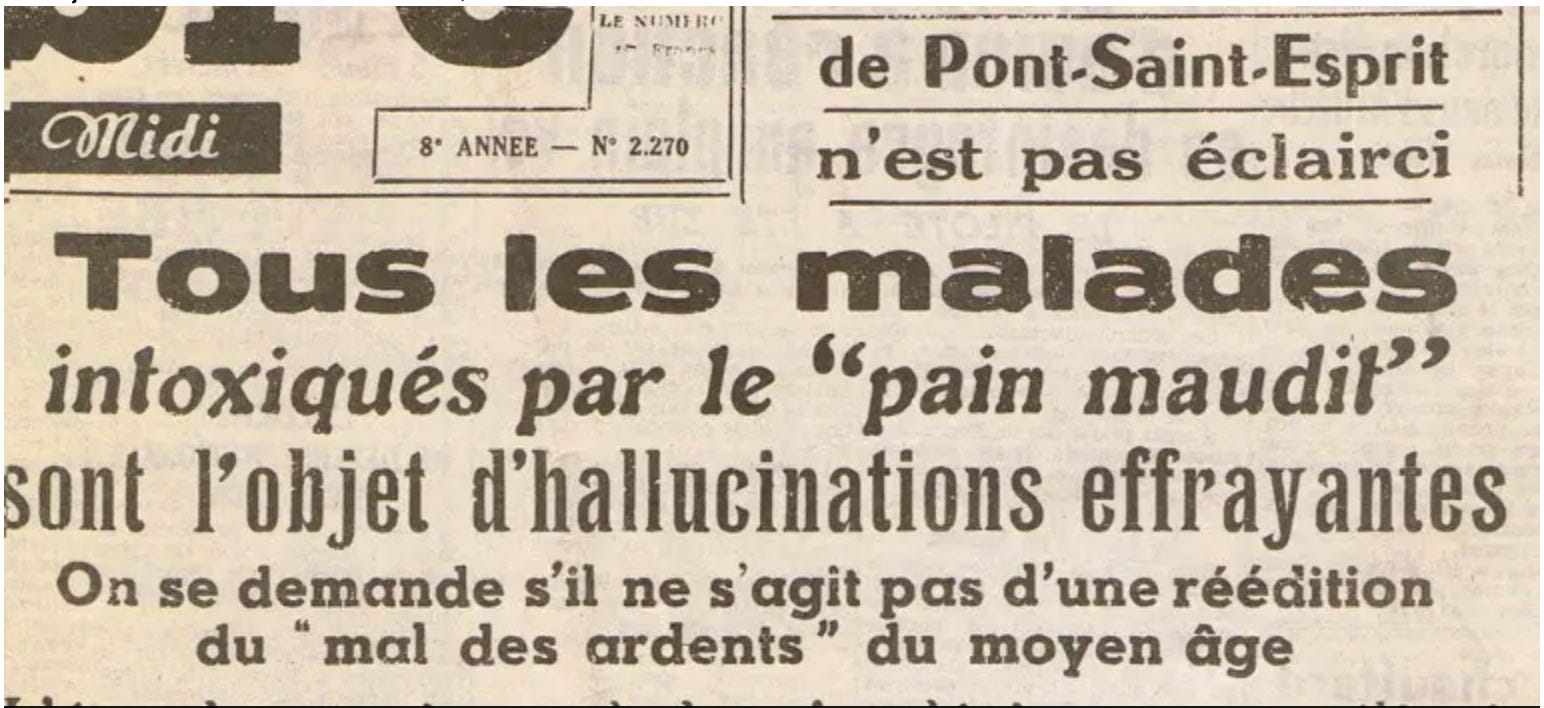
In August of 1951, something toxic ripped through the town of Pont-Saint-Esprit in southern France. Hundreds were poisoned, dozens were committed to psychiatric hospitals, and at least seven died. Witnesses and victims reported hallucinations of fire, animals, and voices from the grave. Some were euphoric, claiming love for all of the world! One man thought he could fly and jumped from a window. Across town a child reportedly tried to strangle his mother.
Everyone said the bread was to blame. But 70 years later, nobody can say with certainty what was in the bread. Ergot fungus? LSD planted by the CIA? An industrial bleaching agent? Contaminated grains? A mix of some of the above?
What unsettles me most about this case is the fact that every theory fails in some way or another, leaving an unsatisfying “we still don’t know” as the only reasonable option.
But here’s what we do know
- Hundreds were affected, at least 250.
- Most had eaten bread from the local Briand bakery
- Symptoms tended to follow the trajectory of nausea/vomiting within a day or two, followed by hallucinations, paranoia, violence, and delirium
- Some were institutionalized for months
- Animals died after eating leftover bread
- No single contaminant was confirmed
What happened should have been a classic epidemiological tracing of what happened. And it looked like it would be that simple for a while. An early British Medical Journal article by the town doctor pointed to ergot in the bread1. But later investigations ended up being a tangle of bad guesses and dead ends.
The Ergot Theory
The first explanation offered by the town doctor was backed up by the fact that ergot is a parasitic fungus that grows on rye and its ingestion produces some of the symptoms above. In the Middle Ages it caused outbreaks of “St. Anthony’s Fire” in the form of convulsions, hallucinations, gangrene and death. A month later, a story ran in TIME under the headline “St. Anthony’s Fire”2. Ergot felt like the most obvious explanation and had historical precedents with similar cases. This became the publicly most well-known culprit of the poisoning.
But it doesn’t quite fit.
Not everyone who ate the contaminated bread got sick, they didn’t see gangrene, and the hallucinations appeared too late (often more than a day later)1,5. However, the gangrene aspect could be due to that appearing in ergotism caused by longer exposure. The historian Steven Kaplan who wrote the definitive book on the incident eventually dismissed the ergot theory, claiming it may have played a role but didn’t explain the full range of symptoms.
The Theory That Won’t Go Away
The next most common theory was much more conspiratorial, yet strangely plausible at first. The claim is that the CIA had poisoned the town with LSD as a test.
The idea didn’t come about until a few decades that passed, but it’s persisted this long because it taps into real, known experiments the CIA was conducting at the time. Investigative journalist Hank Albarelli published a book claiming the outbreak in southern France was part of a covert experiment under the name of MK-NAOMI (a cousin of MK-ULTRA). The claim was that the agency had either sprayed the town from above, or contaminated the flour supply with LSD.
The evidence boils down to a few declassified documents that tie Pont-Saint-Esprit to Frank Olson, a US Army biochemist who died under suspicious circumstances in 1953 after being dosed with LSD a week earlier. Albarelli also cites a conversation between a CIA official and a pharmaceutical rep for Sandoz, in which the latter reportedly says the chemical in the poisoning wasn’t ergot but “something of the diethylamide type”4.
The theory caught fire. It had everything you could ask for in a conspiracy theory. Real CIA programs, dead scientists, destroyed records, all surrounded by the fog of the Cold War. It also explained one thing the ergot theory struggled to, why the hallucinations were so intense.
But it didn’t fully fit either. Upon reading the theory I immediately knew one reason was that LSD typically has much quicker onsets than 24 hours. So, unless there was some delayed-response derivative of the drug, the idea doesn’t quite work.
The man who didn’t buy the conspiracy, but took his own leap of faith
Kaplan dismisses the CIA theory outright. In a 2012 interview he called it “clinically incoherent” and “harebrained”5.
His reasoning was that LSD takes a much quicker effect, doesn’t cause vomiting, fever, or convulsions, degrades under heat (so much for baking it), and he didn’t like the “choice” of the town for the CIA. It had been partially destroyed during WWII and, to him, made no sense as a test site.
These are all (mostly) fair points. But then Kaplan offers his own theory in the form of nitrogen trichloride, an illegal bleach used to whiten flour. The problem is that it’s not hallucinogenic. It can irritate the lungs and make you sick, maybe explaining the vomiting. But the most well-known of the symptoms are completely unexplained.
A Selective Standard of Rigor
It’s tempting to pick a favorite theory on an event or topic and treat the rest as fringe. But the truth here is that every explanation offered, whether it be ergot, LSD testing, fungicides, bleaching agents, or even mass psychogenic illness, has serious problems with the evidence. The big proponents of the CIA theory and dismissal of the ergot theory (Albarelli and Kaplan, respectively), apply very different standards of rigor for their own theory compared to others.
Take Kaplan for example. The French bread historian’s 2008 book Le Pain Maudit is regarded as the most serious investigation of the case. And for good reason. It’s apparently incredibly thorough (I’m relying on select quotes and interviews due to the book being in French and 1164 pages) going through the history of ergotism and bread in France. In it, he dismisses both the ergot and the CIA theory on both pharmacological and logistical grounds. This would be fair, as they both have their holes. But he puts forward the idea that nitrogen trichloride is a more plausible culprit. Critiquing claims as wild and unfounded while putting forward another theory that fits just as poorly, if not more so, seems premature at best. That interpretation fits with Kaplan’s own words in an interview with France 24, where he claimed no clear answer will become favored without evidence.
Albarelli on the other hand heavily champions the CIA theory in his 2005, twelve-hundred-page book A Terrible Mistake: The Murder of Frank Olson and the CIA’s Secret Cold War Experiments. But I’m uncertain how much to take his words at face value. He misinterprets the 1951 BMJ article by the town doctor as not supporting the ergot theory, while that is the only theory mentioned in the article. This made me question how reliable the book would be. Nonetheless, he claims CIA operatives were in France during the time of the outbreak, and that CIA affiliated scientists had been discussing the poisoning at a possible operation gone wrong (or right?).
Basically, in this case, two of the most prominent books on the subject apply a level of selective rigor to the other theories over doing their epistemic due diligence. Whether it be deliberate misquotation or forwarding a theory that makes just as big of a mistake as the one being dismissed, it suggests sloppiness at best and dishonesty at worse.
So what happened?
The truth is, we don’t know, and there hasn’t really been any more evidence coming forward that makes one theory more likely than the others. Ergotism (or a similar condition caused by an unidentified mycotoxin) and a reckless CIA project with some weird LSD derivatives seem like the more probable options. We know that bread storage in postwar France was awful. The same could be said of oversight of CIA chemical experiments and document keeping regarding them. The symptoms point in multiple directions, which suggests we may have the whole thing wrong and it’s a yet unidentified culprit.
Truthfully, what we know now may be all we’ll ever know. The town was poisoned and we’re left wondering if it was natural or nefarious.
The Edge of Epidemiology is a reader-supported publication. To receive new posts and support my work, consider becoming a free or paid subscriber.
Citations
1. Gabbai, Lisbonne, Pourquier. Ergot Poisoning at Pont St. Esprit. Br Med J. 1951;2(4732):650-651. doi:10.1136/bmj.2.4732.650
2. TIME. Medicine: St. Anthony’s Fire. TIME. September 10, 1951. Accessed July 4, 2025. https://time.com/archive/6617670/medicine-st-anthonys-fire/
3. H-France Review of Kaplan’s Le Pain Maudit. Accessed July 4, 2025. https://www.h-france.net/vol9reviews/vol9no130claflin.pdf
4. A Terrible Mistake: The Muder of Frank Olson and the CIA’s Secret Cold War Experiments by H.P. Albarelli Jr.
5. Did the CIA poison a French town with LSD? France 24. March 11, 2010. Accessed July 4, 2025. https://www.france24.com/en/20100311-did-cia-poison-french-town-with-lsd