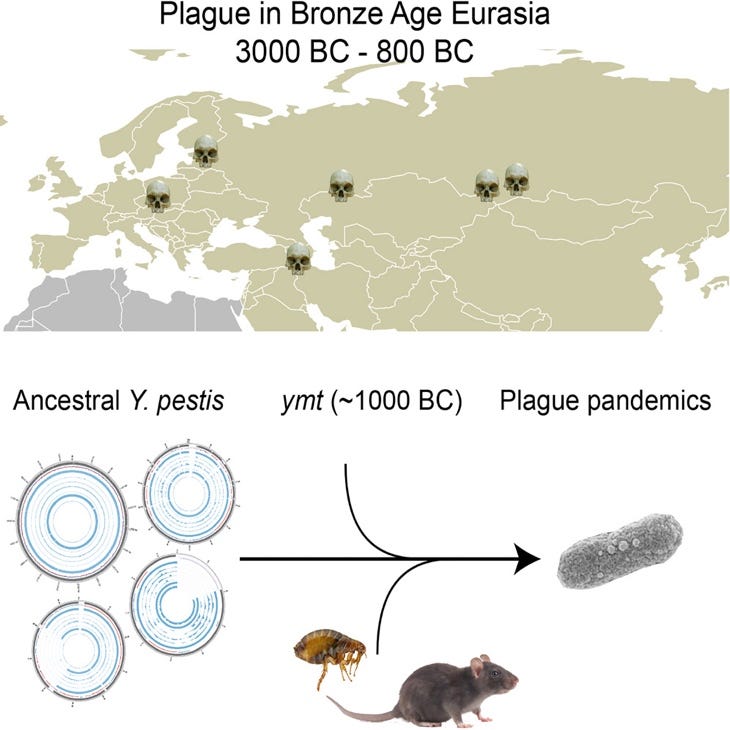
The study of ancient DNA has made the Yamnaya and other early pastoralist groups of the Eurasian steppe some of the better understood prehistoric populations out there. We know basically where they came from, how far they spread, and roughly how much of their ancestry persists in the areas they arrived in. There’s also some good evidence that these Late Neolithic Bronze Age steppe migrations were associated with infectious diseases, including the first evidence we have of Plague in Eurasia and evidence of immune adaptation. So, what we can gather about what the infectious disease burden of these expanding groups looked like as they expanded across the continent? Thankfully we have a beautiful case study to look at in Yersinia pestis, the bacteria responsible for The Black Death and the Plague of Justinian.
The last decade has seen an incredible amount of research shed light on the origins of the plague. The plague has been found in individuals from the Late Neolithic and Bronze Age (LNBA) from over 5000 years ago. It was incredibly widespread as well, ranging from the steppe in modern Russia and Ukraine all the way over to the British Isles and up into Scandinavia. This distribution overlaps with the known expansion zones of steppe cultures like the Yamnaya, Corded Ware, and Sintashta. A study of 17 plague genomes from across Eurasia showed that the LNBA lineage hung around for more than 2500 years and had minimal geographic restructuring, a pattern that is more consistent with rapid, long-distance migrations as opposed to slower local diffusion brought in via trade. The study also revealed two distinct lineages (LBNA+ and LBNA-) based on the presence of the gene required for survival in the gut of a flea and thus flea-transmitted bubonic plague. The LBNA+ variant has been found in genomes ranging from Bronze Age Iberia to the Volga River region in Russia. The flea-adapted plague had been spreading far and wide by at least 3800 years ago. Britain’s Y. pestis genomes from about 4000 years ago represent the earliest evidence we have for the plague in Europe’s most northwesterly region, arriving either after or with the Bell Beaker populations. This expansion was emboldened by the technological advancements of the time, like the spread of ox-drawn carts and wagons and horse domestication.
We don’t have an overall idea of how prevalent the disease was in the area, but a study of 108 individuals from graves dated to Neolithic Sweden and Denmark showed 18 (~17%) were infected with the plague at their time of death. This was a unique site, in that it showed three distinct infection events across a span of about 120 years, or six generations, at the site in Falbygden, Sweden. The infections also didn’t fit a single outbreak model with rapid spread, as multiple plague strains were seen in multiple generations, and the genomic rearrangements in the higher virulence-associated regions, suggested local evolution within the community. This type of pattern is more consistent with repeated spillover events from an external reservoir or some form of chronic, low-level prevalence and circulation in the community.
Until recently all of the LNBA plague genomes we had were recovered from human remains, leaving the zoonotic reservoir undetermined. A major breakthrough came in early 2025 when researchers published a Y. pestis genome from a roughly 4000-year-old domesticated sheep from a Sintashta site in the southern Urals. The genome belonged to the LNBA- lineage and was closely related to the human infections of the time. This is suggestive of some sort of transmission model going from an unidentified wild reservoir to humans via their domesticated sheep, through contact with infected blood, meat, or working with hides. It should be noted that there is technically no direct proof that these particular steppe groups were the actual source of the plague as opposed to another secondary group of victims. The oldest confirmed genome of Y. pestis found in Latvia dated to 5300 years ago slightly predates the Yamnaya and isn’t clearly associated with steppe ancestry; it’s therefore possible that it may have been endemic in European hunter-gatherers or early farmers. The evidence from the study of six generations of graves found in Sweden is also one reason to think there wasn’t a single introduction.
The Edge of Epidemiology is a reader-supported publication. To receive new posts and support my work, consider becoming a free or paid subscriber.
Immune Trade‑Offs of Steppe Ancestry
The longest lasting legacy of these diseases are written in the modern genome of those with steppe ancestry. Ancient DNA lets us see how immune systems adapted to the disease ecologies they entered. The same Bronze Age expansions that carried the plague across the continent also brought immune variants shaped by a constant exposure to their domesticated animals, their novel pathogens obtained from unidentified zoonotic reservoirs, and the repeated spillover events that came with their lifestyles. But in modern populations some of the immune alleles that may have once conferred some sort of resistance to a Bronze Age infection ended up as immunological liabilities, predisposing the carriers to the likes of autoimmune disorders like multiple sclerosis or leaving them less immunologically prepared to deal with other infectious diseases.
A study of over 1600 ancient genomes and 410,000 present day individuals showed that the genetic risk for multiple sclerosis is highly concentrated in steppe ancestry, with one gene originally observed in an Italian Neolithic farmer almost 6000 years ago and showing a dramatic increase in prevalence with the emergence of the Yamnaya, posing a 3x increased odds of MS, while Anatolian farmer and African ancestries were more protective against MS. The strong positive selection for these alleles was between 5000 and 2000 years ago, coinciding with the Bronze Age expansion of steppe pastoralists and their cultural influence into Europe. The result is supported by a north-south gradient of MS in Europe, mirroring the gradient of steppe ancestry with higher rates in the north and lower rates in the south. Researchers argue that some form of heightened immune response gave carriers advantages against the zoonotic pathogens that may have been transmitted to them from their horses, cattle, sheep, and goats. However, it should be noted that the same region (a Human Leukocyte Antigen region important for the immune system distinguishing self from non-self) made one more susceptible to leprosy in medieval Denmark.
Another immune variant that happens to increase the risk of severe tuberculosis in homozygotes originating in West Eurasians some 30k years ago was brought into Europe by both Anatolian Neolithic farmers and steppe herder groups, with an analysis of over 1000 genomes revealing fluctuations of prevalence over the past 10k years but with a more dramatic decrease starting around 2000 years ago. Researchers estimated homozygotes for the P1104A gene had a 20% relative reduction in fitness (number of kids who themselves have kids), an incredibly strong negative selection signal. The dramatic post-Bronze age decline suggests by then TB was a dominant force of selection in the more densely populated agricultural and early urban centers.
Broader patterns of immune adaptation were also discovered, with a study of over 2300 ancient and 503 modern genomes found more than 80% of the 89 genes under positive selection had this selection begin after the Bronze Age had already commenced. Immune related genes, particularly those with involvement in host-pathogen interactions, were disproportionately selected for. The type of selection seen suggests the post-Neolithic period was one of intense pathogen exposure being a force of natural selection in these groups. This selection acted primarily on critical immune cells like lymphocytes, monocytes, and neutrophils which is consistent with bacterial and viral agents (changes in granulocyte of eosinophil apparently would point to helminths. The things genetics can tell us will never cease to amaze me).
The steppe expansions of the Bronze Age were some of the largest epidemiological turning points Eurasia has ever gone through. Long-distance mobility, domesticated animals, novel environments, and collisions of peoples and their cultures made conditions ripe for pathogenic spread. Just like the ships in the age of exploration or airplanes today, the ox-drawn carts and horses allowed for swifter spread and trade than ever before. Plague just happened to be one of the pathogens that hitched a ride and ended up successful multiple times in the course of human history. All that to say, that while it is difficult to attribute specific disease introductions to specific human groups, as ancient DNA can only tell us what the context it is found in and researched within will allow it to, it’s safe to say the Bronze Age steppe pastoralist cultures were embedded in and contributed to an epidemiological network driven by long-distance dispersals of peoples, their livestock, and their microbes, and the evolutionary emergence of a pathogen that would haunt the region for millennia.
The Edge of Epidemiology is a reader-supported publication. To receive new posts and support my work, consider becoming a free or paid subscriber.