In 541 CE the Eastern Roman Empire was in a period of revival. They were stitching back together the long divided Mediterranean region. North Africa had already been retaken from the Vandals and Italy was back in the hands of the Byzantines as their troops were pressing east against the Persians. At the helm was the Emperor Justinian; a tireless, ruthless leader who was convinced he’d been chosen to restore Roman greatness in the region.
Then the ships began arriving from Egypt and the Levant, unknowingly bringing death with their loads of grain. It started in Pelusium on the edge of the Nile river delta and from there, spread like wildfire, moving through Alexandria and the other major port cities before finally making its way to Constantinople. It spread fast, killing in droves and sparing only the luckiest few. This led to the capital of the empire grinding to a halt. Bodies were left in the streets as burial pits overflowed. Procopius claimed ten thousand had died in a single day with even the emperor falling ill.
While the empire had seen outbreaks in the past, this one was different in its disruptive capacity. Military campaigns completely stalled, trade routes went quiet, revenue from taxes tanked and cities shrank, and what began as a sudden catastrophe became a recurring feature of life, reappearing in wave after wave for over two hundred years. The empire survived but was permanently altered for the worse. A turning point had arrived in the form of rats, fleas, and a pathogen nobody could see.
The Pathogen Arrives
The first deaths occurred somewhere along the Egyptian coasts, where fishermen vanished while merchants got sick and never came back. In the eastern Nile delta town of Pelusium people started dying in waves. Alexandria was next, and with it, the arteries of commerce, as Egypt was a breadbasket for the empire, carrying ships of grain to every corner of the Mediterranean. When the plague hit the port there, it had all the room of the Med to spread and never looked back. Because of the speed it could travel along those routes there were no warnings or quarantines. The same routes that had knit the empire together through trade and commerce had swiftly become the transmission lines of a deadly pathogen. Palestine, Syria, and the Anatolian coast were next to be hit. Then the region of Cyprus and the Aegean. This was a pattern that followed the common trade practices at the time, coastal first, then inland through rivers and other trade routes.
Some blamed foul air or miasma arising from the Nile for the outbreak while others pointed to eclipses, comets, or divine wrath to comprehend what was happening around them. In a world with no understanding of microbiology, plague was often seen as a theological problem as well as a medical one. As we now know, the real culprit had hitched a ride into town aboard flea-infested rats. By the time the imperial court realized what was happening, it was already inside the walls. Constantinople had been hit and no one knew how to stop the disease from spreading.
“When plague swept through the city, no one could escape… Physicians were as helpless as the priests.” Procopius was no stranger to exaggeration, but his panic feels grounded. The empire’s capital, administrative core, and symbolic heart had essentially become a morgue.
Symptoms
While Yersinia pestis was responsible for the Justinian plague, it wasn’t limited to a single, well-known presentation in the way later outbreaks such as the Black Death would, so there was little-to-no consistency for physicians at the time to work with. The symptomology was seemingly so varied that it would have been likely been difficult to see the pattern even for modern day doctors without some sort of test. For instance, some victims woke up with a headache and were dead by sundown, others just collapsed suddenly, while further others developed the telltale painful swellings in the form of lumps in the groin, neck, or armpits. These buboes could grow to the size of an apple, were hot to the touch, and filled with puss that had an unbearable stench when they burst.
Unlike most illnesses of the time, it didn’t discriminate by age or class. Young and old, slave and aristocrat, alike were all reduced to the same terror. The speed at which this was happening was what made it so horrifying, as people would speak to a friend one day only to learn the next day that they’d died. Procopius described it in chilling terms.
“In some the plague began with a deep coma, in others a violent delirium… many had both. Some were covered with black pustules shortly before death while others had no symptoms at all but tied suddenly. Tumors swelled in the groin, armpit, or beside the ears… growing large, inflamed, and unbearably painful. The sufferers could not endure to be touched, but screamed in pain, and finally died.” – History of the Wars, II.22
The Capital Collapses
Constantinople was just as unprepared for a plague to hit as any other city at the time would have been. What made it a better tinderbox for the plague to spread was its strategic, interconnected location as a hub of trade, military logistics, and administrative duties. It was also one of the more densely packed town of the Empire, with roughly half a million people calling it home. That simultaneously made it much more dependent on the regular grain shipments coming in. So when the disease arrived aboard those grain ships, it threatened the functioning of the entire empire.
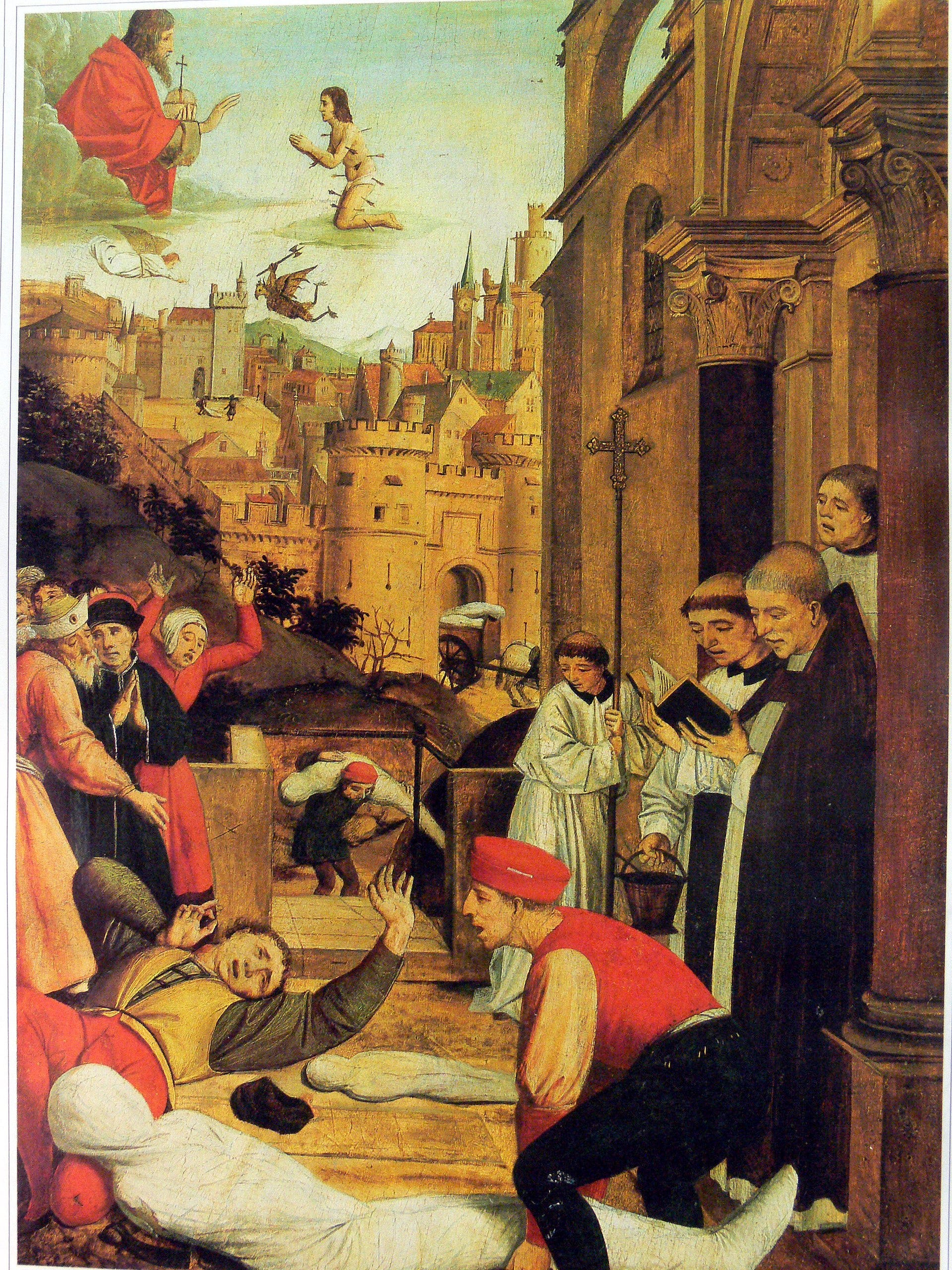
Procopius, the court historian and seasoned hater of the Emperor Justinian, painted his own picture of the city as overcome with dread and disorder, which some modern scholars question as a polemical tale exaggerated to undermine and smear the emperor, but other sources, and uncovered archeological evidence, suggest his depictions may not have been all that far off. He claimed people were dying so quickly that bodies ended up being left in houses for days. Eventually, with too many loved ones to bury, the state had to step in to organize mass graves. When those weren’t enough they made burial trenches. Eventually they resorted to throwing corpses into the sea. One account claimed the stench of rotting corpses was consistent throughout the city. Even Emperor Justinian was feverish and bedridden for weeks, surviving the ordeal but the perception of invincibility surrounding his reign had begun to fade. As panic set in, government functions ground to a halt, with the courts closing and tax collection stopping altogether. Military shipments became less frequent and eventually ceased altogether and for a moment, the entire Eastern Roman Empire teetered on the brink of collapse. Unlike modern governments which respond to outbreak with public health campaigns or emergency protocols, the response from the Byzantine empire was largely theological. Priests prayed and citizens performed their processions with some citizens even lashing themselves to repent, thinking the plague was divine punishment. Others simply fled the area, but there was really nowhere to run since the disease was already well beyond Constantinople, further radiating outward through trade networks.
“There was not a soul to bury the dead, for all were stricken alike, and no man could be found to tend the sick or even to mourn the departed.” – Procopius Secret Wars (Book II)
Diagnosing the Dead
Eight centuries later, we know the bacteria responsible for this plague was Yersinia pestis, the same bacteria responsible for the Black Death eight centuries later that ravaged Europe. Earlier theories had tied the outbreak to smallpox or an unknown hemorrhagic virus, but modern genomics has confirmed the diagnosis. Ancient DNA extracted from sixth-century skeletons in Germany, France, and the Eastern mediterranean has revealed Y. pestis in its more medieval form, although an earlier, now-extinct lineage. Ecological clues back this up, as just before the outbreak the climate had shifted toward cooler and wetter conditions which were ideal for rodent populations to surge. That’s part of the reason that even as the first waves were fading away, local outbreaks would continue for over two centuries in what historians now call the First Plague Pandemic.
But the confirmation of the pathogen wasn’t the end of debates around the Justinianic Plague. Over the years some historians and archeologists have pushed back against the idea that it was as severe as once believed. Pointing to patchy written records, inconsistent archeological signs of demographic collapse, and the absence of significant changes in some economic indicators, they claim it’s been vastly overstated. Others reject that view altogether. They claim the absence of mass graves in some areas could simply reflect differences in burial customs, that economic slowdowns were multifactorial but impacted severely by the widespread death in working age individuals, and that the sheer consistency of reports across the multiple regions (despite their cultural and linguistic divides) suggests a profound level of disruption. Not all villages left behind records, but the empire’s core cities consistently tell a grim story.
Memory and Meaning
Until recently, most people haven’t heard of the Justinianic Plague. For a pandemic that may have killed a quarter of the Eastern Roman Empire, it left behind a surprisingly faint imprint on history unlike the Black Death, which birthed entire genres of art and writing in its wake, or COVID-19, which generated terabytes of tweets, journal articles, and data. Part of the answer is literary. There was no Boccaccio, Chaucer, or Camus. We got no Danse Macabre or woodcuts of skeletons leading nobles to their graves. It struck a world with fewer chroniclers, no printing press, and even fewer enduring voices from the arts. The stories that were written down, like those of Procopius, were mostly produced by the imperial elites and were not well circulated. They also didn’t have the visual flair that was used by artists in the time of the Black Death. There could also be bias in the record, as we don’t know how much written down but didn’t survive or hasn’t been discovered.
There’s also the matter of framing. Western history has long treated the year 476 CE as “the end of Rome”, and everything after is seen as a “Byzantian decline.” That’s more of a clean cutoff for bar trivia with a much more complicated truth behind it. The Eastern Roman Empire was very much alive when the plague struck. It was militarily aggressive, economically integrated with the surrounding empires, and was diplomatically active, but because this wasn’t the romanticized “Rome” of old, it's struggles didn’t quite make it into the Western canon.
Then there was the timing. By the time scientists had used ancient DNA to confirm Y. pestis as the cause of the plague, it was the 2010s. For more than a century. researchers had debated whether it was really even a plague, casting doubt on its place in the broader history of pandemics. All while the Black Death was cemented as the great pre-modern pandemic, complete with its medieval imagery, churchyards of mass graves, and the doomsday sermons recorded to match. In the end, the Justinianic Plague changed the entire course of an empire but it was left without its own mythology and metaphors afforded to later diseases.
Aftershocks and Echoes
What started in 541 CE didn’t burn out after a few dreadful years. At least 15 to 18 distinct outbreaks have been identified by historians hitting not just the Byzantine Empire, but Ireland, Persia, Arabia, and the early Islamic world. If the first wave decimated Constantinople, the later ones were gnawing away at the civilizations on its periphery. In Western Europe, the Frankish bishop and historian Gregory of Tours documented recurring plagues through the 500s and beyond. His vivid accounts describing outbreaks in modern day France between 571 and 590 with people suffering from the same painful swellings in the groin and armpits, many dying within days. He mentions mass deaths in Narbonne and Albi, blaming ships from Spain for reintroducing the disease in Marseille. Like in the south, these outbreaks were met with religious processions with blame again being placed on sin.
Further north, early medieval Ireland was struck by the pandemic as well, although the impact is harder to measure through chronicles. The “Plague of Mohill” survives in landscape and linguistic quirks. The Irish term “támh-leacht” refers to a mass plague burial and appears in dozens of place names across the island, including the modern suburb Tallaght near Dublin. The sites are often apart from the traditional cemeteries of the area, possibly reflecting emergency burials in response to large-scale mortality. Gene Haley’s work suggests that these toponyms (names for places and geographic features), concentrated especially in Leinster and the midlands, are not linguistic coincidences. He argues they likely mark real, remembered sites of epidemic victims. If true, it means the Justinianic Plague or one of its aftershocks penetrated even to some of the more remote and insular regions and left an enduring imprint on Irish cultural geography.
Ireland was again hit along with England in 664 CE. A solar eclipse darkened the skies over the isles and was soon followed by what became the first recorded epidemic in English history. Chroniclers like Bede described the plague as moving from the southern coasts northward, killing clergyman and commoner alike. Contemporary accounts note the social disruption, apostasy, and theological confusion. Some modern scholars suspect this was really smallpox, but others have argued for plague based on clinical clues like rapid deaths and groin swellings. The Irish annals and saints’ lives offered their own framing with figures like Adomnan of Iona claiming certain monastic regions were spared thanks to spiritual protection.
In the East, outbreaks continued during a period of major religious and political change. A notable recurrence was the Plague of Amwas (638-39), which hit Syria during the Muslim conquest of the region. Arab sources describe how it decimated the early Islamic army, including several high-ranking companions of the Prophet Muhammad. The epidemic was severe enough to threaten the momentum of the campaign and became embedded in the Islamic cultural memory. Historian Michael Dols claims the plague shaped Islamic attitudes toward disease for generations, including the principle that one should neither flee from nor enter a plague-stricken land, a doctrine echoed in hadith literature.
Later waves also hit the Byzantines in the 600s and 700s. Regions like Anatolia, Mesopotamia, and North Africa were hit with recurrent blows that weakened the tax base, hollowed out the urban centers, and made military campaigns harder to sustain. That combined with war and climatic shifts allowed the plague to transform the formerly Roman Mediterranean into an even more fractured, depopulated landscape.
The Edge of Epidemiology is a reader-supported publication. To receive new posts and support my work, consider becoming a free or paid subscriber.
Citations
Allen, M. (2022). Plague and the End of Antiquity: The Pandemic of 541–750. Oxford University Press.
Dols, M. W. (1974). Plague in Early Islamic History. Journal of the American Oriental Society, 94(3).
Green, M. (2014). The Black Death and the Transformation of the West. Harvard University Press.
Haley, G. C. (2002). Tamlachta: The Map of Plague Burials and Some Implications for Early Irish History. Proceedings of the Harvard Celtic Colloquium, 22.
Harper, K. (2017). The Fate of Rome: Climate, Disease, and the End of an Empire. Princeton University Press.
Little, L. K. (Ed.). (2007). Plague and the End of Antiquity: The Pandemic of 541–750. Cambridge University Press.
McCormick, M. (2003). Rats, Communications, and Plague: Toward an Ecological History. Journal of Interdisciplinary History.
Mordechai, L., Eisenberg, M., Newfield, T. P., Izdebski, A., & Kay, J. (2019). The Justinianic Plague: An inconsequential pandemic? Proceedings of the National Academy of Sciences, 116(51).
Procopius. (c. 550 CE/1914). History of the Wars, Volume I: Books 1–2.5 (Persian War) (H. B. Dewing, Trans.). Loeb Classical Library. Harvard University Press.
Rosen, W. (2007). Justinian’s Flea: Plague, Empire, and the Birth of Europe. Viking Press.
Stathakopoulos, D. (2004). Famine and Pestilence in the Late Roman and Early Byzantine Empire: A Systematic Survey of Subsistence Crises and Epidemics. Ashgate.
Tashakori, M., & Yavarian, J. (2016). Plague in Iran: Its history and current status. Epidemiology and Health, 38, e2016033.