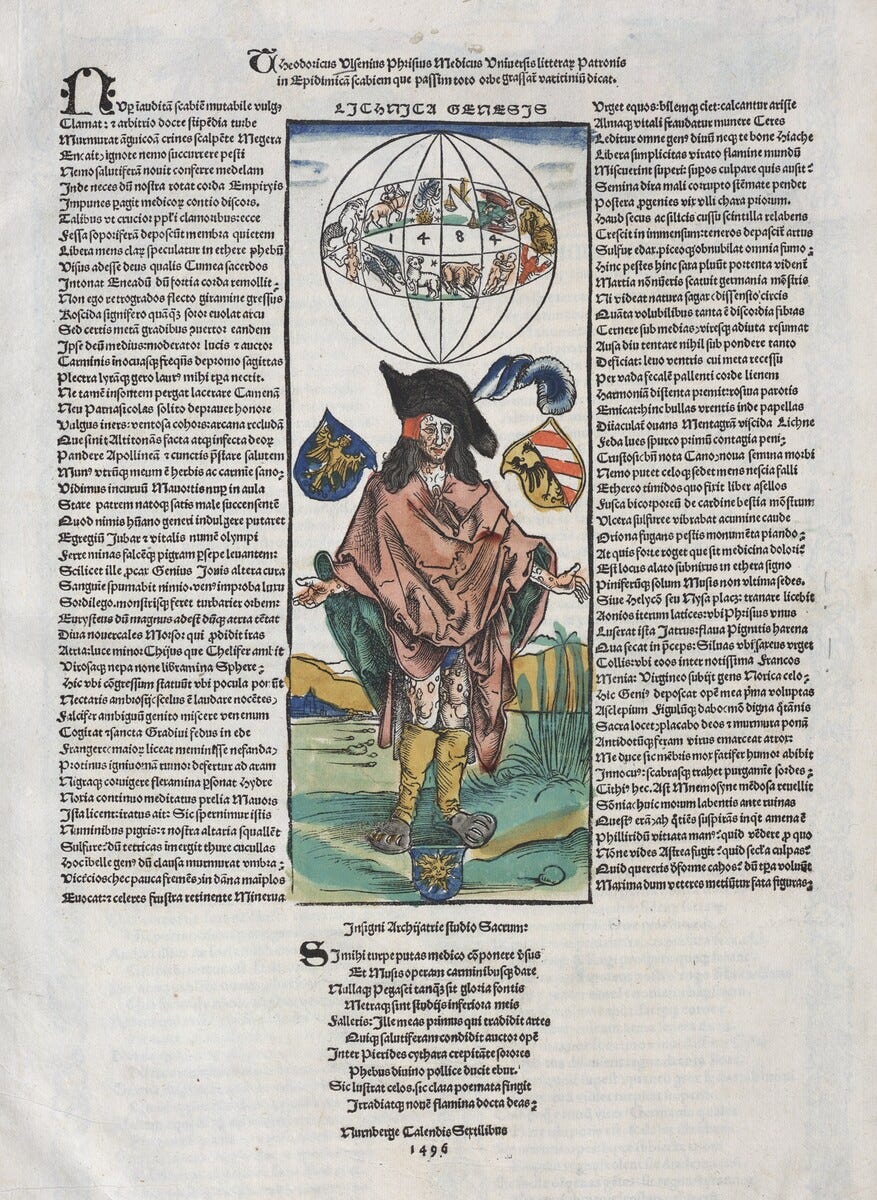
For a family of pathogens that has likely been with humanity since the dawn of agriculture, Treponema has a funny way of keeping its secrets. Its fingerprints show up everywhere in the archaeological record in the form of bowed tibias in desert burials, childhood skull lesions in the Caribbean, and scarring of the lining around bones from the Andes to Oceania. And yet, one form, venereal syphilis, showed up abruptly in Europe in 1495 like it fell out of the sky. That juxtaposition, with the ancient ubiquity of treponemes conflicting with the sudden appearance of a sexually transmitted version, created a puzzle that has annoyed paleopathologists, geneticists, and historians for more than a century. How can a disease family be so old and global, but its most infamous member be so recent and explosive?
Not up for debate: ancient treponemes
One thing that is not up for debate is the fact that the Old World was home to ancient strains of treponemes. Non-venereal treponemes like yaws (T. pallidum pertenue), bejel (T. pallidum endemicum), and pinta (T. careteum) are ancient, widespread, and predate Columbus in both hemispheres. Yaws tended to hang around the warm, humid areas and is transmitted by skin-to-skin contact in children. Clinically, it showed itself through highly contagious lesions, papillomas, and if unchecked, destructive changes in the bone. There seems to have been minimal involvement in genital symptoms. We see clear skeletal signatures in the Caribbean, Central America, and in coastal South America, and ancient genome samples from roughly 2,000 years ago provisionally confirming yaws in the region (provisionally due to the year old editor’s note attached to the paper suggesting the debate is ongoing even from paper to paper. Maybe a virologist or geneticist who reads this can explain the issue in the comments). Bejel, on the other hand, prefers the more arid, colder regions with close contact again being the common route of transmission and largely was hitting kids. This too resulted in skin lesions, especially in the mouth, as well as changes in the bone structure. We’ve got evidence for it in the Americas, North Africa, the Near East, and in the Mediterranean, but again, it had little to no emphasis on the genitals. Pinta was a New World variant from rural, warm and human environments in Central and South America. It presented strictly cutaneously from what we can tell, with scaly lesions being the tell-tale sign. It’s likely to have been widely distributed pre-contact with modern distributions including Mexico, Central America, and the northern areas of South America. However with minimal bone involvement it is invisible to paleopathologists except for DNA studies.
So the global distribution before the Age of Exploration was likely pretty wide. Dozens of skeletons show unequivocal treponemal lesions, including congenital cases, childhood yaws-like lesions, and periosteal thickening in adults. This includes evidence from the Americas, Africa, the Near East, Southeast Asia, Oceania, and Europe.
The paleopathology studies show us that these treponemal diseases have overlapping characteristics in the form of the bone lesions they produce. Treponemes can produce inflammation of the bone known as periostitis, tibial bowing (bending of the tibia bone) and cranial lesions known as caries sicca. Paleopathologists can usually detect severe treponemal disease, but it wasn’t until ancient DNA started being tested that the exact species could be pinpointed. That’s why much of the evidence for pre-Columbian venereal syphilis in the Old World collapsed. Yes, the bones showed signs that looked like it, but the DNA was always a different strain than the cause of venereal syphilis. Deep genomic splits are shown between the yaws-causing variant, bejel-causing variant, and venereal syphilis causing variant, however they all show evidence of recombination suggesting a long-coexistence and ecological overlap. They’re also all part of the T. pallidum subspecies line suggesting either common ancestry or a branching at some point.
So, what’s up for debate?
The real debate around treponemes is the origin of venereal syphilis (T. p. pallidum). The core problem is that venereal syphilis pops up suddenly in Europe in 1495, with contemporary physicians describing it as new, horrifying, and unprecedented. So, if treponemes existed worldwide for millennia, including in Europe, why does the sexually transmitted form appear so late and with such a volatile entry?
First, a bit of syphilitic biology. Venereal syphilis has a very distinct clinical and ecological profile compared to the other treponemes. Primary infection occurs within the genital mucosa resulting in chancres, firm, painless sores that are often found around the genitals, mouth, or other areas of the skin. When the infection becomes more systemic, you end up with secondary rashes, mucosal patches, and swollen lymph nodes. When the infection becomes chronic due to immune evasion, you end up with rubbery growths called tertiary gummas and the possibility of neurosyphilis (which, BTW, killed prohibition era mobster Al Capone). As an STI, its transmission obviously depends on sexual networks as opposed to environmental or household transmission. However, transmission within a household, in the literal sense, was not uncommon due to a high rate of congenital transmission from mother to child. Genetically, it is distinct enough from its cousins to form a tight monophyletic clade. It’s estimated to have emerged rather recently as well, with dates clustering around the 13th to 15th centuries, and support from the rather small levels of divergence between them.
The 1495 Outbreak in Naples
So why is the appearance in 1495 so strange? One would think that’s a pretty normal year for a new disease outbreak given the people coming back from a newly discovered continent half-way around the world in which they were exploring while immunologically naïve. It’s not exactly a shocking coincident that Columbus returned in 1493, the Italian Wars broke out in 1494 with a massive multinational army existing in Naples by 1495, and then the epidemic explodes with soldiers likely spreading the disease across Europe.
Between 1495 and 1500 it spread across the continent incredibly rapidly, being called a “new plague” and a “disease unheard of.” No medieval European text described anything remotely resembling this awful new disease prior to the 1490s. Early descriptions reported large, ulcerative pustules, debilitating bone pain, rapid deterioration of the health, and a shockingly high mortality rate for a bacterial STI. This era of hyper-virulence had declined by 1530, suggesting a couple of factors were at play. The first being the naïve European population which had zero antibodies to confront the disease until it was already inside of them. The second, suggested by the decline in virulence, is a subsequent adaptation by the pathogen itself. A pathogen that kills off its victims too quickly is also one that tends to die off itself and not have a lasting transmission chain. Pressure to not kill the infected so it could spread further was likely at play here.
Competing Origins
We end up with three competing explanations for the arrival of venereal syphilis in the New World. (although only two of them still get any real attention). The first, and most well-supported given the ancient DNA evidence, is the Columbian Exchange Hypothesis. It proposes that a pre-existing American treponeme, likely similar to yaws, was introduced to Europe. This then rapidly adapted to a sexual transmission route in the new ecological conditions it existed in. The Naples outbreak in 1495 was its first major outbreak in a virgin-soil population, although it likely existed in some small pockets somewhere. These things don’t literally come out of nowhere, we just have a tough time tracking down the exact origin.
The second hypothesis, which is now mostly rejected in academia, is the Pre-Columbian Old World Hypothesis, which claims that Europe had syphilis all along. It was the stupid medieval doctors that just happened to misdiagnose it. They saw 1495 as an exacerbation as opposed to the emergence of a new disease. But the problem there is that once researchers corrected for errors in radiocarbon dating, all of the supposedly “ancient European cases of syphilis” disappeared. We’ve got no ancient DNA of the pallidum variant before 1492 in Europe and no medieval texts describe venereal lesions of congenital syphilis prior to 1495.
Third is the Ecological Shift Hypothesis. The idea is that a pre-existing treponeme in the Old World mutated into the venereal form due to environmental pressures in the form of a colder climate, heavier clothing, less childhood skin contact, and urban density/sexual network diversification. But again, the genomics just don’t support this. All of the basal relatives of venereal syphilis are American in origin and not from the Old World.
The current state of the debate
There are a few things we can say with confidence about venereal syphilis and where it came from. First, this is a young lineage. Genomics keeps pushing us toward a date somewhere between the 13th and 15th centuries. Second, the Americas had the necessary diversity in treponemes for something like this to emerge, Europe didn’t. The rich landscape of treponemes in the pre-contact Americas had yaws, bejel, pinta, and possibly others that have gone unsequenced and undiscovered. Third, the 1495 event behaves exactly like an introduction event, something we’re all familiar with after covid. The sudden appearance of a grotesquely virulent disease with a high mortality and rapid spread was an utter shock to the system. Something that only happens on virgin-soil as opposed to when something already there shifts its niche.
So, we’re left with the Columbian-exchange scenario. It’s not tidy and there are still unanswered questions, but the genomics, paleopathology, and historical epidemiology all point in the direction of “a New World treponeme landed in Europe and adapted quickly.” Debates are still to be had about exactly where that shift into STI occurred. It could have been in the Americas in the two centuries leading up to Columbus’ arrival. Or maybe it happened in Europe shortly after arrival. There’s no smoking gun for either side, so both remain plausible. Hopefully I get to update this post at some point with an actual answer to exactly when syphilis entered Europe.
The Edge of Epidemiology is a reader-supported publication. To receive new posts and support my work, consider becoming a free or paid subscriber.