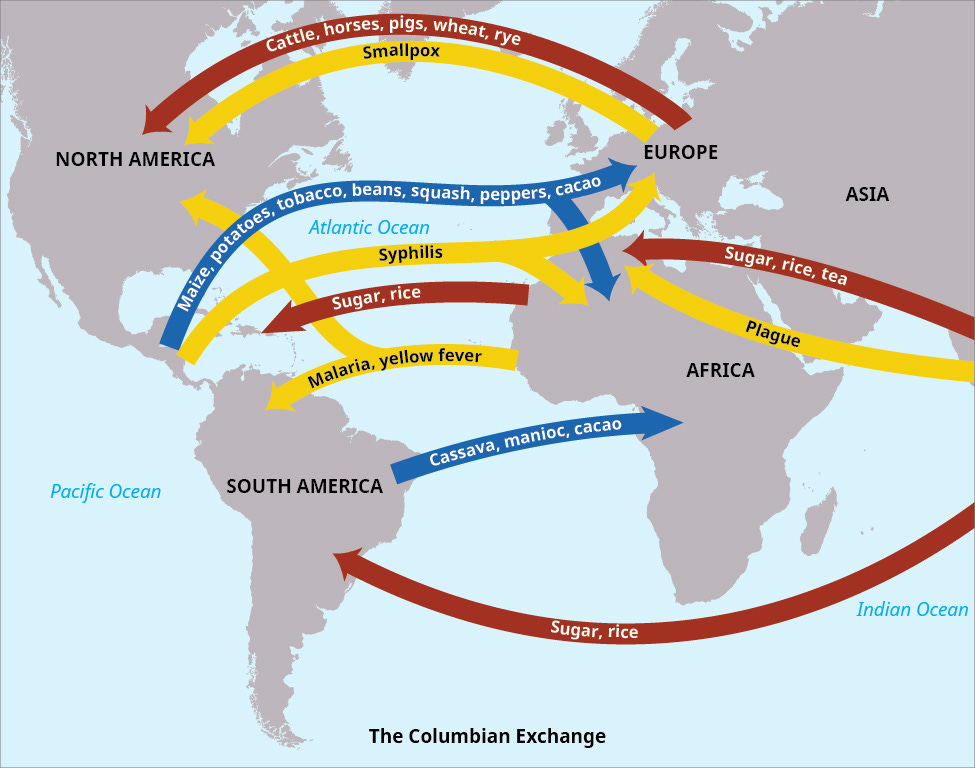
The story of disease in the Americas post-1492 is usually told in a blunt manner, with Europeans arriving, Old World pathogens hitching a ride, and then causing a total collapse of the Indigenous Populations. That narrative, while broadly true, is also radically incomplete, with flattened timespans, ignorance of geographical differences, and a lack of engagement with environmental and societal reasons for such a population decline. What unfolded after contact was neither uniform nor immediate, with epidemics happening at different times and behaving differently in varying ecosystems. This piece is a regional, mechanistic look at early post-contact disease ecology in the Americas, hopefully providing a clearer map of how disease, labor, and ecology were interacting in the centuries after contact.
The Caribbean
The Edge of Epidemiology is a reader-supported publication. To receive new posts and support my work, consider becoming a free or paid subscriber.
The first post-contact epidemic in the Americas happened during Columbus’ second voyage. In 1493, both native Taíno people and the Spanish in the town of La Isabela, Hispaniola succumbed to a likely influenza outbreak, with fever, malaise, and high mortality rates. Contemporary accounts describe an illness that spread rapidly and decimated populations in the first decades after contact. Due to smallpox not being recorded on the island for couple more decades, later researchers argue that neither smallpox, nor one of the other classic Eurasian plagues are to blame here. The clinical description and timing of its appearance, alongside the fact that some pigs were introduced from the Canary Islands, leads us in the direction of a likely swine flu outbreak.
It’s possible the first smallpox outbreak occurred on the in 1507, when disease was devastating the populations of the island. A 1508 census showed about 60,000 Taíno on the island but just 8 years later that number was down to 23,000, but it’s possible this was due to swine flu and other diseases as opposed to smallpox. It is safe to say that population collapse was well underway by the time of the 1518-1519 (and first confirmed) smallpox epidemic. After disease and working conditions had killed off a large percent of the native populations, enslaved Africans started to be brought over to work in the mines. The Spanish were meant to have total and complete rights to trade in the area, including that of slaves, but increased demand led to Portuguese and Genoese traders bringing slaves over to the island directly from West Africa. Smallpox first showed up in slaves working the mines in 1518 and by the next year, a third of the remaining natives had died of the disease. It also refused to be contained to the island, with Cuba and Puerto Rico experiencing their own significant population declines. Trade among native groups may have been one way smallpox made it to the mainland as well. I can’t find other sources for this, so take it with a grain of salt, but the National Library of Medicine has a page on their Native Voices project which looks at Native American health, and it claims tribal trade expeditions by canoe may have brought smallpox to the Yucatan first, with Spanish invaders bringing it further inland during their conquest.
Mainland Mexico
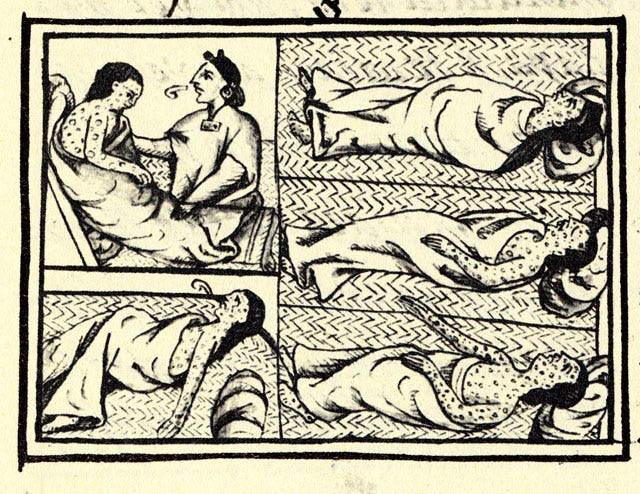
They arrived in the Spring of 1519, with the expedition of Hernan Cortes landing in the eastern Gulf of Mexico. Cortes famously fought the Aztec Empire, one of the most powerful in all the Americas at the time. By the 16th century the Aztecs, then led by Montezuma, had a massive sphere of influence in today’s central Mexico. But it’s much less simple than “Cortes beat the Aztecs” because there was already a massive distrust and borderline hatred of the Aztecs by other native groups which led many to join the side of the conquistadors.
The Mexica people of the Aztec Triple Alliance were ruling what was far from a unified nation. The Aztecs ran an empire based on tribute, with the Mexica of Tenochtitlan ruling with an iron fist as opposed to through integration. While allowed to have their own rulers and social identities complete with languages other than Nahuatl, economically and militarily they were subordinate groups there via coercion. Groups under Aztec rule were forced to deliver regular tributes, that could be increased at any time and for no reason, in the form of food, textiles, and labor/military services. Failure to meet the quota would often lead to military raids, taking of captives for ritual sacrifice, and the replacement of local rulers with one more sympathetic to the Aztec crown. War and smallpox came together to kill off massive proportions of the population, with mortality estimates as high as 40% for populations in the Valley of Mexico and somewhere around 8 million deaths total.
Not long after (and possibly before, and during) were the mystery Cocoliztli epidemics (which I wrote about here) which killed off another 7-17 million individuals. This “syndemic” of multiple pathogens (Salmonella was confirmed, but doesn’t match the symptoms, which are more in line with a viral hemorrhagic fever), severe rain storms during a megadrought, and horrific living conditions ended up being the largest epidemic in the Western Hemisphere during the first century of contact.
The Andes
When we get into the 16th century Andes and when Old World diseases first arrived, we end up in the middle of a historiographical debate. The Incan monarch Huayna Capac was said to have died of smallpox introduced before the conquest of the area had begun (Pizarro arrived in 1532). The research team of Robert McCaa, Aleta Nimlos, and Teodoro Hampe Martínez put forward evidence of a much later smallpox introduction to the area, dating it to around 1558, where they argue the prior collapse and death of Huayna Capac were largely driven by civil war and famine. They note that only 6 of the 17 chroniclers of the time mention smallpox explicitly as Capac’s cause of death, with most hedging their bets with the phrasing “se dice” (“it is said”) while offering alternatives. The source they deemed most reliable described something more like scabies or a leprosy-like rash as opposed to smallpox. They also point to linguistic evidence in the form of the first Quechua-Spanish dictionary, which contains no term for smallpox despite linguistic fieldwork having been conducted in the coastal lowlands where smallpox would’ve supposedly entered. The term “muru oncoy” (“spotted disease”) describing smallpox first appeared in the 1586 dictionary, well-after the 1558-58 epidemic. There’s also the lack of any mention of pockmarked indigenous survivors before 1565. All of this to say, it is possible that smallpox circulated sporadically through trade or tribal warfare in the Caribbean, Central Mexico, Andes, and North America, going unnoticed in the records until population size and living conditions allowed the disease to cause more notable damage.
North America
The importation of disease into the various regions of North America was more uneven than other areas, largely due to the vast distances and differences in ecology that would allow different diseases to persist at different times. The first expedition into North America was Hernan de Soto’s, where his group traveled through the modern-day states of Florida, Georgia, Tennessee, Mississippi, Arkansas, and Louisiana. They documented encounters with densely populated groups like the Coosa, the Apalachee, and various Mississippian tribes. It was largely assumed that de Soto’s passing through the area would have been the start of the epidemics for North America, but just like in the Andes, we see little evidence for that until much later and no “wildfire” like spreading, with the first clearly documented epidemics of the area only occurring after sustained colonial trade networks had emerged in the 17th century.
That first epidemic was the 1616-1619 epidemic in New England, on the coastal regions of modern Massachusetts. This was the “Great Dying” that affected the native groups making up the Pennacook confederation of modern-day southern Maine, northeastern Massachusetts, and southern New Hampshire. It’s unlikely to have been due to a single infectious agent, as the incoming Europeans were likely carrying multiple other diseases, like smallpox, influenza, plague, typhus, and more. There’s also a debate on this outbreak, with some modern researchers suggesting leptospirosis may have played a role as well. Whatever the causes, it was an absolutely devastating blow to the natives in the area. It’s possible other diseases had made it through the Mississippi valley and into the northern regions or up through the southwest through trade routes, but those require confirmation to do anything more than just speculate. The southwest likely had infectious disease introduced a bit later, with population collapse not occurring until nearly a century after first making contact with the Europeans.
The southwest and Pacific Northwest were largely free from the brought over diseases until the creation of Missions and Reducciones, with measles outbreaks first being noted in 1806 and smallpox in 1833 (although Baja California was hit by smallpox in 1781 through trade with central Mexico).
The Amazon and Inland South America
Some of the last groups to be impacted by epidemic level infectious disease spread in the Americas were those living in the Amazon rainforests. It’s possible that Old World infectious diseases were brought into the area by trading along river systems or from later missionary networks, but what evidence we do have suggests these were episodic waves as opposed to full on pandemics. The inland populations were largely isolated until the rubber boom of the late 1800s, with contact becoming more common through the 20th century. Many of the documented epidemics brought into the area were measles, influenza, or malaria. But this ends up looking a bit like the southwestern U.S. and PNW, where it’s possible there was some earlier introduction of Old-World diseases, but we have no idea when, where, or what it would have been.
All of these introductions would have been “virgin soil introductions” meaning the native groups living in the area had no past immunity to the diseases being brought in. But an immunologically naïve population isn’t the only driver in these kinds of epidemics. Labor systems like the Encomienda system that had the natives working mines or on plantations with brutal conditions led to malnutrition and disease. Some areas like the southwest and Mexico were hit with severe drought conditions that constricted the food supply which likely made disease outbreaks worse. Congregation of what used to be smaller groups into close-quarters missions allowed infection to spread much more readily among the natives in the Southwest, Florida, and California. Then later trade networks like the fur trade and gold rush brought in miners, settlers, and shipping that helped to sustain disease circulation in areas that were previously isolated.
Early maritime contact produced the fastest collapses. The Caribbean and coastal trade hubs went through repeated reintroductions of disease through shipping, overcoming what would otherwise have been a natural barrier to persistence. Long voyages were the bottleneck for many diseases, especially fast-burning ones like measles, but once regular maritime traffic was established, that bottleneck no longer mattered. Inland regions were isolated until trade networks, missions, or forced labor brought them into contact with the settlers. In other regions the disease arrived late or episodically, like large parts of North America, the Amazon, and the Pacific coast which avoided sustained epidemics for generations despite sporadic contact. Population dispersal, limited connectivity, and ecological constraints prevented many pathogens from becoming endemic. Where collapse did occur, it often followed deliberate congregation into missions or labor camps rather than initial encounter. In Mexico, smallpox was followed by repeated outbreaks of poorly understood hemorrhagic or enteric diseases, amplified by drought and exploitation. In the Andes, civil war and famine preceded any clear evidence of smallpox giving a clear example of why disease severity cannot be separated from the political economy of conquest.
I’m glad to be living in the era of paleogenomics, climate reconstruction, and ecological modeling, because when you combine all those methods with a willingness to accept that some epidemics may never be clearly identified, you end up with much more satisfying explanations for what happened throughout history. The future has so much to tell us about the past.
The Edge of Epidemiology is a reader-supported publication. To receive new posts and support my work, consider becoming a free or paid subscriber.