Disclaimer. I’m not a geneticist or a geroscientist. Any errors are mine. I’m coming at this as an epidemiologist trying to translate what “biological age” means, what a new heat-waves study actually estimates, and who should care.
The headline that’s not much of a headline
A new cohort analysis from Taiwan links hotter years to small upticks in “biological age” (a composite built from routine clinical markers like blood pressure, lipids, and liver enzymes). On average the effect is measured in days over a two-year window, not in years (thankfully). The data don’t justify any of the language I’ve seen like “heat ages you like smoking.” But they do suggest that repeated heat exposure nudges physiology in the wrong direction, especially for people who can’t get away from it.
The Edge of Epidemiology is a reader-supported publication. To receive new posts and support my work, consider becoming a free or paid subscriber.
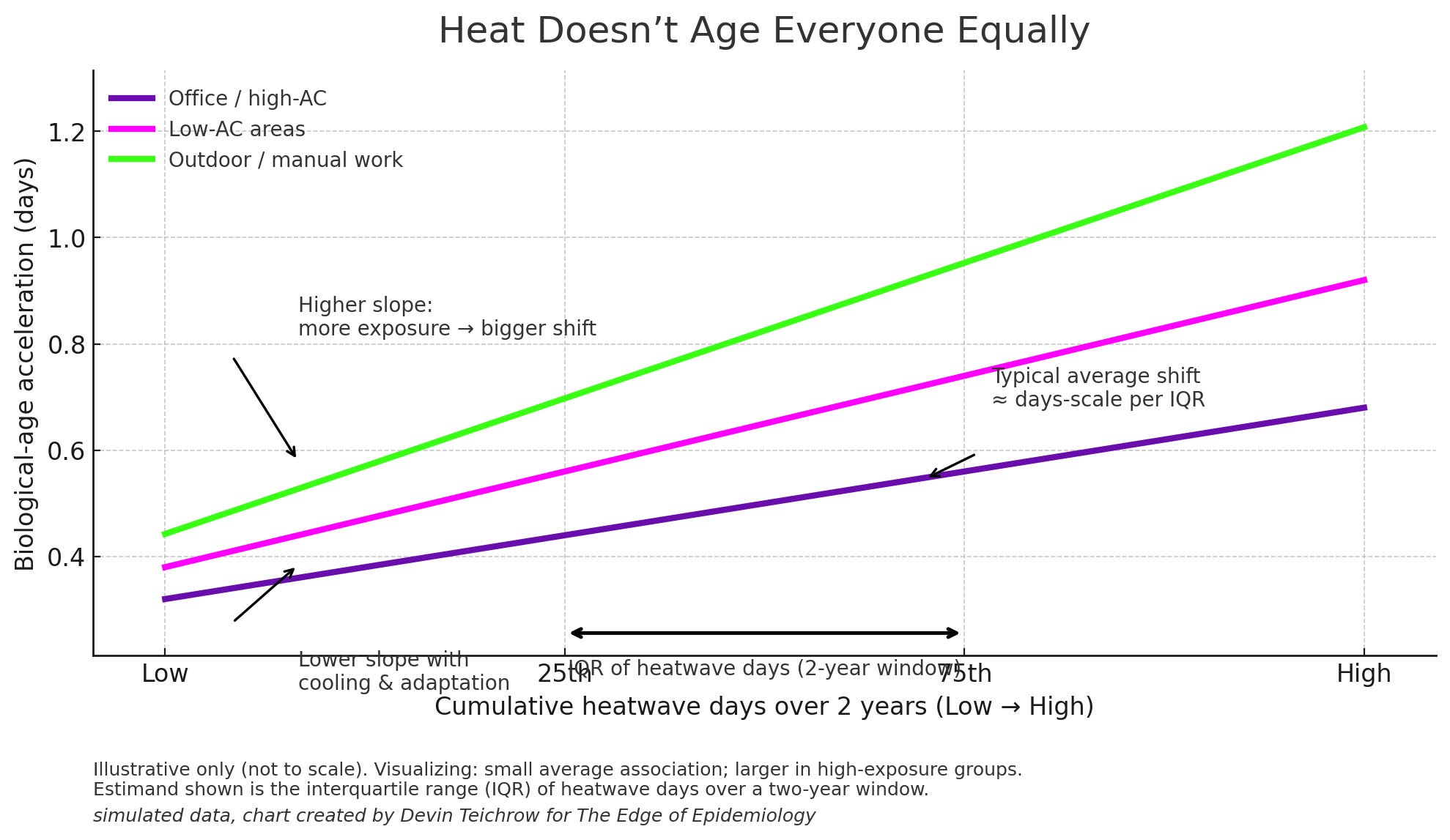
If you stop reading here, take this as the gist of it: the average effect is tiny, and the bigger story is the massive heterogeneity with outdoor and manual workers, rural areas, and low-AC neighborhoods showing larger shifts than office workers with central air.
What “biological age” actually is (and isn’t)
“Biological age” is a summary score extracted from health signals that correlate with future risk: either clinical-marker composites (the Taiwan study’s approach) or epigenetic clocks (built from DNA methylation). Think of it as a noisy, unit-converted risk meter where higher biological age relative to your actual age, so-called “age acceleration”, generally tracks with worse outcomes in longitudinal studies. But it’s not a death clock and it’s not meant to be read one-to-one as “years of life lost.”
The estimand, plainly
The “8–11 days” figure you may have seen going around is the estimated difference in biological-age acceleration associated with moving from the 25th to the 75th percentile of heatwave days measured over a two-year window, all other things held constant (that is, all the things they measured including all their imperfections). That’s known as the interquartile range (IQR), which is basically the middle half of the exposure distribution. It’s not per year, and it’s not meant to be stacked linearly for decades since people move, adapt, change jobs, buy AC, and the models just aren’t built to extrapolate across half a lifetime.
Why does a days-scale effect matter? Because (a) it’s consistent with other datasets using different “clocks,” and (b) the average hides bigger impacts where exposure is chronic and unavoidable.
The part that convinces me: who moves the average
The association is stronger in subgroups that are plausibly more exposed: outdoor/manual workers, rural residents, and places with low air-conditioning penetration. That pattern does two things. First, it makes the finding more believable, as the dose modifiers line up with common sense. Second, it makes the result actionable: if heat exposure is the dose, then job type and cooling access are the ways we can make change.
Skepticism, on purpose
A few reasons to raise an eyebrow at the findings:
They’re observational, not experimental (but good luck doing a RCT of heatwaves). This is a cohort of people who come in for health checks. That’s a self-selected sample which comes with its own bias and confounding structures. The models adjust for a lot, but residual confounding (housing quality, occupational exposures, neighborhood SES, UV exposure) is always a risk.
Exposure misclassification. Ambient heatwave counts are a coarse proxy for personal heat. Shade, microclimates, indoor vs outdoor time, and AC use all matter. Coarse exposure leads to diluted effects on average which means the heterogeneity matters even more.
Adaptation over time. The reported associations attenuate across the study period. That likely reflects changing behavior and infrastructure (more AC, better warnings, work-practice shifts) at least as much as biological “adaptation.” It’s a useful signal that context evolves.
Scale confusion. Biological age is correlated with outcomes, but translating “days of biological age” into “days of life lost” is the wrong scale. It’s also why cross-study comparisons (“like smoking/alcohol”) are more PR than science with different clocks, cohorts, confounding structures muddying the results.
None of that means the signal is fake. Confounded? Probably. But to me, that just means we probably should file it under small average association with plausible mechanisms, clear subgroup differences, and the usual suspect of caveats that come with an observational study.
Triangulation (why I don’t dismiss it)
A separate U.S. analysis using epigenetic clocks (different biomarker, different cohort) also links ambient heat to age-acceleration in older adults. Two teams, two measures, same direction. Neither study is causal proof, but converging evidence across methods is what you want to see before you take something seriously.
Why “as bad as smoking” isn’t the right comparison
Smoking is a dominant cause of specific diseases (lung cancer, COPD, vascular events) with large, well-characterized relative risks, clear dose–response, and massive attributable fractions. Heat exposure is a broad stressor: it worsens cardio-renal strain, hydration, sleep, and sometimes air-quality exposures at the same time. It’s a many-small-pathways phenomenon. You can meaningfully compare what to do about both (protect workers; regulate environments), but you shouldn’t equate biological-age deltas across incompatible metrics. It’s an apples and oranges thing
What I’d tell a smart relative or city council
For most people: The average effect is tiny. Treat multi-day heat like a smog alert where you adjust outdoor exertion; hydrate; maybe check on older neighbors
For outdoor and manual workers: This is where it matters. Guaranteed water breaks, shaded areas, misters for cooling, and rescheduling heavy exertion away from peak heat are the exposure controls.
For low-AC neighborhoods and rural areas: Shade is key. Increases in foliage by the city can reduce local temps. Fans, AC units, extended cooling-center hours, and outreach during multi-day heat events hit the problem where it lives.
For clinicians: “Biological age” is a risk-flag not to be mistaken for any diagnostic criteria. Use the heat waves as a prompt for practical advice with your cardio-metabolic patients, especially those who work outside.
What would change my mind
Increasing confidence: Replication across countries with both clinical and epigenetic clocks, plus stronger designs on exposure (e.g., wearable or job-linked heat metrics). A clear dose–response by personal exposure would move me.
Decreasing confidence: A well-controlled study showing the heterogeneity disappears (e.g., no bigger effects for outdoor workers or low-AC regions) would push me toward “artifact.”
Bottom line
Heat might make everyone a tiny bit older. It makes the already-exposed a little older a tiny bit faster, on average. I don’t see that as a reason to panic. Just aim cooling and work-practice protections where they matter.
The Edge of Epidemiology is a reader-supported publication. To receive new posts and support my work, consider becoming a free or paid subscriber.