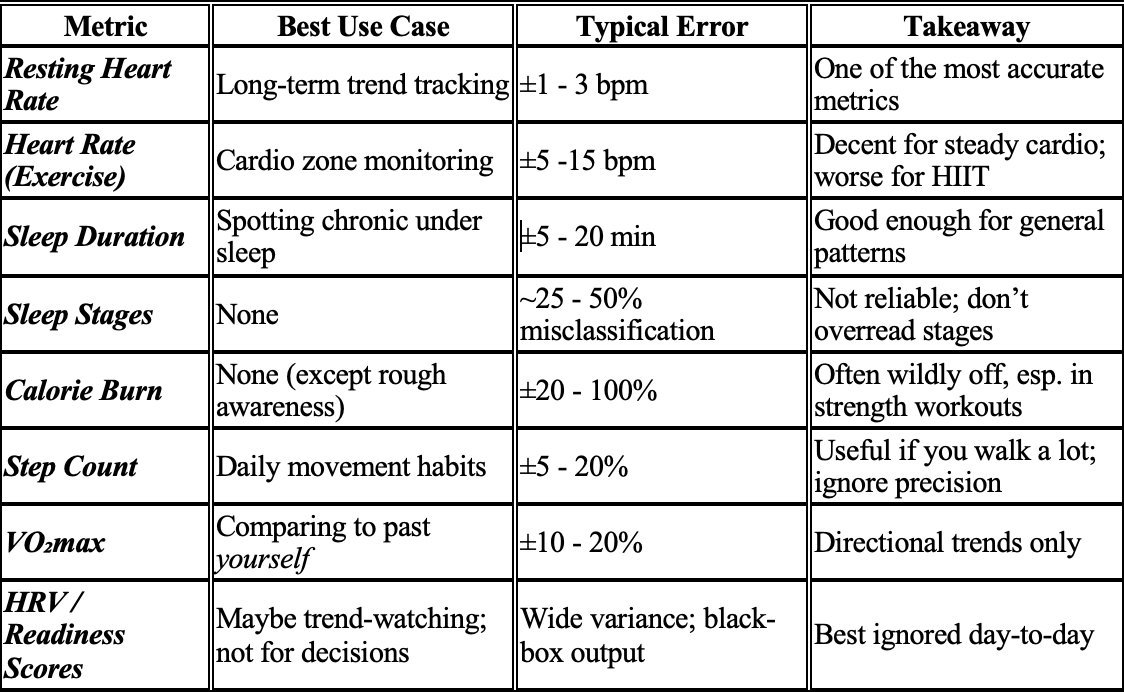
I’ve had an Apple watch for a while and have mostly used it to track my sleep. It was more out of curiosity than anything. It’s a strange feeling to wake up groggy as all hell but with an app basically telling you “you slept great!”
Wearables like Apple watches, Fitbits, Garmins, WHOOPs, and Oura rings have gone from strange tools used by fitness nerds to being mainstream health accessories. They promise to track your heart rate, calories burned, step counts, sleep stages, and more. And the marketing would have you believe that device knows more about your body than you do!
But how accurate are these trackers? In short, some of the measurements are surprisingly good while others are damn near meaningless. The problem is, people have no clue which are which.
Here we’ll walk through what wearables measure well (resting heart rate, total sleep time), where they still could use a bit of work (HRV, sleep stages, caloric burn), and what that means for people trying to implement some of this data into their lives.
The Edge of Epidemiology is a reader-supported publication. To receive new posts and support my work, consider becoming a free or paid subscriber.
How Accuracy Gets Measured
To know how well a wearable is doing at measuring a metric, it gets compared to a gold-standard test. Heart rate gets benchmarked against a chest strap or an ECG. Calories burned are measured with a metabolic cart. Sleep stages would be compared to polysomnography, which tracks brainwaves, eye movement, and muscle activity. Steps are tested against motion capture or ankle mounted sensors. VO2 max is normally calculated via running or cycling to exhaustion while hooked up to an oxygen reader.
Most wearables don’t use these methods. Instead, they estimate based on other factors like optical sensors, accelerometers, and proprietary algorithms that estimate what’s happening based on movement patterns and heart rate data. Some of these guesses end up being quite close to the gold standard, and at the price of a wearable that could be worth it to some. But others are way off and should be taken with a grain of salt.
Some measurements are accurate enough that the error won’t bother most users. A watch saying you slept 7 hours instead of 6 and a half probably won’t be too impactful. But someone working to lose weight thinking they burned 750 calories in a workout when it was actually 450? That’s a scenario that might lead someone to think they’re in a caloric deficit when they aren’t and stifle any possibility of weight loss.
What Wearables Get (Mostly) Right
While the marketing of these devices tend to oversell just how accurate these devices are, some of the core measurements are surprisingly solid. This is especially true for resting measures where the signals are cleanest. If you’re using these to keep tabs on your resting physiology or some daily patterns, you’re likely getting data that’s good enough to be useful.
Resting Heart Rate
Resting heart rate is one of the most consistently accurate things wearables measure. Multiple validation studies have shown devices like Oura Ring, WHOOP, and Apple Watch all come within 1 to 3 beats per minute of a chest strap ECG when at rest1–3. That’s more than good enough to do some tracking of real change over time. As long as you’re tracking it under the same conditions, it’s one of the few metrics worth watching closely.
Total Sleep Time
While not perfect, total sleep time is pretty good at measuring how long you were asleep. Studies comparing a wearable device to full polysomnography found most devices come within about 10 to 20 minutes (+ or -) of the real number2,4,5.
For example:
- The apple watch overestimated sleep time by about 3%, or about 15 minutes on 7.5 hours of sleep.
- Oura clocked in at roughly 92% accuracy when compared to lab-grade data across multiple nights.
While not perfect, it’s good enough to tell if you’re consistently sleeping less than you’d like to or starting to get a bit more sleep than you used to.
Step Counts
Tracking step counts tends to be pretty accurate in people with a typical gait pattern. The Apple Watch and some higher end Garmin models generally report step counts within about 5 to 10% of lab grade measures. Oura ring had a much higher error rate when compared to a pedometer with 50.3% measurement error.3,6. More errors tend to come in with slower walking speeds, when running, walking while using hands (like pushing a stroller), or when the device is worn loosely or on the dominant wrist. Overall, for tracking a daily movement goal, they’re pretty solid but again, trends matter more than exact step counts. But for those like me with restless leg syndrome, you may find yourself waking up with steps already measured.
Where Wearables Still Struggle
Most of the measures don’t quite live up to the promise. Noisy data, fuzzy and incomplete algorithms, or basic assumptions built into models don’t always end up holding true. In these cases, even the trendlines can be misleading and error ridden.
Sleep Stages
The sleep stages of light, deep, and REM seems to be one of the most interesting metrics to people with a wearable. But no matter how nice the plot on your app looks, these numbers seem to be guesses at best. Polysomnography (PSG) is the gold standard for sleep measurement. It uses brain waves (EEG), eye movement tracking, and muscle tone measurements to help distinguish between sleep stages. Wearables have nothing like that. They mostly rely on heart rate and movement data, along with some skin temperature and respiratory rate stuff.
In a multicenter validation study comparing 11 commercial devices to PSG in sleep labs in the US and South Korea.
- Apple Watch, Oura Ring, and Withings Sleep had the best overall agreement for total sleep time and staging.
- Fitbit Charge 4 and Garmin’s Vivosmart 4 showed less accuracy, especially for REM and deep sleep classification
- Stage-specific accuracy was modest at best, with REM and deep sleep oven being misclassified as light, and REM was frequently overestimated
- The best devices had roughly 70% agreement with PSG on classification, meaning nearly 1 in 3 30-second sleep windows were labeled differently than in the sleep lab.
Sleep stage estimates from wearables are alright at helping to spot a general trend, but aren’t precise enough to help optimize a REM cycle or help diagnose a sleep disorder.
Calories Burned
Caloric burn is one of the least reliable metrics that wearables provide, with even the best devices showing huge error margins depending on the activity. This is because measuring energy expenditure in the lab involves oxygen consumption (VO2) measured with a mask or hood under controlled conditions. Wearables obviously can’t do that and instead are left relying on heart rate, motion sensors, and proprietary algorithms to get their best estimate at how many calories are being burned.
Some of the better performers were the Apple Watch devices and higher end Garmins. These tended to be within about 10-20% of true caloric burn, especially during more steady activities like walking on a treadmill or cycling7,8. That’s good enough to track trends or compare workouts to one another, but it’s not accurate enough to assume a workout earned you those extra calories.
The Oura Ring EE did show strong correlations in the lab (r = 0.93), but were still underestimating energy expenditure more often than not6. This discrepancy tended to get greater as the activity got more intense. That pattern reflects the broader issue of wearables doing much better when the body is still compared to moving. Those doing resistance training, interval running/sprints, or HIIT are stuck with error ridden caloric burn estimates. This is yet another area where these trackers are best for looking at trends and not the absolute numbers.
Overhyped and Underexplained: HRV and VO2 Max
Two of the flashier numbers fitness trackers try to provide are heart rate variability (HRV) and VO2 max. They’re sometimes dressed up under a label like “recovery score” or “fitness age.” These are real, scientific measures, but the precision of wearables leaves much to be desired regarding their accuracy. This leads to easily misinterpreted numbers than are also difficult to put much trust in.
Heart Rate Variability
HRV is the beat-to-beat fluctuation in pulse. Contrary to the former idea that a “steady heart rate” is healthy, higher variability in HR is generally better. It’s also used by athletes to adjust their training. The problem is, it’s an incredibly sensitive measure. HRV varies substantially throughout the day depending on hydration, caffeine use, sleep quality, time of day, and even respiration. Another problem are the black box algorithms being used to calculate the metric. Studies also show high variability between devices as well as when using the same device, with some showing large fluctuations without any physiologic change1.
To get anything of value out of this, it’s again important to focus on trends and not the actual number. Ensuring it is being measured the same way, at the same time, and under relatively similar conditions is key, otherwise the noise will win out over the signal.
VO2 Max
VO2 max is the maximum oxygen uptake capacity during exercise. It’s a gold-standard marker of aerobic fitness, but is measured during an intense session on a treadmill or bike while hooked up to a metabolic cart. Your wearable guesses this based on heart rate trends during vigorous exercise or even just while walking. Combine those measurements with age, weight, and pace and you get the VO2 max from your wearable. It’s not terrible for looking at trends. If your VO2 max is constantly climbing as you do more cardio, that’s likely to be legit. But the number it’s telling you is likely to be far off (error rates are up to 10-15%9,10.
So What Should You Do With Data from Wearables?
Most wearables aren’t lab tools, nor are they trying to be. They’re behavioral nudging agents that can help with accountability. They’ll remind you to get your steps in or let you see how your physiology has been changing over the past year. But they’re not quite diagnostic tools (outside of aFib, and even there it’s not perfect). They may spit out polished looking numbers on beautiful graphs, but theres a lot of guesswork, assumptions, and algorithms that work better for some than others. They’re not useless, but treat them as they are: tools for spotting a pattern.
Use them to:
- Track whether your resting heart rate is trending up or down over time
- Notice when you’re consistently sleeping poorly
- Spot some lazy days where you didn’t move as much as expected or desired
Ignore them when:
- Seeing if you earned an extra slice of pizza based on the calories burned in a workout
- You see a single night of bad sleep that doesn’t track with your energy level in the morning
- Your VO2 max drops a couple of points from one day to the next (you’re not suddenly unfit, that’s just measurement error)
If you’re training for performance or trying to manage stress levels, focus on how you feel, how well you’re sleeping, and how your body performs. Don’t let your watch gaslight you into thinking you had a shitty night’s sleep when you woke up energetic and ready to hit the day, or that you slept like a rock when you woke up groggier than ever.
The Edge of Epidemiology is a reader-supported publication. To receive new posts and support my work, consider becoming a free or paid subscriber.
Citations
1. Miller DJ, Sargent C, Roach GD. A Validation of Six Wearable Devices for Estimating Sleep, Heart Rate and Heart Rate Variability in Healthy Adults. Sensors. 2022;22(16):6317. doi:10.3390/s22166317
2. Svensson T, Madhawa K, Nt H, Chung U il, Svensson AK. Validity and reliability of the Oura Ring Generation 3 (Gen3) with Oura sleep staging algorithm 2.0 (OSSA 2.0) when compared to multi-night ambulatory polysomnography: A validation study of 96 participants and 421,045 epochs. Sleep Med. 2024;115:251-263. doi:10.1016/j.sleep.2024.01.020
3. Doherty C, Baldwin M, Keogh A, Caulfield B, Argent R. Keeping Pace with Wearables: A Living Umbrella Review of Systematic Reviews Evaluating the Accuracy of Consumer Wearable Technologies in Health Measurement. Sports Med Auckl Nz. 2024;54(11):2907-2926. doi:10.1007/s40279-024-02077-2
4. Schyvens AM, Van Oost NC, Aerts JM, et al. Accuracy of Fitbit Charge 4, Garmin Vivosmart 4, and WHOOP Versus Polysomnography: Systematic Review. JMIR MHealth UHealth. 2024;12:e52192-e52192. doi:10.2196/52192
5. Haghayegh S, Khoshnevis S, Smolensky MH, Diller KR, Castriotta RJ. Accuracy of Wristband Fitbit Models in Assessing Sleep: Systematic Review and Meta-Analysis. J Med Internet Res. 2019;21(11):e16273. doi:10.2196/16273
6. Kristiansson E, Fridolfsson J, Arvidsson D, Holmäng A, Börjesson M, Andersson-Hall U. Validation of Oura ring energy expenditure and steps in laboratory and free-living. BMC Med Res Methodol. 2023;23:50. doi:10.1186/s12874-023-01868-x
7. Falter M, Budts W, Goetschalckx K, Cornelissen V, Buys R. Accuracy of Apple Watch Measurements for Heart Rate and Energy Expenditure in Patients With Cardiovascular Disease: Cross-Sectional Study. JMIR MHealth UHealth. 2019;7(3):e11889. doi:10.2196/11889
8. Ho WT, Yang YJ, Li TC. Accuracy of wrist-worn wearable devices for determining exercise intensity. Digit Health. 2022;8:20552076221124393. doi:10.1177/20552076221124393
9. Lambe R, O’Grady B, Baldwin M, Doherty C. Investigating the accuracy of Apple Watch VO2 max measurements: A validation study. PLOS ONE. 2025;20(5):e0323741. doi:10.1371/journal.pone.0323741
10. Caserman P, Yum S, Göbel S, Reif A, Matura S. Assessing the Accuracy of Smartwatch-Based Estimation of Maximum Oxygen Uptake Using the Apple Watch Series 7: Validation Study. JMIR Biomed Eng. 2024;9:e59459. doi:10.2196/59459