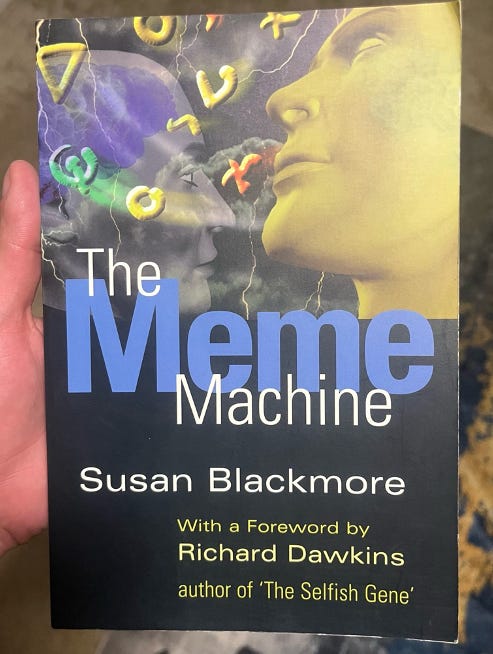
I was organizing my bookshelf the other day and I started flipping through The Meme Machine by Susan Blackmore. I hadn’t touched it in years, maybe since I first read it as a psychology undergrad. But flipping through it now as an epidemiologist, I was amazed at how familiar the language felt. Memetics, as laid out by Blackmore, is essentially a transmission model of information/social constructs/cultural units. What started as a clever metaphor for cultural evolution seemed more like an addition to the outbreak modeling books and lectures I had read and been to. It was immediately self-evident that information spread can be seen as similar to viral propagation.
It seems like memetics, while having lost its flagship journal, never really died. The field by that name may have faded from view, but the ideas are alive and well in other domains. You’ll find the traces in information studies, political psychology, cultural evolution, and behavioral economics (to name a few). It’s all over the place under different names. Paper titles like Epidemic Spreading in Scale-Free Networks1 show that the language of information as contagion is alive and well.
Memes as Pathogens
The metaphor itself is compelling to me as an epidemiologist. The structure is so similar to how we think about infectious diseases. The basic units replicate and mutate. The hosts (us) differ in our susceptibility and transmission behavior. The environment (social networks, media platforms, culture) act as a medium for the selection pressures to play out in. The conceptual overlay with virology is striking.
Some memes spread fast and wide, like measles of COVID, with short incubation periods and high transmission rates (think celebrity gossip, viral videos, or tiktok dances). Others, like ideological, philosophical, or moral frameworks may take more take to incubate, but end up embedded in our institutions and identity (political slogans). You also see co-infections in the form of “memeplexes” (bundles of ideas that increase one another’s transmissibility, like cultures or religions).
If you strip away the biology, many models used to study pathogen spread apply to the spread of ideas. SIR and SEIR frameworks have been adapted in network science to model the diffusion of rumors and misinformation1,2. Contact networks become social graphs. R0 becomes a measure of virality online. In public health, we often talk in terms of “inoculating” the public with accurate information before misinformation takes hold3,4 (even if that’s often difficult), an idea that has similarities to memetic logic even if nobody calls it that anymore.
The language of memetics was a bit clunky and the early science seemed speculative to some. Others, like Dan Dennett, found it convincing. But the core idea ended up useful for disciplines with better funding, better models, and more institutional respectability. Cultural evolution has been referred to as “stealth memetics”, in that they have different terminology but the same architecture.
What makes a meme ‘fit’? Satanic Panic as a Case Study
Few memes have infected the American psyche with the speed and fervor as the Satanic Panic of the 1980s and 90s. A handful of rumors around daycare abuse and devil worship turned into full blown social contagion, complete with televised confessions, bestselling books, new police training manuals, and families torn apart by fabricated memories.
From a memetics-as-epidemiology point of view, the Satanic Panic was a textbook outbreak. The idea mutated, spread rapidly, and thrived in susceptible hosts (likely still lingering in message boards). And when you look at why it spread, it hits just about every psychological and structural factor that drives a meme to be reproduced.
First, the emotional payload was massive. Fear, outrage, and disgust all fuel transmission online5. Berger & Milkman’s work on what makes information go viral points to those emotions as predictive of sharing behavior. There was also the moral component. People were outraged, and that’s a highly contagious social signal.
Second, it offered identity alignment and a signaling value. Alertness to the “Satanic influence” was seen as being a good parent, moral Christian, and protector of children in the circles it spread in. Spreading the meme could bump up one’s standing in a religious community, especially the evangelical subcultures where the panic found its most fertile ground.
Third, the structure of the idea made it unusually “sticky” and transmissible. It had a simple core (“they’re abusing children in secret”), high emotional salience, high mutation potential (could be adapted to any town, school, or suspect), and something akin to asymptomatic carriers in the repressed memories narratives. The more it was repeated, the more plausible it seemed. Once therapists adopted it, there was institutional legitimacy built in.
If that’s not a full-on memetic epidemic, I’m not sure what would count as one. A viral memeplex hijacked the moral immune system and weaponized cultural anxieties to replicate.
Memetics Doesn’t Need It’s Name
It’s somewhat understandable why the field didn’t quite make it as far as having departments dedicated to it. But the ideas were solid, so they found new homes in established and up-and-coming fields like information science, social psychology, sociology, and cultural evolution research.
Daniel Dennett was a strong defender of memetics’ potential. He argued iteration, perception, and differential replication were all that is needed to explain how cultures arise and spread. Some memes survive because they’re catchy. Others do because they’re useful. Either way, we (and increasingly online bots) become their vectors. The competition of cultural evolution means some ideas will spread more reliably.
You don’t have to buy every piece of that argument to see its relevance. We can study information spread via epidemiological models. And doing that, we see that moral outrage travels faster than correction.
So yes, memetics is dead. Long live memetics.
The Edge of Epidemiology is a reader-supported publication. To receive new posts and support my work, consider becoming a free or paid subscriber.
Citations
1. Pastor-Satorras R, Vespignani A. Epidemic Spreading in Scale-Free Networks. Phys Rev Lett. 2001;86(14):3200-3203. doi:10.1103/physrevlett.86.3200
2. Wang L, Wood BC. An epidemiological approach to model the viral propagation of memes. Appl Math Model. 2011;35(11):5442-5447. doi:10.1016/j.apm.2011.04.035
3. van der Linden S, Leiserowitz A, Rosenthal S, Maibach E. Inoculating the Public against Misinformation about Climate Change. Glob Chall. 2017;1(2):1600008. doi:10.1002/gch2.201600008
4. Lewandowsky S, Ecker UKH, Cook J. Beyond misinformation: Understanding and coping with the “post-truth” era. J Appl Res Mem Cogn. 2017;6(4):353-369. doi:10.1016/j.jarmac.2017.07.008
5. Berger J, Milkman KL. What Makes Online Content Viral? J Mark Res. 2012;49(2):192-205. doi:10.1509/jmr.10.0353
Blackmore, S. (1999). The Meme Machine. Oxford University Press.
Dawkins, R. (1976). The Selfish Gene. Oxford University Press.
Stewart-Williams, S. (2025). The Case for Memetics. Substack.