In my work in the neuroinformatics lab at UCI, we’ve recently been looking at the relationship between migraine and cognitive function, particularly the decrease in cognition that comes during the various stages of migraine. Cognitive issues is one of the biggest complaints migraineurs have, whether they be brain fog, slowed reaction times, or a decrease in critical thinking skills. Most often these complaints arise during the migraine phase but also tend to be noticed during the postictal period (after the migraine) and sometimes in the preictal period. Here we’ll look at how migraine impacts cognitive function. It’s both incredibly important for better treating migraine and surprisingly complex.
What cognitive domains does migraine affect?
Research has consistently identified a few cognitive domains as being particularly impacted during migraine attacks and sometimes between attacks. These include:
- Attention: in the form of trouble concentrating and sustaining attention
- Memory: difficulties with short term memory and working memory
- Processing speed: tasks often take longer to complete, and reaction times can be noticeably lower
- Executive functioning: decision making, planning, and multitasking become unusually challenging
- Language: some migraineurs report difficulties finding the right words (less consistent across studies, but similar to my cognitive issues post-epilepsy disorder, so interesting on a personal level)
A shockingly comprehensive narrative review from last year noted those as the most robustly impacted areas of cognition but notes that there is a debate in the area about how common these problems are in migraineurs. Methodological differences between studies, small sample sizes, and inconsistent test use make developing a consensus on that part difficult, but the research suggests cognitive issues are at least somewhat common in migraine patients.
Impacts through the migraine cycle
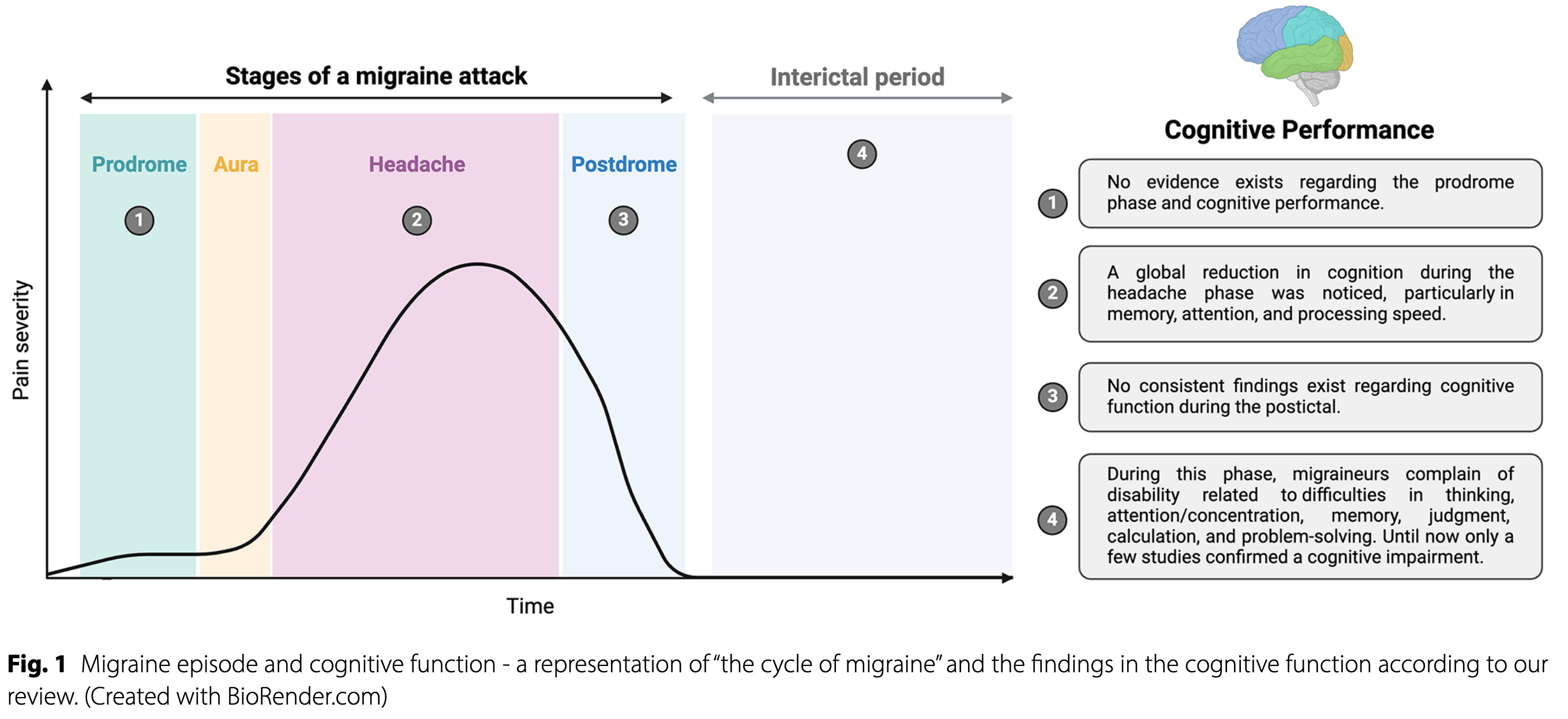
Migraines have four distinct stages, each possibly having different cognitive impact.
- Preictal (before the attack): many report mood swings, fatigue, and subtle cognitive slowing in the hours or days before an attack. Some studies suggest minor impairments in working memory or attention may begin during this period1, but the evidence is mixed on objective cognitive impairment in this phase.
- Ictal (during the attack): this is where cognitive dysfunction is at its worst. Studies consistently show deficits in attention, processing speed, memory, and verbal abilities during attacks1–3. Tasks involving reading speed, verbal recall, and working memory tasks like digit span suffer most here3–5. fMRI studies have shown altered neural patterns during attacks which suggest less efficient processing paths.
- Postictal (after the attack): recovery can vary, but some individuals report some lingering cognitive issues for hours or days after their pain subsides, though the evidence here is far from conclusive. Some research suggests no significant difference between phases6 while others have shown persistent impairment1.
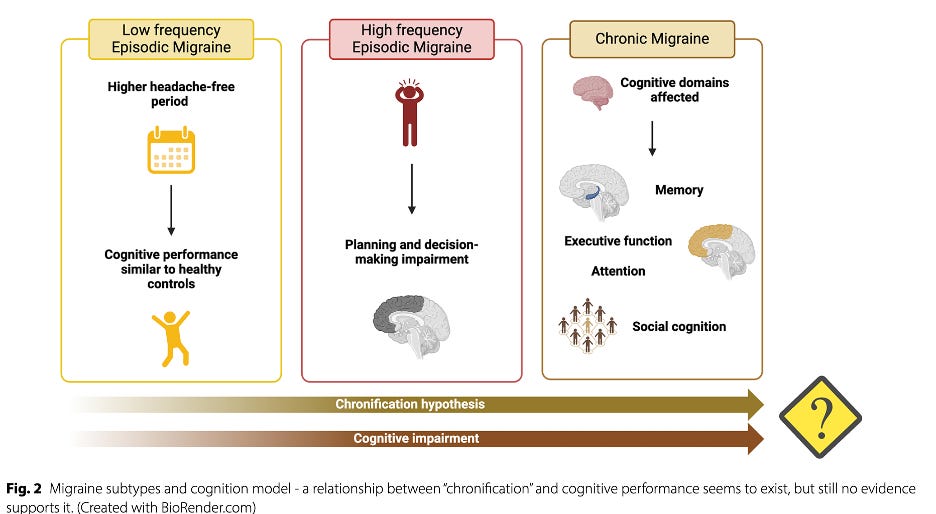
- Interictal (between attacks): recovery times can be inconsistent. Some bounce back within a few hours while others have malingering effects for days. Migraineurs, especially chronic migraine patients (more than 15 headaches a month), show persistent cognitive difficulties, even when pain free, in thinking, attention, memory, judgement, calculation, and problem solving. Part of why chronic migraineurs have more problems in the interictal period is the shorter distance in time between attacks, while episodic migraine allows for a bit more time to recover7.
Overall the cognitive burden we see in migraine patients has been estimated to be responsible for a €50 billion annual cost to the EU (as of 2011), 93% of which is due to productivity loss8. I plan on doing an economic impact of migraine post in the future here, so keep an eye out if you like that sort of thing.
How migraine medications impact cognitive function
Migraine patients often report some brain fog arising from their medications. It’s a bit underdiscussed, but some medications do come with a tradeoff.
- Triptans are one of the most prescribed medications for migraine, and while highly effective for acute attacks, they sometimes come with reports of transient cognitive symptoms like mild confusion and rare cases of amnesia9. It’s thought to be due to their vasoconstrictive properties impacting some more sensitive individuals. Most users won’t notice this, but for that subset it’s a jarring experience.
- Topiramate is commonly prescribed for migraine (and epilepsy), but is more notorious for its side effects on cognition, especially at higher doses9. Patients often report difficulties with word finding and concentration, enough so that dropout rates in trials have been driven by cognitive complaints. Migraine patients tend to report fewer cognitive side effects than epilepsy patients, but I hesitate to put that down to the drug and could be because seizures can also impact memory and cognition (pretty severely if I do say so myself).
- CGRP-antagonists: newer migraine therapies targeting the CGRP pathway, like erenumab or Rimegepant, seem to be more cognitively well-tolerated. Some small trials and case series analyses even suggest some improvement in cognition after starting these treatments10. This could be due to better symptom control, fewer side effects, or something implicating the CGRP pathway’s role in those side effects. More research needs to be done though, as these drugs only came out this decade.
- Botox: many may not know that Botox is a FDA-approved therapy for migraine and may improve cognition in some patients. In one study, patients had better cognitive scores post injections, and those gains didn’t just track with fewer migraines. Although a smaller study of 60 patients without a control group, this suggests Botox, either directly or indirectly, benefits attention and executive function in migraineurs11.
This should really be a whole post on its own covering how well the various migraine meds work and their side effects, I’ll get that out in the coming weeks!
What can you do about these symptoms?
There’s really no magic bullet for these symptoms. A few things might help to deal with these symptoms and help to plan around them though. Keeping a journal can help to clarify which phases affect you most and whether your meds are impacting these areas. For some, scheduling the most mentally demanding tasks during your more common pain free windows can help to manage the strain felt while working through a migraine. And let your doctor know about these problems.
To finish up
Cognitive dysfunction during migraine shows up across multiple domains consistently. It may also be impacting migraineurs in the time before, after, and between attacks, depending on how regular their migraines are. Hopefully we can get a better handle on why this happens, how patients can better deal with it, and predict who should be on what medication to minimize cognitive side effects.
Coming up in the migraine series on the blog: a post on medications, a post on economic impacts, and a post on long-term impacts and what migraine is a risk factor for. Share with those you know who have migraine if you found this useful!
The Edge of Epidemiology is a reader-supported publication. To receive new posts and support my work, consider becoming a free or paid subscriber.
Citations
1. Ray JC, Darby D, Butzkueven H, Matharu MS, Hutton EJ. Cognitive assessment during the phases of a spontaneous migraine: a prospective cohort study. Neurol Sci Off J Ital Neurol Soc Ital Soc Clin Neurophysiol. 2024;45(9):4445-4449. doi:10.1007/s10072-024-07520-w
2. Fernandes C, Dapkute A, Watson E, et al. Migraine and cognitive dysfunction: a narrative review. J Headache Pain. 2024;25(1). doi:10.1186/s10194-024-01923-y
3. Gil-Gouveia R, Oliveira AG, Martins IP. Cognitive dysfunction during migraine attacks: A study on migraine without aura. Cephalalgia. 2015;35(8):662-674. doi:10.1177/0333102414553823
4. Ruiz-Tagle A, Figueiredo P, Pinto J, Vilela P, Martins IP, Gil-Gouveia R. Working memory during spontaneous migraine attacks: an fMRI study. Neurol Sci. 2024;45(3):1201-1208. doi:10.1007/s10072-023-07120-0
5. Koppen H, Palm-Meinders I, Kruit M, et al. The impact of a migraine attack and its after-effects on perceptual organization, attention, and working memory. Cephalalgia. 2011;31(14):1419-1427. doi:10.1177/0333102411417900
6. Quadros MA, Granadeiro M, Ruiz-Tagle A, Maruta C, Gil-Gouveia R, Martins IP. Cognitive performance along the migraine cycle: A negative exploratory study. Cephalalgia Rep. 2020;3. doi:10.1177/2515816320951136
7. Qin T, Chen C. Cognitive Dysfunction in Migraineurs. Medicina (Mex). 2022;58(7):870. doi:10.3390/medicina58070870
8. Linde M, Gustavsson A, Stovner LJ, et al. The cost of headache disorders in Europe: the Eurolight project. Eur J Neurol. 2012;19(5):703-711. doi:10.1111/j.1468-1331.2011.03612.x
9. Russo M, De Rosa MA, Calisi D, et al. Migraine Pharmacological Treatment and Cognitive Impairment: Risks and Benefits. Int J Mol Sci. 2022;23(19):11418. doi:10.3390/ijms231911418
10. Torrisi M, Corallo F, Lo Buono V, et al. Migraine Treatment Using Erenumab: Can Lead to a Cognitive and Psychological Qualitative Improvement? Medicina (Mex). 2023;59(5):936. doi:10.3390/medicina59050936
11. Ho S, Darby D, Bear N. Cognitive effects of onabotulinumtoxinA in chronic migraine. BMJ Neurol Open. 2020;2(1):e000014. doi:10.1136/bmjno-2019-000014