I currently work in a neurology lab where my projects focus on migraine. I’ve had headaches for as long as I can remember and after being in the lab for a few months, I’ve realized just how overlooked and complex the world of headache and migraine really is. I wrote an earlier post on migraine a few weeks into the job (still serving its purpose, some good stuff on genetics of migraine in there).
This post is a deeper look into the epidemiology of migraine. I’ve currently come around to thinking my headaches are likely tension type headaches (TTH), we’ll get to why I think that later when we get to differentiating that from migraine.
But for now, a few basic numbers to get us started. The WHO reports that about 50% of the population are impacted by headaches1, while migraine in particular impacts roughly 14-15% of the global population at any given time2. This number tends to be higher in women by about 3:1. In the USA, prevalence reaches 18% in women and 6% in men3. It’s more common than diabetes or asthma, but ~46% of people with migraine go undiagnosed, likely stuck taking over-the-counter medications instead of a more tailored treatment4.
In this post, my goal is to walk through what I’ve learned about migraine epidemiology. I’ll cover who it affects, how early it tends to start, who gets left out of care, and why it’s still one of the most burdensome, impactful diseases worldwide.
So, what is migraine and how does it differ from other headaches?
A lot of people think of migraine as a really bad headache, but it’s got a much more specific medical definition (i.e. not all headaches are migraines). The International Classification of Headache Disorders (ICHD-3) uses the following criteria for migraine (without aura):
At least five attacks fulfilling criteria B-D
Headache attacks lasting 4-72 hr (untreated or unsuccessfully treated)
Headache has at least two of the following four characteristics:
unilateral location
pulsating quality
moderate or severe pain intensity
aggravation by or causing avoidance of routine physical activity (e.g. walking or climbing stairs)
During headache at least one of the following:
nausea and/or vomiting
photophobia and phonophobia (sensitivity to light/sound)
Not better accounted for by another ICHD-3 diagnosis.
Sometimes people with migraine also experience an aura. These are temporary neurological symptoms that precede or accompany the headache. These can be visual hallucinations like flashing lights, tingling in a limb or the face, disturbances in speech, and motor symptom issues. These folks are diagnosed with ‘migraine with aura’ and make up about 25-30% of people with migraine.
On the other hand, tension type headaches (the most common form) tend to be bilateral, have more of a pressing feeling, last between 30 minutes to 24hrs, and are more mild in there severity on average. They also tend to involve less nausea and photo/phonophobia.
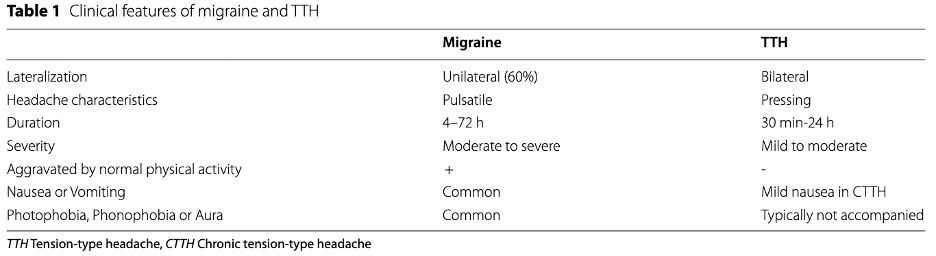
Since we still a lack of a reliable biomarker for migraine, distinguishing TTH from migraine is down to old school conversations between patient and doctor. It’s a clinical judgement call, and one that gets better as the criteria differentiating them become better known. Some patients also go without a formal diagnosis, in part because of the availability of over-the-counter medications that work “well enough.”
It's worth mentioning there are also many different subtypes of migraine, but that’s for another post.
Who Gets Migraine and When?
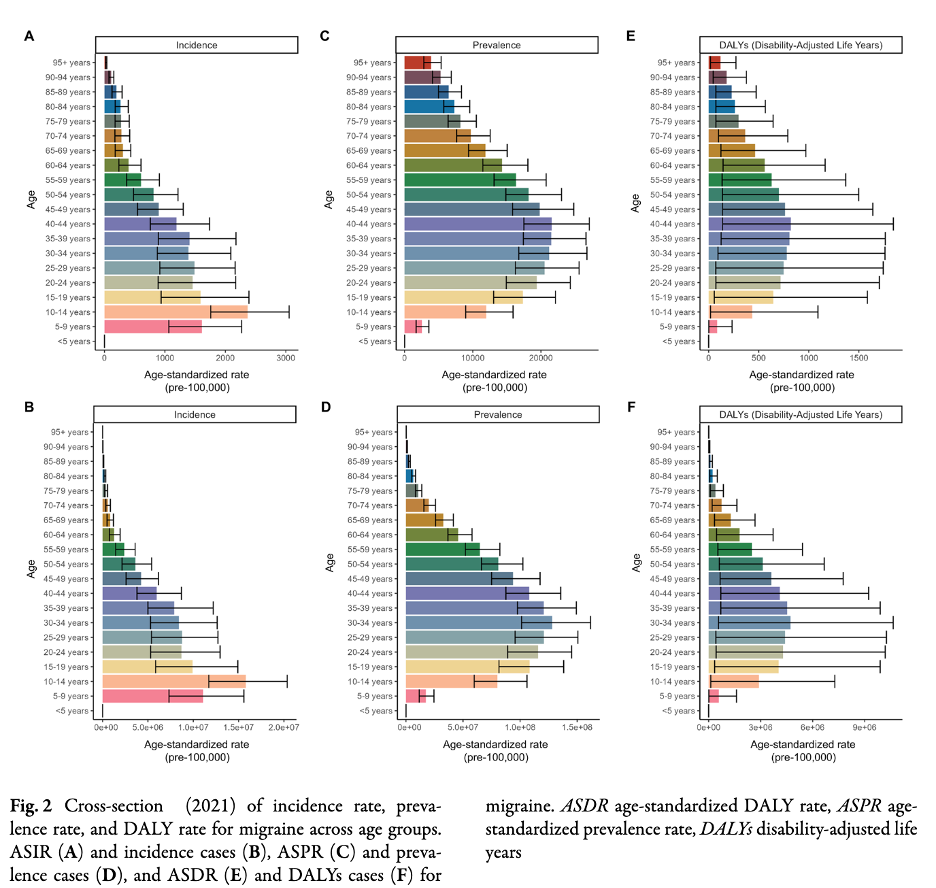
Diagnoses for migraine start rising in the population starting around the age of 8, rising steeply through adolescence and peaking in early adulthood around. Then we see a gradual drop followed by a second, smaller rise starting in midlife2,5. But overall prevalence for the disorder is highest from the ages of 25-55, the ages people are trying to hit their economic stride, raising kids or grandkids, and maintaining relationships.
The sex differences are where things get more interesting. Across nearly all studies and regions, migraine disproportionately affects women. I previously mentioned a 3:1 ratio, which is a great rule of thumb, but studies do range from about 2:1-3:16,7.
But before puberty, the sex difference is typically reversed, with boys having higher rates of headache and migraine than girls. That flips pretty rapidly during adolescence, likely due to a mix of hormonal, genetic, and neurodevelopmental factors.
Interestingly, the ratio between men and women drops a bit further when it comes to a statistic called “disability-adjusted life years” or DALYs. According to the Global Burden of Disease study update in 2021, this was down to about 1.62:1,. This suggests that while women are more frequently diagnosed, men with migraine more experience more severe impairment per case, that men underreport symptoms and delay care longer, possibly leading to greater burden by the time of diagnosis, or a combo of these8. A visualization for incident (new) cases, DALYs and prevalence by age group can be seen above (from Dong et al. 2025).
These female-leaning ratios probably aren’t just down to a diagnosis artifact either. Hormones, especially fluctuations in estrogen, interact with the migraine pathophysiology to the point of menstrual migraines. But estimates for how many women deal with menstrual migraine in particular vary widely. Using the Danish Migraine Population Cohort and a community based cross-sectional study in Saudi Arabia as examples, we see estimates of 16.6% for the Danish to nearly 58% for the Saudi study9,10. One did use prospective diaries while the other used retrospective self-report, which could account for some of the gap between the two. But it’s a striking difference, and whether that’s cultural, methodological, or biological, I don’t yet know, but I want to learn more.
A Global View
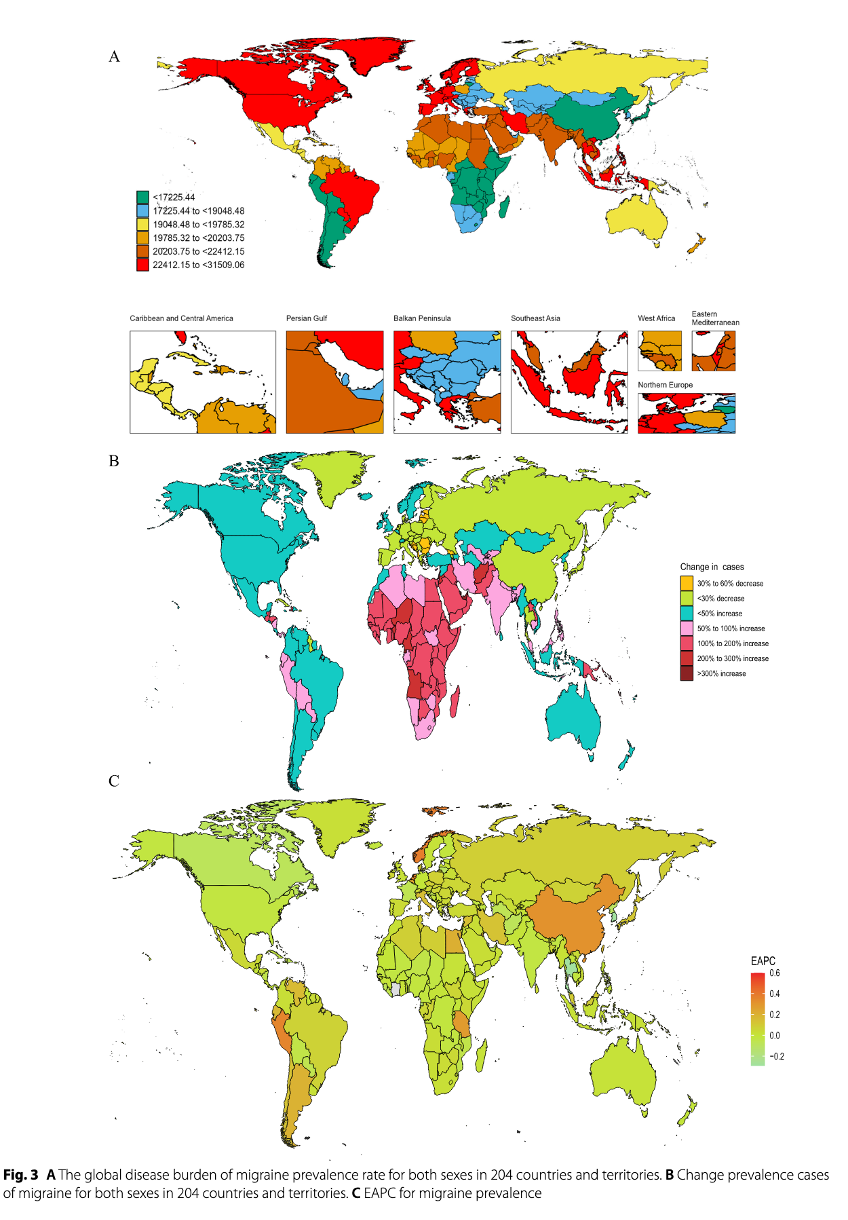
Migraine isn’t just a western focused issue either. The chart below from the Global Burden of Disease data shows the change in migraine prevalence across the globe over time7. What jumps out to me is the staggering increase in diagnoses across Africa, parts of the Middle East, and South East Asia. I don’t see this as signs of some worsening migraine epidemic. This likely reflects massive improvements in medical access, health record infrastructure, and local clinician awareness. In other words, we may be finally counting the people who were always there.
Who Gets Left Out of Care?
Migraine diagnostics is a bit of a leaky pipeline. It seems simple to go to a primary care practitioner, explain your symptoms, and get a diagnosis, but according to Dr. Richard Lipton, a forefront figure of migraine research for decades, nearly half of all people (44.8% with migraine go undiagnosed4. Some may not even realize their symptoms count as migraine. Others may simply lack the access to care. Plenty of people are just managing their symptoms with over-the-counter meds, trying to get through the day
These gaps aren’t distributed equally, as certain groups are much more likely to fall through the cracks. These include people from lower-income backgrounds, Black and Hispanic patients in the US, more geographically isolated individuals, and those without health insurance, all of whom are less likely to receive a formal diagnosis of migraine11,12. Education and trust in the system seem to be large players in this effect across medical disciplines.
Even when people are diagnosed, they may not be given the most effective treatment. Part of this is down to the simple fact that it’s incredibly difficult for a clinician to know exactly what medication will work best for each patient. I went through this with my epilepsy, trying somewhere around 10 different medications/combos before landing on one that worked. Persistence is key, but not everyone is a 20 year old, not in college, and having a willing mother to drive me to neurology appointments.
Predictive modeling work is being done to make this better in practice (including by my lab), but they’re not quite ready for prime time where a clinician can enter a few numbers and facts about the patient and the computer spits out the best medication for them. Maybe in a few years, but not quite yet. Medication costs also play a part here, with triptans being seen as first line medication in part due to how cheap they are compared to alternatives like gepants (~ $5 a month vs ~$1000). Insurers like to see a couple of cheaper options were tried before doling out a grand a month (maybe models saying “this will work” could change things though).
What all of this adds up to is a disease that can be seen as both common and neglected. In a system without perfect diagnostic precision combined with difficulty in meeting with a specialist, plenty of people get left to their own resources and the OTC section at Walgreens.
Common Migraine Comorbidities
With an estimated 15% of people having migraine, we’re going to see comorbidities with other conditions. This is backed up by large, population level datasets such as Buse et al. (2020) which examined commonly co-occuring conditions with migraine. The figure below shows the adjusted relative odds ratio for a range of comorbid conditions in people with migraine compared to those without
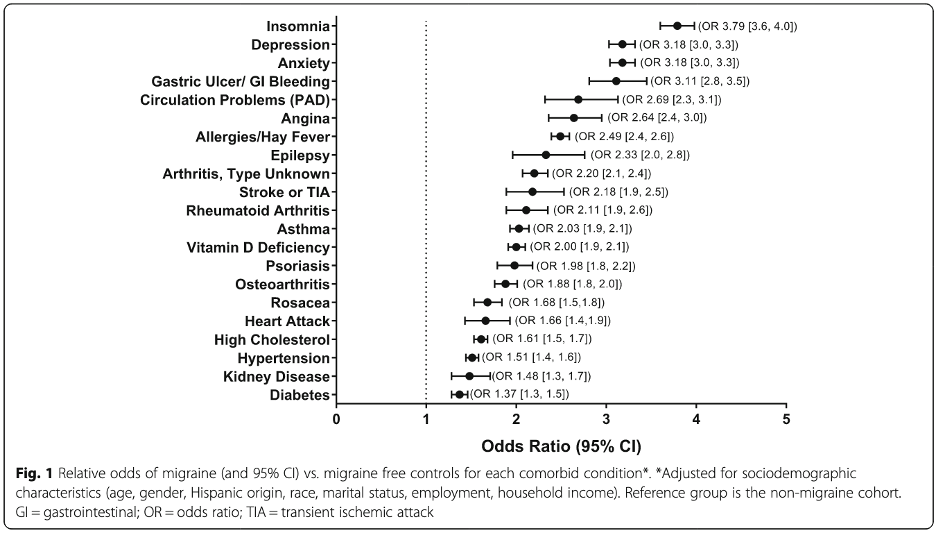
At the top we see insomnia, depression, and anxiety, with migraineurs having more than threefold higher odds of these diagnoses. Some suggest some level of neurological or cognitive factors that could be intertwined in some twisted way, like epilepsy and stroke. Others seem more like curve-balls to me, like psoriasis and rosacea.
But there’s a fascinating pattern here as far as the clustering of inflammatory and vascular conditions looking down the chart: gastric ulcer and GI bleeding, circulation problems, angina, rheumatoid arthritis, stroke, psoriasis, heart attack, and hypertension. These all have well-established inflammatory pathways, wither systemic of localized, which raises the possibility that inflammation could be a shared thread for some migraineurs and the subtypes they have. It doesn’t mean migraine is always an inflammatory disorder, but it might be acting like one in some patients.
Of course, we’re stuck with a big “chicken-or-egg” problem here. Are these comorbidities downstream of migraine, sharing some risk factor, or just coincidentally co-occurring in stressed-out bodies that have overlapping vulnerability profiles? I’m honestly not quite sure yet, but maybe I’ll have some idea by the end of my time working in migraine research.
Open Questions and Where We’re Headed
I’ve learned a lot the past 5 months working in migraine, but honestly I tend to leave the lab most days with more questions than I entered with.
Why do some people with migraine seem to improve over time while others progress to chronic, refractory patterns? Why do men have fewer cases of migraine, but seemingly worse impairment when they do? Why do population-level estimates of menstrual migraine vary so widely across studies despite applying the same diagnostic criteria? Why do anywhere from 40-50% of patients not get good relief from their medications? And what in the hell do psoriasis and rosacea have to do with migraine?
We don’t have good biomarkers for migraine yet and we still rely pretty heavily on symptom based interviews. This could change in the future though. One candidate that popped up in a paper this year is called autotaxin (ATX), an enzyme involved in vascular tone, pain, and inflammation13. The small, cross-sectional study found that ATX levels were elevated in both episodic and chronic migraine patients compared to controls, and correlated with other markers like CGRP and IL-6. My PI was out of the lab when I presented on the paper in our weekly meeting, and when I mentioned it to a couple of senior researchers, they didn’t seem especially moved. But it’s hard to judge whether that’s due to it being so preliminary or just fatigue from decades of false starts in biomarker research. Still, ATX is physiologically higher in females even outside of migraine, and its links to vascular and inflammatory pathways make it worth watching in my eyes.
There’s much more coming from the field of migraine research. I plan to write follow up articles on treatment response patterns (including OTC meds, triptans, gepants, monoclonal antibodies, and devices). Eventually I’d like to dig into the comorbidities in more detail. For now though, I hope this post is a decent map of the territory of migraine epidemiology.
If you made it this far, you’ll likely really enjoy what I’ve got coming in the future. Please consider subscribing. This is a fully reader-supported newsletter and every sub and share counts!
Citations
1. Stovner L, Hagen K, Jensen R, et al. The global burden of headache: a documentation of headache prevalence and disability worldwide. Cephalalgia Int J Headache. 2007;27(3):193-210. doi:10.1111/j.1468-2982.2007.01288.x
2. Steiner TJ, Stovner LJ. Global epidemiology of migraine and its implications for public health and health policy. Nat Rev Neurol. 2023;19(2):109-117. doi:10.1038/s41582-022-00763-1
3. Victor T, Hu X, Campbell J, Buse D, Lipton R. Migraine prevalence by age and sex in the United States: A life-span study. Cephalalgia. 2010;30(9):1065-1072. doi:10.1177/0333102409355601
4. Diamond S, Bigal ME, Silberstein S, Loder E, Reed M, Lipton RB. Patterns of diagnosis and acute and preventive treatment for migraine in the United States: results from the American Migraine Prevalence and Prevention study. Headache. 2007;47(3):355-363. doi:10.1111/j.1526-4610.2006.00631.x
5. Lipton RB, Bigal ME. The epidemiology of migraine. Am J Med Suppl. 2005;118:3-10. doi:10.1016/j.amjmed.2005.01.014
6. Amiri P, Kazeminasab S, Nejadghaderi SA, et al. Migraine: A Review on Its History, Global Epidemiology, Risk Factors, and Comorbidities. Front Neurol. 2022;12:800605. doi:10.3389/fneur.2021.800605
7. Dong L, Dong W, Jin Y, Jiang Y, Li Z, Yu D. The Global Burden of Migraine: A 30-Year Trend Review and Future Projections by Age, Sex, Country, and Region. Pain Ther. 2025;14(1):297-315. doi:10.1007/s40122-024-00690-7
8. Steinmetz JD, Seeher KM, Schiess N, et al. Global, regional, and national burden of disorders affecting the nervous system, 1990–2021: a systematic analysis for the Global Burden of Disease Study 2021. Lancet Neurol. 2024;23(4):344-381. doi:10.1016/S1474-4422(24)00038-3
9. Chalmer MA, Kogelman LJA, Ullum H, et al. Population-Based Characterization of Menstrual Migraine and Proposed Diagnostic Criteria. JAMA Netw Open. 2023;6(5):e2313235. doi:10.1001/jamanetworkopen.2023.13235
10. Al-Qahtani Z, Narapureddy BR, Reddy LKV, et al. Study to Determine the Prevalence of Menstrual Migraine in Reproductive-Age Women in Saudi Arabia. Healthcare. 2024;12(3):317. doi:10.3390/healthcare12030317
11. Kiarashi J, VanderPluym J, Szperka CL, et al. Factors Associated With, and Mitigation Strategies for, Health Care Disparities Faced by Patients With Headache Disorders. Neurology. 2021;97(6):280-289. doi:10.1212/WNL.0000000000012261
12. Nicholson RA, Rooney M, Vo K, O’Laughlin E, Gordon M. Migraine Care Among Different Ethnicities: Do Disparities Exist? Headache. 2006;46(5):754-765. doi:10.1111/j.1526-4610.2006.00453.x
13. Ouro A, Castro-Mosquera M, Rodríguez-Arrizabalaga M, et al. Serum levels of autotaxin reveal its role as a novel biomarker of migraine. Headache J Head Face Pain. 2025;65(6):944-960. doi:10.1111/head.14922