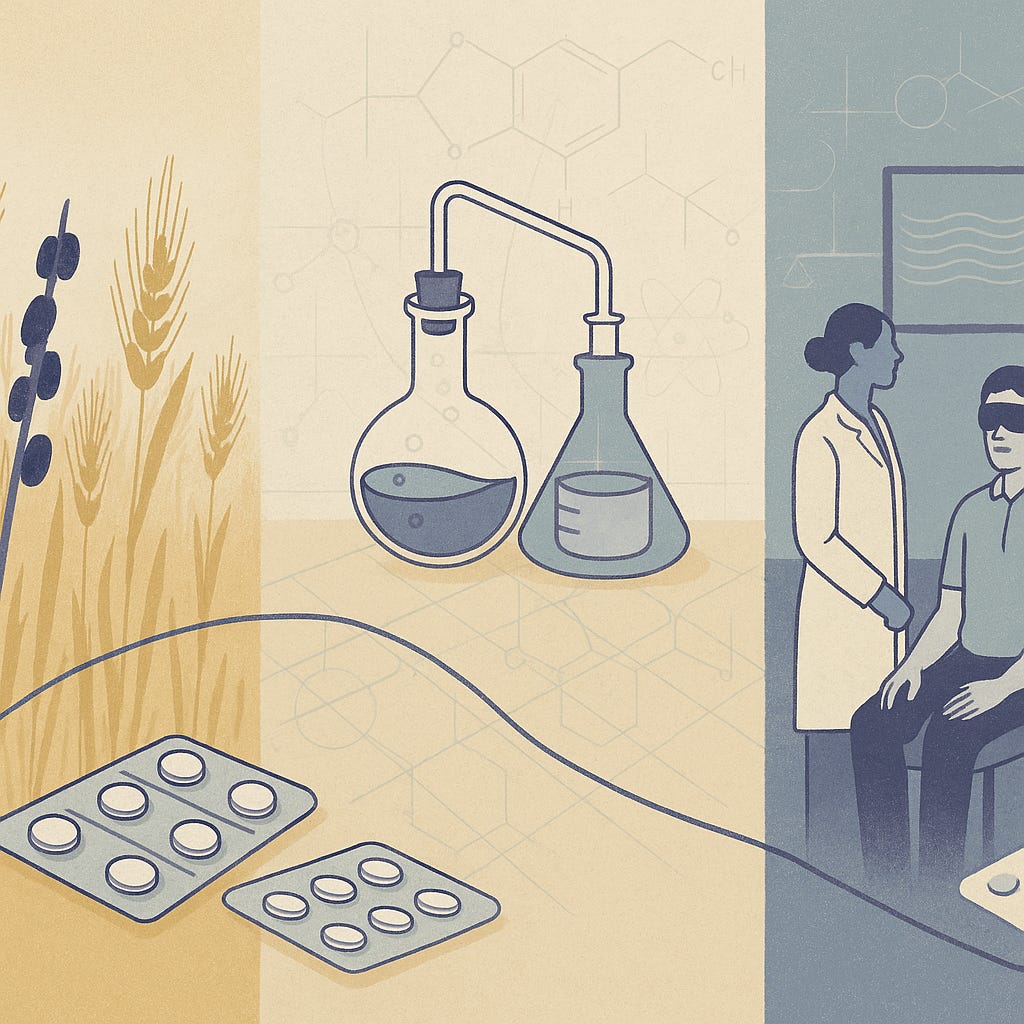
In the Middle Ages, ergot was a curse with a Latin name. People ate rye, rye ate fungus, and the fungus ate people’s limbs and their sanity. Out of that mess chemists eventually pulled out ergotamine, a clean(ish) tool for migraine. Not by gnawing on moldy bread, but by isolating molecules, dosing them precisely, and testing them like adults. We extracted a medicine from a poison and left most of the poison behind. That’s the right lens for psychedelics too.
For those who read my post a while back on psilocybin trials, some of that (and what follows) may be familiar. But for those who haven’t, I argued that a lot of the buzz is inflated by functional unblinding (people know they took the mind-bender) and that when you compare apples to apples (open-label vs open-label), psychedelic-assisted therapy (PAT) performs about the same as standard antidepressants on depression, with both averaging ~12-point drops on the HAMD-17 and essentially no difference between them (estimate ≈ 0.3 points; Bayesian and frequentist in agreement). That was the “equal-unblinding” preprint by Szigeti et al., and it was a necessary reality check on the field.
Now comes a cleanly designed counterpoint, not to psilocybin for depression, but to lysergide (MM120) for generalized anxiety disorder (GAD). A phase 2b, multicenter, randomized, double-blind, placebo-controlled trial gave one supervised dose of either 25, 50, 100, or 200 µg to adults with moderate to severe GAD and followed them for 12 weeks. No trial-provided psychotherapy was given, just the drug. The result was that 100–200 µg beat placebo by ~5–6 HAM-A points at 4 weeks, with durable separation to week 12 and response/remission rates roughly double placebo. The practical “sweet spot” was 100 µg mark, where they saw more benefit per side effect than at 200.
This is a pretty big milestone for drug-forward psychedelic pharmacotherapy: a signal that survives without the expensive therapy wrapper. It doesn’t refute the unblinding problem, but it does sidestep part of the therapy angle.
What’s consistent with my prior stance and what updates
• Consistent: Expectancy effects still matter. 37 of the 40 people on the 100 µg dose had hallucination like side effects and everyone at 200 µg did. At higher doses, nearly everyone can guess what they got, but that’s also the sweet spot. Central, blinded raters helped to blunt some of the bias, but active placebo is still the missing control that’s needed. I asked for it before and I’m asking again now.
• Update: You might be able to isolate a medicine-like effect. The dose-response (low doses null; mid/high doses separate) and durability argue it might be possible to separate the hallucinations from the benefit. But MM120 hasn’t gotten there yet. At least we’re getting a bit closer to the ergotamine story than the “trip + therapy” mystique.
• Consistent: External validity is narrow. Participants tapered meds, were mostly White and medically tidy, and spent ~12 hours in a curated dosing room with two monitors. That’s not Tuesday clinic. Transportability is completely unknown.
• Consistent (and important): Sponsor fingerprints are everywhere, from the design to the drug supply, analysis, and write-up. Disclosed, yes; reason to demand independent replication with active placebo, also yes.
How this squares the circle with psilocybin hype vs. reality
The equal-unblinding meta-analysis told us that when everyone knows what they’re on, PAT and SSRIs/SNRIs do about the same for depression. That pulled expectations back to Earth. The MM120 trial tells us that for GAD, a single, therapy-free lysergic session can beat placebo by a clinically meaningful margin (MCID on HAM-A ≈ 2.5), and keep doing so for weeks. Both can be true: psychedelic therapy isn’t a miracle cure for depression, and certain psychedelic-family drugs might be useful medicines for other indications when dosed and monitored with rigor. That’s the “extract the medicine from the poison” playbook again.
Where I land (for now)
• Claim you can quote: A single 100 µg dose of MM120 produced a medium, clinically meaningful reduction in GAD symptoms without trial-provided psychotherapy at four weeks that was somewhat sustained up to 12 weeks. It’s nice but not a miracle.
• Putting on the brakes: we’ve got a combination of probable unblinding + a curated setting + a sponsor footprint. This isn’t rock-solid to me yet. The remedy in phase-3 is an active placebo, pragmatic inclusion (keep usual meds), and outcomes that matter to patients like daily function, home life, rumination, sleep, and work.
• Policy-ish take: If a phase-3 clears those hurdles with a much larger sample, this moves from boutique to plausible practice and honestly could become much more scalable than therapist-heavy models. But that’s a big if, so until then, I see something somewhat promising but not exactly practice-changing.
The Edge of Epidemiology is a reader-supported publication. To receive new posts and support my work, consider becoming a free or paid subscriber and sharing my work.