In the middle ages people feared ergot like a curse. The fungus that infected rye which when eaten caused searing pain, hallucinations, gangrene, and even death. Some put it down to divine punishment when their fields would be overrun with ergot poisoning cases. Some modern historians think it explains some of the mass hysteria events and “dancing plagues.” While it was used for inducing labor back in the day, I doubt many people would have believed you if you said someday that toxic mold that drove people mad would be used to treat headaches. But here we are, and ergotamine is used for just that.
We didn’t get there by eating moldy rye and seeing what happened. Chemists figured out what was in ergot (other than LSD), figured out how to dole out doses in a controlled manner, and ran randomized controlled trials to understand the efficacy and adverse events. They extracted a medicine from a poison leaving the poison behind.
I think this is the lens that we should be viewing psychedelics through. Recent decades have seen psychedelic therapies like psilocybin have been touted as nearly a miracle cure on blogs and podcasts. Shrooms are now seen by quite a few people as a breakthrough treatment for depression. Sorry to say, but its more hype than anything.
A new preregistered (preprint) meta-analysis recently came out that helps to clarify what’s actually happening with psilocybin and depression. As you may be thinking, it’s pretty difficult to randomize someone to a powerful dose of a hallucinogenic substance and have them not realize they were given the drug and not the placebo. The paper titled ‘Equal-unblinding’ meta-analysis of psychedelic therapy vs. antidepressants for the treatment of depression tries to make do with what we’ve got by comparing psilocybin trials to open label trials of antidepressants. We’re left with trials of people knowing what they’re taking and expecting a benefit on both sides.
And when they ran their analyses, some of the hype died. Let’s get into why.
What they found
The meta-analysis by Williams and colleagues tried to answer a pretty simple question: if both groups know what they’re taking, does psychedelic assisted therapy (PAT) truly outperform standard antidepressants.
To do so they looked at 8 PAT trials (548 patients) of mostly high dose psilocybin trials and one ayahuasca trial, and 16 open-label antidepressant trials of SSRIs and SNRIs (9751 patients) and had a pre-registered hypothesis that PAT would be more effective than the open-label treatments.
The trials had used different questionnaires, so all results were standardized to a common depression questionnaire called the Hamilton Depression Rating Scale. An important number in this area of research is the minimal clinically important difference (MCID). 3-5 units is deemed the MCID on the depression measure in question (the authors went with the lower bound of 3 for the MCID in this meta-analysis).
The result? Both treatments worked and people got significantly less depressed. But the average difference between PAT and antidepressant therapy was basically nil (0.3 points). The chart below (figure 1) shows the effect sizes for each study and the averages of the antidepressant trials and of the PAT trials.
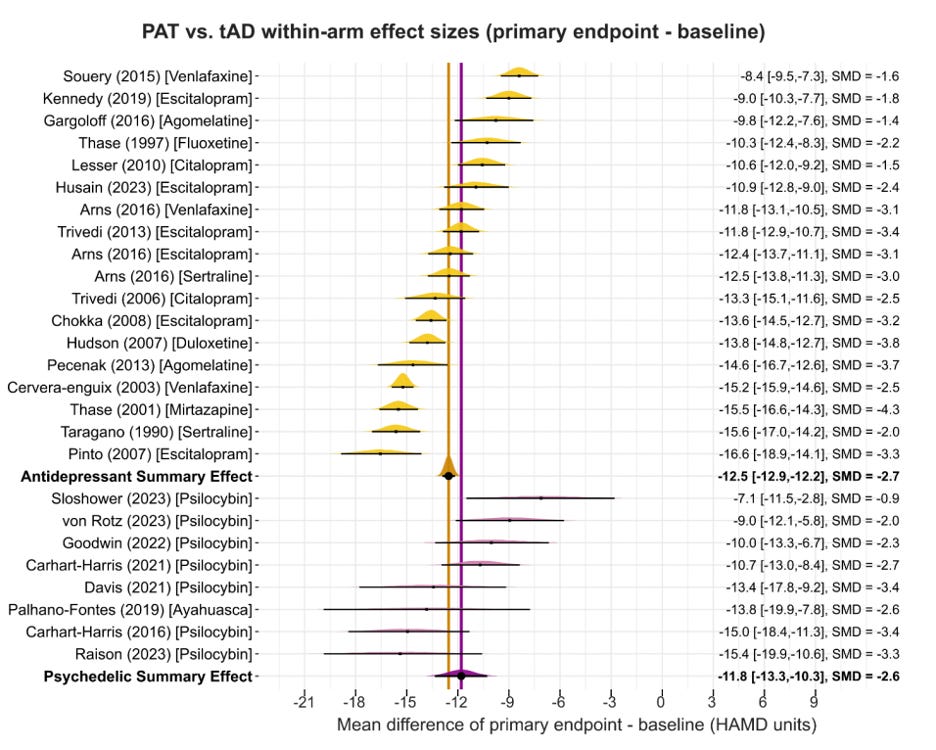
The average reduction was about 12 points on the HAMD-17 scale for both groups. Psychedelics don’t seem to help any more than standard anti-depressants do (which already have small treatment – placebo differences).
The tie they found was surprisingly stable, with both frequentist and Bayesian methods providing similar estimates of a null effect.
Why placebo-controlled trials fail in this arena
In most drug trials, people don’t know whether they’re taking the study drug or a placebo. We need to be able to cleanly estimate the effect of the drug above and beyond the expectation effect. This only works when the treatment doesn’t come with obvious effects like hallucinations. And there lies the problem for psychedelics.
Like I said before, it’s pretty damn hard to blind someone to a drug like psilocybin or ayahuasca. Somewhere between 90-95% of participants correctly guess they get the active drug. And of course they do, if you’re tripping hard in a therapist’s office, it’s not exactly subtle. But that destroys any integrity in a placebo comparison. When people know what they’re getting and expect it to work, the expectation becomes a part of the treatment.
That’s not to say the benefits are fake, just biased a bit. That’s what made these authors try something different by testing open-label studies. In the end it feels more akin to an equivalency trial, testing a new drug against a known quantity (just without the randomization between them). Antidepressants are used in the real world already and this could be the evidence people have been looking for to make PAT more available. But people shouldn’t be fooled into thinking shrooms are a cure-all for depressive cases. Maybe they’ll turn out to work great for people who are unresponsive to antidepressants, but we’ll need much more work done in the area to understand if that’s the case.
Bullish on derivatives
Psychedelics clearly aren’t snake oil; they’re working in open-label trials on par with antidepressants. It’s a great starting point.
But I think we might be in the early stages of turning weird, natural compounds into real medicines. A few labs and biotech companies are exploring how to create new drugs inspired by psilocybin but modified to be shorter acting, less hallucinogenic (some people don’t like that part), and more targeted in their effects. Like ergotamine being derived from a toxic mold, I think the future will hold more than capsules of ground up mushrooms.
If you find this blog useful or entertaining, consider becoming a free or paid subscriber.