The past few days I’ve been at the American Headache Society Scientific Meeting in Minneapolis talking with researchers in academia, industry, and various pharmaceutical and device companies. It was an eye-opening experience into how interdependent the world of medical research needs to be to function.
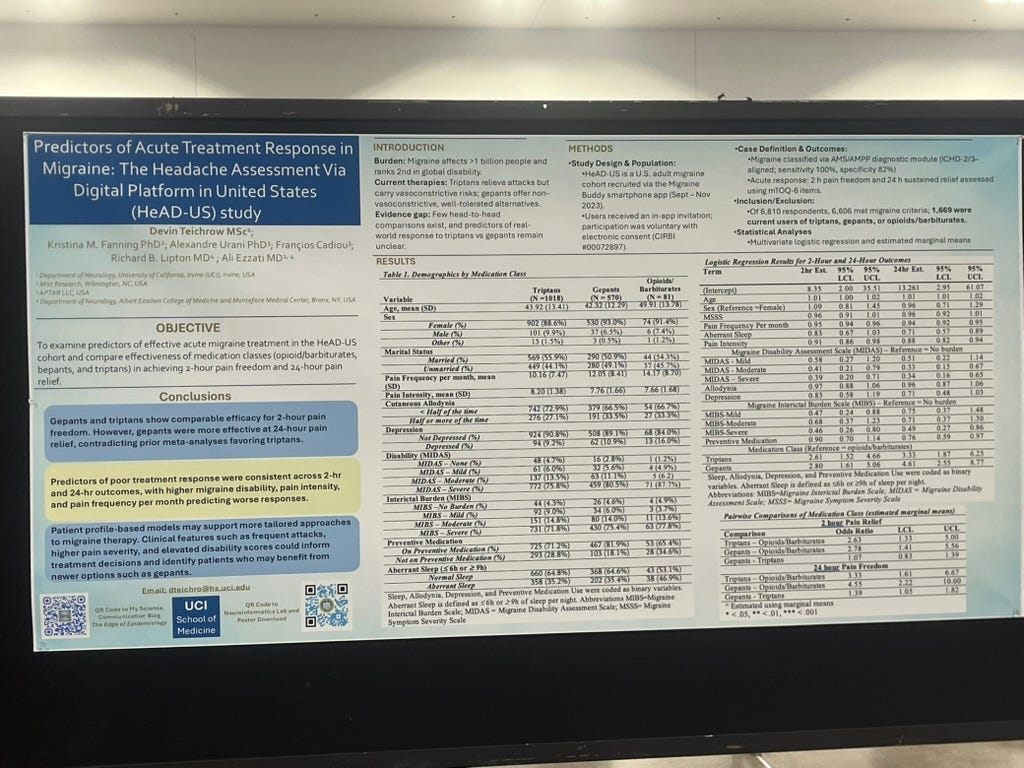
While I was there I presented a poster on an app-based survey study looking at predictors of treatment response in migraine and comparing the medication classes of triptans and gepants. Migraine is the second most debilitating disease worldwide, yet it receives far less funding than other neurological and other disabling disorders, so it was nice to have an advocate from another society tell me they’re reaching out to celebrities to create the migraine equivalent of the Michael J. Fox foundation (Parkinson’s). Trouble is that the celebrities don’t seem to be biting. Apparently, some asked to be paid for the privilege of advocating on behalf of the group (one of which is, quite literally, a billionaire). I hope to see someone like Lady Gaga, who is currently doing commercials for a migraine medication, start up a foundation and fund some life-changing research.
For now, much of research is being done by pharmaceutical companies. While that’s not necessarily a bad thing, it sometimes can shape what kinds of questions get asked, and who those answers are most geared toward.
This problem became more clear to me when I was watching a Pfizer presentation I attended discussing a Phase IV trial of rimegepant. They had a great sample size, and based on the poster I had seen, some excellent results to show for their efforts. But when the presenter reached the slide on inclusion/exclusion criteria, I paused. Only patients who had between 4-14 migraine days per month were included in the trial. That sounds reasonable, and for researchers it checks a box of using the known criteria of episodic migraine. But it also meant that anyone with chronic migraine (15+ days per month) was excluded.
While it’s not a flaw in the study design, it limits how confidently we can extend those results to those suffering most. Someone with 20 migraine days per month could have their life changed by just 5 better days.
Chronic migraineurs aren’t rare, they make up about 7-8% of migraine patients, often experience more intense pain, and are notoriously difficult to treat. Yet they’re often excluded from clinical trials that clinicians later cite when prescribing treatments for them. That’s not bad medical practice, but it is a type that’s built on assumptions that may not be met in a more difficult patient to treat. A neurologist will still prescribe a drug that was tested on less severe patients to those with a more severe form of the disease, but they don’t quite know just what kind of results to expect.
To be fair, clinicians are aware of this gap between the clinical trial populations and their most complex patients. They’re not going to blindly apply the trial data to population the research may not generalize too. Instead, they do what medicine has always done when the evidence runs thin: extrapolate carefully, lean on experience, use their best clinical judgement, and try to tailor the care to the person in front of them. In the case of chronic migraine, that means trying a drug like Rimegepant even if the trial didn’t include someone with 20+ headaches a month. If it’s the best option available, messy data won’t stop a doctor from giving it a try.
This phenomenon isn’t unique to the migraine field either. Trials for weight loss drugs or cardiovascular medications often exclude patients with comorbidities that could complicate the results, like severe psychiatric illness, advanced diabetes, or poor liver or kidney function. And while practical to exclude from an early study, it creates an awkward tension in which the people most in need of treatment are the ones clinicians know the least about.
Pregnant women are another major group that tends to be systematically left out of trials (completely understandably, given the ethical and legal constraints). But the consequence is that many drugs are prescribed without robust safety data, and potential harms are left to be uncovered via later trials, observational studies, or registry data. For example, ibuprofen is a mostly safe anti-inflammatory drug, but it wasn’t tested for prenatal use. Only after widespread use and observational reports had linked NSAID usage during pregnancy (> 20 weeks) to fetal kidney failure.
These gaps in the literature aren’t going to be easy to resolve. It’s more reflective of a basic reality in medicine, that the strongest evidence often comes from the cleanest data coming from the patients a treatment is expected to work best on, but the hardest problems live in the messy gray areas and the gaps. Thankfully clinicians are used to working in that space, but it would be nice if they didn’t have to. Especially with a Phase IV trial.
The Edge of Epidemiology is a reader-supported publication. To receive new posts and support my work, consider becoming a free or paid subscriber.