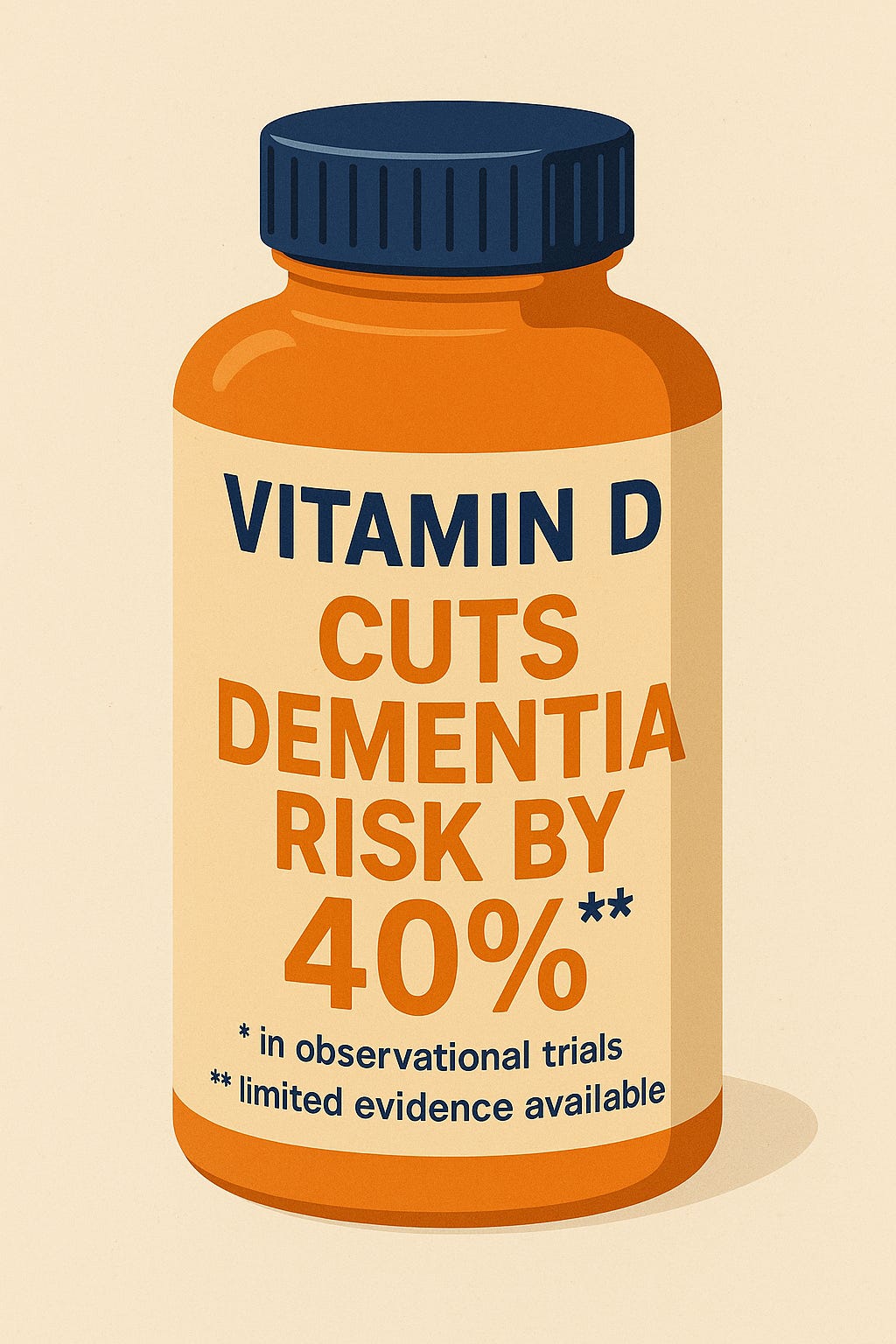
By now, more than 200,000 people on twitter and over 30,000 on YouTube1 have seen the new video of Dr. Rhonda Patrick explaining how vitamin D supplements can cut your dementia risk by 40%2. That’s a bold, hopeful claim based on an observational study of over 12,000 people. And I think she means well, even adding an asterisk to the video thumbnail to say “*in observational studies”. But how true is the claim?
Well, it’s technically correct (in this one study). The researchers did find that people who took vitamin D had lower rates of dementia over time. But if we stop there, we miss out on a lot of the story.
And to her credit, Patrick doesn’t just rely on this result. She mentions plausible biological mechanisms, small RCT studies, and some mendelian randomization studies, which use genetic proxies related to vitamin D levels to reduce confounding. In theory, this is what I want to see, somebody engaging with the broader literature to build a causal case.
But that’s not what is actually happening in the video. Instead, she cherry-picks the most supportive evidence while glossing over the mixed or null findings. By acting like the evidence nearly follows the same trend over and over, she gives the impression that the causal link between vitamin D and dementia in the overall population is settled, but it’s not. Sure, it’s promising, but it’s an area in flux.
I like to think of this post as an erratum, respectfully correcting a one-sided interpretation of the science from Dr. Patrick. So, with that said, let’s look at what the evidence really shows us and how a little too much optimism can quietly slip into the realm of misinformation.
The Edge of Epidemiology is a reader-supported publication. To receive new posts and support my work, consider becoming a free or paid subscriber.
What the Study Found
The video highlights a large 2023 study of over 12,000 adults without dementia at baseline. They found that people who self-reported taking any form of vitamin D supplements had a 40% lower incidence of dementia over 10 years compared to those not supplementing. Even at 5 years the discrepancy was at 84% dementia-free for supplementers vs 68% of non-users.
Those are some pretty striking numbers. But this study is observational, and most importantly, these groups are not the same.
Table 1 of the paper tells us a bit about how different these groups were at baseline. As far as statistically significant differences, supplementers were more likely to be women (70.5% vs 46.9%). They were slightly better educated with 16.2 years vs 15.5 years of education. They were also more likely to be cognitively normal at baseline with less mild cognitive impairment (71.8% vs 61.3%). The authors adjusted for these differences in their models, but they can’t adjust for what they didn’t measure.
Those variables don’t get at other systematic differences in the groups. I’d bet, dollars to donuts, that they were also more likely to see a doctor regularly, follow their directions, and exercise more, all of which would contribute to a decreased risk of dementia. The vitamin D group was advantaged from the outset.
The (Mixed) Evidence from Mendelian Randomization Studies
One way to get us a step closer to establishing causality is Mendelian Randomization (MR). It’s a method that uses natural genetic variation to understand the impact of an exposure on an outcome. In this case, some people are born with genetic variants that make them more likely to be chronically low in vitamin D. If those people have higher rates of dementia, despite everything else being equal, we get some stronger evidence that low vitamin D might be causing dementia.
That’s where things get murky. Some of the MR studies do suggest a real effect. One paper found that genetically predicted vitamin D deficiency of below 10ng/mL was associated with a 54% increased risk of dementia. But that effect seemed to only exist in people with very low levels. In contrast, other large MR studies found no significant effect of vitamin D on cognitive function3,4. One of the largest to date had over 170,000 participants (28k of which had serum vitamin D measured in the form of 25(OH)D) and found no causal link between vitamin D and dementia4.
So yes, vitamin D may be important, especially those with chronically low levels. But that’s not the same as saying raising your levels from 25 to 40 ng/mL with some supplement will protect you from dementia. That’s a very different message from “this supplement cuts dementia risk by 40%.”
Interesting Mechanisms, Unproven Benefits
So, if the outcome data is so mixed, why does the story feel so convincing? Because mechanistic evidence is seductive. When something sounds biologically plausible, wrapped in a language of genes, hormones, and inflammation, it feels more real. Even when the outcome data isn’t there to back it up.
In the video Dr. Patrick goes through multiple different biological mechanisms that make vitamin D look like it would be a promising candidate for brain health. She cites the role in amyloid clearance, reduction in neuroinflammation, and gene regulation, pointing out that vitamin D often acts similarly to a hormone by regulating genes in the brain.
That all sounds good and convincing. But mechanistic plausibility doesn’t always translate to clinical relevance. Plenty of compounds have cleared amyloid proteins in the lab, but most have failed in clinical trials. Reducing inflammation is also a popular idea for reducing dementia, but inflammation is a vague target, and not all suppression of inflammation would be beneficial. The mechanisms can tell us where to look, but not whether an intervention will help people.
Tracing the mechanistic threads without checking them against outcome data risks falling into the same trap that has plagued Alzheimer’s and Dementia research for years: chasing elegant ideas that never end up reducing disease burden. That’s why outcome data should be the standard for making health claims.
My Problem with Overstating the Case
The issue here isn’t that Dr. Patrick is completely wrong. It’s the confident presentation of a best-case scenario as settled science that is a turn-off. Saying vitamin D “reduces dementia risk by 40%” makes it sound like a causal guarantee, but that’s not what the evidence says.
She gestures toward nuance with wording like “it’s just one study” and that it’s part of a broader pattern, but the overall framing still implies “take this supplement and your brain will thank you when you’re old.” That’s a very strong claim to make in front of hundreds of thousands of viewers, especially based on non-randomized evidence.
She also frames the benefits as generalizable when they may only apply to people with extremely low vitamin D levels. And even for them, we’re likely looking at a smaller effect size than that headline 40%. Precision matters, especially when you’ve built a brand on translating science for public consumption.
In the end, it’s about trust. When a well-known science communicator begins to blur the lines between early evidence and settled fact, they risk misleading the very same people they set out to help. Vitamin D may very well turn out to be protective, and I hope it is. It’s a low downside supplement, which is part of why I understand the desire to get more people in the healthy range of vitamin D levels (70% of people in the US are below the 30ng/mL level deemed sufficient by the Endocrine Society). But to frame it around dementia prevention feels premature at best, and dishonest at worst.
The Edge of Epidemiology is a reader-supported publication. To receive new posts and support my work, consider becoming a free or paid subscriber.
Citations
1. This Supplement Could Cut Your Dementia Risk By 40%.; 2025. Accessed May 20, 2025.
2. Ghahremani M, Smith EE, Chen HY, Creese B, Goodarzi Z, Ismail Z. Vitamin D supplementation and incident dementia: Effects of sex, APOE, and baseline cognitive status. Alzheimers Dement Diagn Assess Dis Monit. 2023;15(1):e12404. doi:10.1002/dad2.12404
3. Kuźma E, Hannon E, Zhou A, et al. Which Risk Factors Causally Influence Dementia? A Systematic Review of Mendelian Randomization Studies. J Alzheimers Dis. 64(1):181-193. doi:10.3233/JAD-180013
4. Maddock J, Zhou A, Cavadino A, et al. Vitamin D and cognitive function: A Mendelian randomisation study. Sci Rep. 2017;7(1):13230. doi:10.1038/s41598-017-13189-3