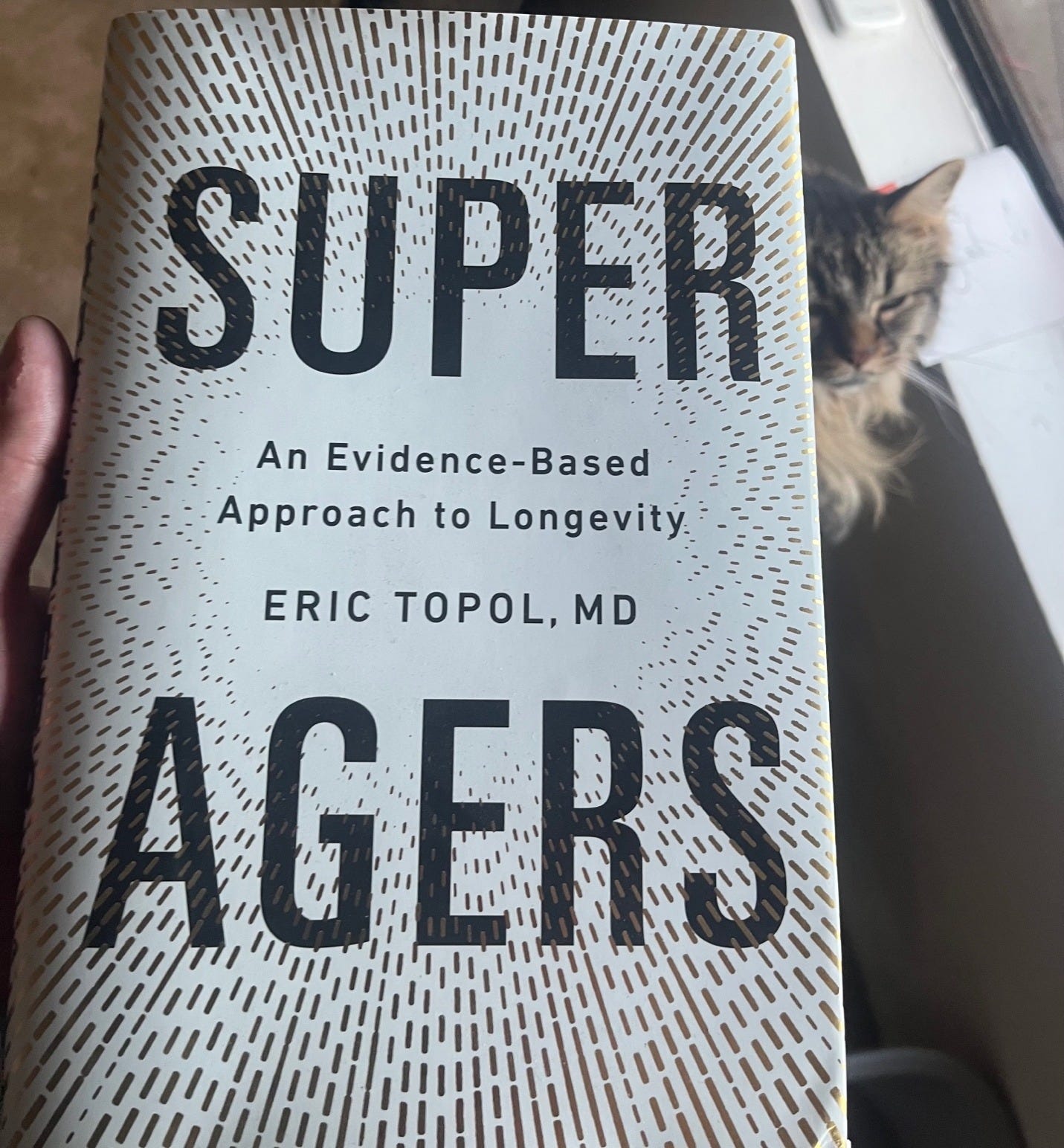
I remember sitting in a gymnasium in Walnut Creek, California working with a group of elderly folk at an independent living facility measuring things like grip strength, up and down speed, and walking speed. The people at this scenic old folk’s home were taking part in a trial run by UC Davis’ School of Medicine Professor David. K Johnson looking at how diet and exercise could be used to prevent age-related memory decline and insulin resistance issues; a simple question, can lifestyle changes keep people healthier longer. It was called the Dementia and Diabetes Prevention Project. Reading Super Agers by Eric Topol MD, I got flash backs to that work up at Davis.
Years later everybody has heard something about longevity research. Whether it’s having seen a clip of Bryan Johnson showing his pill regimen or listening to podcasts like Huberman Lab or the Peter Attia Drive, longevity is on the mind of many researchers as well as being on the public’s mind. But this post is about Super Agers, because I think it’s a nuanced take on longevity research that doesn’t fall into the traps the others mentioned tend to fall into.
Health Span > Lifespan
Topol opens the book with a pair of case studies that might challenge how some people think about aging. The first is Mrs. L.R., a 98 year-old woman with no chronic illnesses, no chronic impairment, and no family history to explain her health at such an advanced age. She paints, drives herself to her own appointments, and lives independently. The second is Mr. R.P, also 98, but having gone through bypass surgery, multiple cardiac procedures, and a covid hospitalization. Still alive and functional, but thanks to relentless medical intervention. The contrast is there to show just how different the paths in aging can be. Mrs. L.R.’s story is the one plenty of people hear (or see) growing up of their elderly family member being coherent and independent well into old age. It’s even a sign of pride in some families. But Mr. R.P’s story is much more familiar.
Topol makes it clear early on that health span should be the real goal we’re working toward. And there’s a lot of work to be done in modern medicine to grow into a field that prioritizes the goal of living longer without losing our cognitive function and physical autonomy. He introduces the concept of the “Wellderly”. These are a group of over 1400 individuals who aged without major chronic diseases that his team has been studying. Despite full-genome sequencing, they found no obvious genetic explanations. These people hadn’t won the genetic lottery to be this way. However, they were thinner, more active, more educated, and more socially engaged than the general population. Many of them were still volunteering in the community, going dancing, and playing bridge well into their 90’s. Some even smoked.
The takeaway here is that cumulative exposure likely matters more than biological exceptionalism when it comes to healthy aging. Behavior won’t override every risk, but it’s the first actionable thing one can do in their life.
Lifestyle +
The first line of defense to aging gracefully and with our faculties intact is full of the obvious stuff. Diet, sleep, exercise, and social connection are key aspects in Topol’s view of what keeps us healthier longer. He calls these things ‘Lifestyle +’ and they’re the major focus of the first part of the book. Beyond eating healthy, sleeping well, and getting exercise (all of which get their own detailed overviews on things like nutrients, sleep stages, and type of exercise), the ‘+’ includes pollution exposure (air, microplastics, ‘forever chemicals’) and social isolation.
That’s not to pretend that behavior change is easy or that the evidence is always clean. He draws on plenty of observational studies that come with the usual caveats (self-report bias, confounding, healthy-user bias, survivorship bias) that aren’t always acknowledged. But I think he threads the needle well, presenting the patterns as strong signals as opposed to settled, causal scientific findings.
The part that might make the ‘splitters’ among us flinch is the one on ultra-processed foods. His indictment of UPFs is passionate and heavy on the evidence, but it doesn’t really differentiate between nutritionally engineered shakes and shelf-stable garbage snacks. The NOVA classification is mentioned, but there’s no real parsing of nuance between items in the same category. But the takeaway is solid. Most UPFs are bad and minimizing them is probably an effective and low-cost method to increase health span.
The factors in lifestyle + are the foundation of the book and Topol does a great job reminding the reader that living healthier for longer starts with living better today.
The Chronic Killers
A unifying theme later in the book is that we’re finally getting the tools to act early on chronic diseases. Those are becoming more common in the form of AI-based risk models for cardiovascular disease, polygenic screening for cancer predisposition, or blood-based biomarkers for Alzheimer’s, the focus is fully on shifting the timeline of diagnosis forward.
GLP-1 drugs are a decent example of that shift, although not in the early prevention sense. Most people won’t be starting them before diabetes, obesity, or metabolic dysfunction sets in. But they’re a step in the right direction of treating these as modifiable disease states. He also mentions their possible broader effects like improving our “aging-clocks”, slowing neurodegeneration, and smoking cessation. Trials are underway for many of these and it’s an area to keep an eye on. Thankfully, he doesn’t sell them as a miracle drug though, going through the possibility of unidentified side-effects that may appear in the real world.
The optimism feels earned. Most of the interventions Topol covers are real, validated, and in clinical use. They’re just not everywhere. Larger hospitals or niche, longevity doctors may have access to do whole genome sequencing on each patient, but not the average clinic. Thankfully this will likely get cheaper and more available over time. The optimism feels most grounded in the neurodegenerative diseases chapter. There’s a quiet confidence that earlier detection (something my lab works on as well) will mean earlier and more targeted support.
On the whole, the chronic disease chapters do what a good review of the field should. They orient the reader without overpromising by simply showing what is within reach. But they also assume a level of political will to change the health infrastructure that is rare in the US. Closing that gap will take systemic investment into deploying what we already know works.
Genomics and Precision Medicine
The chapters in Super Agers that deal with rare diseases, immune system rewiring, and the near-future of brain and cancer therapeutics have a thread of ‘precision medicine’ throughout. What Topol describes is a medical system built more around individual biology as opposed to statistical averages.
This clicked with me. I too want things like whole genome sequencing, immune profiling, and multi-omic risk prediction to become routine clinical tools as opposed to concierge-level add-ons. Topol makes the compelling case that we’re on the way there, although not yet affordably or broadly.
The framing of what he hopes to be previously novel technologies like CRISPR, CAR-T cell therapy, or newborn genome sequencing becoming part of a system-level transition is bold and hopeful. These tools could become the templates for how we treat everything from asthma to autoimmune disease and cancers.
The chapter on rare diseases is probably the best example. Topol uses examples like familial hypercholesterolemia to highlight how gene therapy works, as well as how those same tools could make their way into broader medical practice. He mentions the use of full-genome sequencing in unexplained deaths in young adults being used to both determine what happened and hopefully prevent it from happening in relatives. Some programs are underway sequencing infants at birth to catch rare metabolic or developmental conditions early.
When turning to the immune system, the principle of “target what’s broken, not everything at once” is at the forefront. Current treatments for autoimmune diseases rely heavily on broad immunosuppression, which often comes with steep tradeoffs. Newer approaches like olergenic therapies aim to retrain the immune system to stop attacking the self. He’s hopeful we’ll be able to fully recalibrate the immune architecture making autoimmune diseases a thing of the past. That would be a major shift, but it probably won’t be in the next couple of years.
And that’s an important point to make. Topol doesn’t get breathless about timelines or try to predict when these therapies will be commonplace. He’s clearly thought about the barriers in access, making the point that these tools tend to exist in large hospitals, biotech pipelines, or private, concierge clinics. All of this builds up quite a thesis, that biology-first, person-specific care is no longer science fiction.
A Future Worth Building Toward
Unlike some longevity medicine pushers, Topol’s book doesn’t promise the moon. There’s no handwaving away of infrastructure gaps or pretending we’ll be gene-edited to live to 100. Instead, it offers a clear, grounded vision of where medicine is at, and is currently headed. Or at least, could be headed, if we take health span seriously.
There’s a strange comfort in knowing we don’t have to invent longevity from scratch. Applying what we know better, earlier, and with a bit more imagination about who benefits is all that’s needed.
If I had one wish for a follow-up book or essay from Topol, it would be to give an idea of what implementation would actually look like. What the costs would be, what kind of economic savings they would provide by catching diseases earlier and preventing others altogether. The ideas are sound, but they assume a level of systemic coordination that the US healthcare system doesn’t really offer. Some ideas are more feasible, like universal genomic screening, but they also could be expensive and logistically complex.
Still, it’s a book I’d recommend highly to clinicians, public health folks, policy wonks, and anyone else trying to understand where the next decade of medicine could go. If you’ve been annoyed by the longevity discourse being shaped by tech bros and biohackers, Super Agers might be your antidote.
The Edge of Epidemiology is a reader-supported publication. To receive new posts and support my work, consider becoming a free or paid subscriber.